ACAT Thresholds: What Defense Contractors Must Know
ACAT thresholds determine who approves your program, what documentation you need, and how long procurement takes. Here is what defense contractors must know to build a smarter pursuit pipeline.
When a capture team commits resources to a defense program and the projected costs cross the ACAT I threshold mid-cycle, the decision authority shifts, oversight escalates, and the schedule the team built around can reset entirely. That is the real cost of a threshold breach: not just added paperwork, but lost momentum and replanned timelines. ACAT thresholds are not background knowledge; they are a core input to how you structure every pursuit.
- ACAT category sets who approves milestone decisions, what documentation is required, and how long your competitive window stays open.
- When a program's costs cross a threshold mid-cycle, oversight shifts upward and timelines lengthen, sometimes substantially.
- Faster timelines, lighter governance: ACAT III programs are high-value targets that many prime competitors overlook.
- Compliance obligations scale with category, so knowing the tier before you staff a capture team saves weeks of wasted effort.
- As of September 2026, 44 open solicitations mention ACAT across the 23,000+ sources we track, with 10 closing within the next 14 days.
The short answer
ACAT (Acquisition Category) thresholds are the cost and criticality benchmarks the Department of Defense uses to classify defense acquisition programs into tiers of oversight and management authority. Each tier sets a different level of review: ACAT I programs receive the highest scrutiny, with oversight reaching the Office of the Secretary of Defense level; ACAT II programs are managed at the Service or Component level; and ACAT III programs are managed by the program executive office or equivalent. Higher categories carry heavier documentation requirements, mandatory milestone reviews, and longer timelines between competitive phases. Aligning your business development investments to the right ACAT tier is a strategic decision, not an administrative one.
What the ACAT tiers actually cover
The DoD uses four primary acquisition categories, each with statutory dollar thresholds that trigger specific oversight requirements and milestone review processes. ACAT I programs are Major Defense Acquisition Programs (MDAPs), the largest and most scrutinized in the portfolio, requiring oversight at or near the Office of the Secretary of Defense level. ACAT IA programs are Major Automated Information Systems (MAIS), governed by separate cost thresholds that apply to software-intensive and IT-heavy programs. ACAT II programs fall below ACAT I and IA thresholds but still require Component-level oversight and a documented acquisition strategy. ACAT III programs sit below all other thresholds and move on faster decision cycles with lighter documentation requirements.
The table below reflects statutory threshold figures as published in DoD Instruction 5000.02 and Title 10 of the U.S. Code. Verify against the current edition of DoDI 5000.02 before relying on these figures for program planning, as thresholds are subject to periodic legislative and regulatory revision.
| Category | Program Type | Key Threshold Triggers | Primary Decision Authority |
|---|---|---|---|
| ACAT I | Major Defense Acquisition Program (MDAP) | RDT&E > $480M or Procurement > $2.79B (FY2014 constant dollars); or designated by USD(A&S) | Under Secretary of Defense for Acquisition & Sustainment or designee |
| ACAT IA | Major Automated Information System (MAIS) | Total cost > $520M; or > $165M across any 5 consecutive fiscal years; or > $40M in a single fiscal year | DoD CIO or designee |
| ACAT II | Defense Acquisition Program (below MDAP/MAIS) | Below ACAT I and IA thresholds; designated by Component Acquisition Executive based on program risk and complexity | Component Acquisition Executive |
| ACAT III | All remaining acquisition programs | Below ACAT II designation criteria | Program Executive Officer or designated commander |
What does not change across threshold revisions is the underlying logic: higher dollar value and strategic significance means more oversight, more documentation, and more time between milestones. Positioning your capability at the right ACAT tier is as important as the technical proposal itself.
Why threshold breaches reshape your pipeline
When a program's projected costs cross an ACAT threshold during execution, the program restructures at a higher oversight tier and the acquisition timeline resets. Defense programs routinely experience cost growth that pushes them from ACAT II into ACAT I territory, triggering Nunn-McCurdy breach notifications and in some cases a full program review. For contractors, a threshold breach on a program you are already pursuing means the decision authority shifts, new requirements may enter the source selection, and the schedule you built your capture plan around may no longer apply.
The inverse matters equally. Programs that begin as ACAT I candidates but are descoped can drop to a lower tier, which compresses timelines and creates entry points for smaller firms that were priced out of the original competition. Monitoring threshold status throughout a program's pre-award phase, not just at initial market research, is how effective business development teams stay ahead of these shifts. Official resources for tracking program status include SAM.gov program announcements, Selected Acquisition Reports (SARs) published by the Office of the Under Secretary of Defense (Comptroller), and Defense Acquisition University's acquisition program databases.
The scale problem: tracking ACAT solicitations across sources
The challenge is not understanding the categories: it is finding and monitoring every relevant solicitation before the deadline passes. Defense opportunities are posted across dozens of agency portals, contracting activity sites, and federal acquisition systems. A single program may generate market research notices, draft RFPs, sources sought filings, and final solicitations across different platforms over a multi-year pre-award cycle. Pulling compliance requirements from each solicitation and monitoring threshold changes adds another layer of work that most capture teams cannot sustain alongside active proposal development.
As of September 2026, 44 open solicitations mention ACAT across the 23,000+ sources we track. Of those, 10 close within the next 14 days and 28 new ones were posted in the last 30 days. Florida, California, and Texas currently lead in ACAT-related postings, but active opportunities are distributed nationally. Spotting every relevant solicitation across that many sources, at that pace, is not realistic for a manual monitoring process.
See your ACAT-matched opportunities free, no credit card required. BidSparq's semantic matching surfaces defense solicitations by meaning, not just keywords, and scores each one from 0 to 100 for fit, so your team focuses on the right pursuits before deadlines compress.
Building a pursuit strategy across ACAT tiers
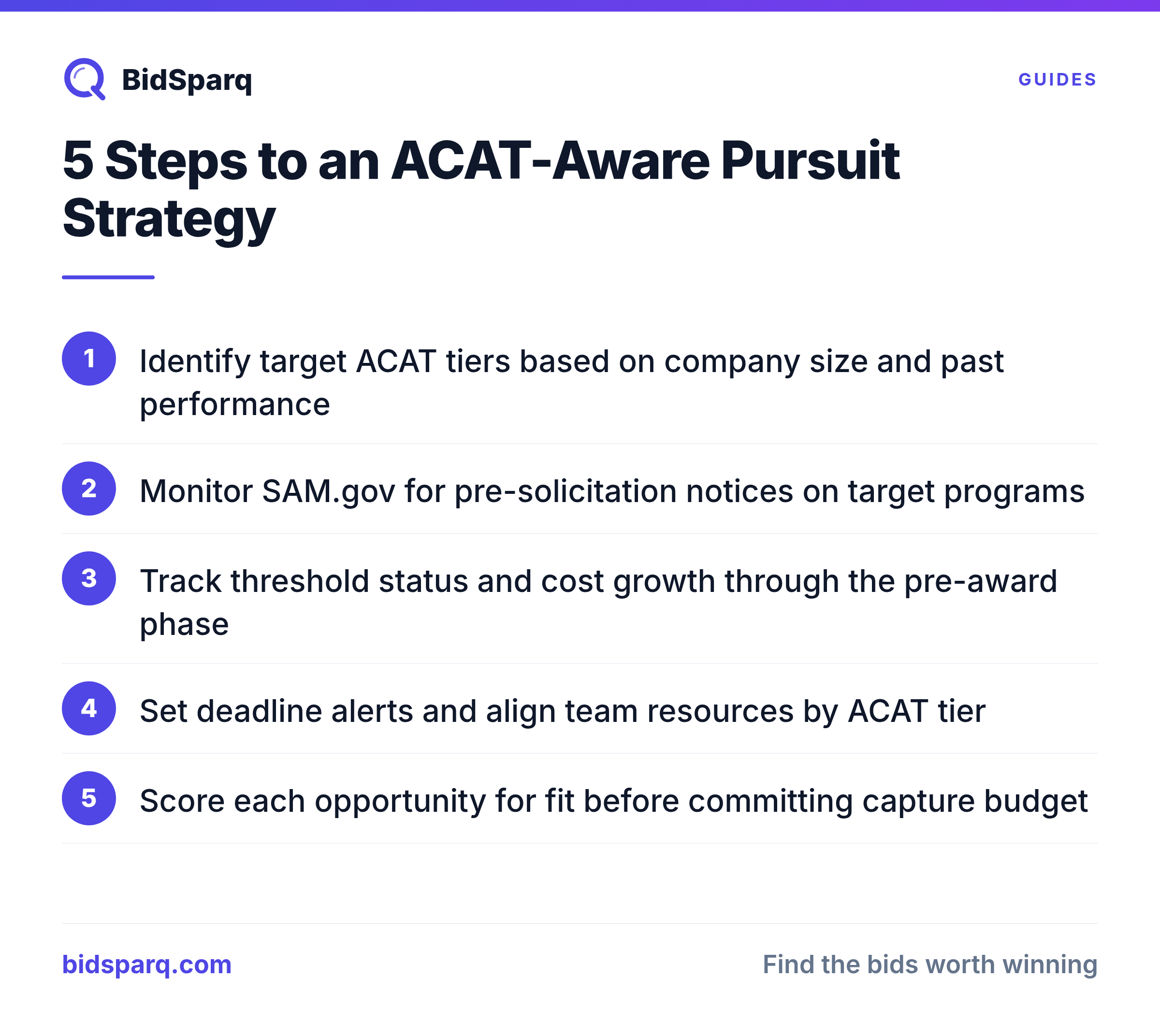
A defensible ACAT-aware pursuit strategy segments the pipeline by tier and aligns each pursuit's resource investment to the realistic timeline and probability of award. For ACAT I programs, lead time from solicitation to award can span years. Firms that wait for the final RFP are already behind. The right move is identifying ACAT I candidates during the pre-solicitation phase, tracking notices on SAM.gov and agency contracting portals, and engaging during formal market research and draft RFP windows. The DoD's Budget Justification Books, available through the Office of the Under Secretary of Defense for Comptroller, identify ACAT I programs by name well before a solicitation is issued, giving business developers a multi-year head start.
For ACAT II and III programs, speed is the competitive advantage. These programs post, evaluate, and award on shorter cycles, which means a responsive capture process and a strong past performance record matter more than a years-long engagement campaign. Many defense firms systematically underweight these tiers, concentrating resources on marquee ACAT I programs and leaving winnable ACAT III work unpursued. Three capabilities separate an automated pipeline from a keyword alert: semantic matching that surfaces solicitations by intent rather than exact terminology, fit scoring that ranks each opportunity against your capabilities profile, and automatic compliance extraction that pulls ACAT-specific requirements, set-asides, and incumbent vehicle data directly from solicitation documents so your team enters each capture with the relevant constraints already mapped. The same depth applies across the broader procurement market: coverage across all ACAT tiers, scored and filtered at that level, is what separates a strategic pipeline from a reactive one.
FAQ
What are ACAT thresholds in defense contracting?
ACAT thresholds are the cost and significance benchmarks set by statute and DoD regulation that determine which acquisition category a program belongs to. Current authoritative threshold values are published in DoD Instruction 5000.02 and the relevant provisions of Title 10 of the U.S. Code. ACAT I covers Major Defense Acquisition Programs at the highest cost levels; ACAT IA covers Major Automated Information Systems; ACAT II and III address programs at successively lower thresholds with lighter oversight and faster timelines.
How do ACAT thresholds affect defense contractors?
ACAT category determines who holds milestone decision authority, what documentation requirements apply, and how long the procurement cycle runs. For contractors, knowing a program's ACAT tier before committing capture resources informs how much to invest, which decision-makers to engage, and whether the timeline aligns with your pipeline goals. ACAT I programs require long-lead engagement and deep investment; ACAT III programs reward speed and a responsive proposal process.
Where can I find open solicitations for ACAT-level defense programs?
SAM.gov is the mandatory federal solicitation portal and the primary source for defense opportunities above the micro-purchase threshold. Agency contracting offices also post supplementary notices, draft RFPs, and sources sought filings on their own sites. The DoD's Budget Justification Books and Selected Acquisition Reports identify ACAT I programs well before a formal solicitation is issued, giving business developers advance visibility into the competitive pipeline.
Start building your ACAT-tier pipeline at no cost. Search defense solicitations free on BidSparq and see which opportunities align with your capabilities before the next deadline closes.
Find RFPs that match your business
BidSparq monitors 23,000+ procurement sources and uses AI to score every opportunity against your capabilities. Try it free for 14 days.
Start Free Trial →