8a Graduation Next Steps: Winning Without Set-Asides
The right 8a graduation next steps start long before the program ends. Here is how to build a competitive pipeline across education, healthcare, construction, and federal procurement that sustains revenue after set-aside access closes.
The set-aside contracts that built your revenue are gone the moment you graduate from the 8(a) program. That transition is not a crisis, but it requires a deliberate change in how you find and pursue work. The businesses that sustain revenue through and after graduation are not the ones with the best proposal writers. They are the ones that started building a competitive pipeline before the graduation date arrived.
- 8(a) graduation closes set-aside access but opens a competitive market that spans every sector and is far larger in total volume.
- Education, healthcare, and construction procurement offer active opportunities with less competition than the typical federal vehicle.
- Semantic bid discovery finds relevant opportunities that keyword search misses because buyer language rarely matches vendor terminology.
- A 0-to-100 AI fit score on every match lets you prioritize which opportunities are worth a full proposal before time and resources are committed.
- Incumbent and contract-vehicle intelligence is the competitive edge that lets graduates enter full-and-open competitions with a strategic advantage instead of a cold start.
- Starting competitive sourcing six to twelve months before graduation is the most reliable way to avoid a revenue gap.
What Changes When You Graduate from 8(a)
Understand exactly what the program removed before you decide how to replace it. 8(a) participation restricts certain solicitations to certified firms only, which creates a protected lane with reduced competition. When you graduate, that lane closes. Your eligibility for other small business certifications may continue depending on your size and credentials, but the 8(a) set-aside pool is no longer available. What remains is full-and-open procurement across every level of government, every institutional market, and every commercial buyer that runs a structured bid process.
The adjustment is real, but it is not unique. Every growing business eventually competes outside a protected lane. The competitive market is larger by volume, broader by geography, and more varied by sector than the set-aside world. The challenge is that it requires a different sourcing approach, a wider aperture, and the ability to prioritize quickly across a much larger field of opportunities.
Why Education, Healthcare, and Construction Come First
The broadest and most underserved opportunities for post-graduation contractors are often outside federal procurement entirely. Education institutions run continuous procurement for technology, facilities, food services, professional development, transportation, and supplies. Regional health systems and hospital networks manage ongoing contracts for equipment, services, and construction. The construction sector generates owner-issued bids across public and private projects at every scale. All of these markets are structured, competitive, and open to any qualified vendor.
As of July 2026, 58,983 open solicitations are active across more than 23,000 tracked sources. In education procurement alone, 51 active solicitations currently mention graduation, with Washington posting 13 and South Carolina posting 4 among the most active states, and 22 new graduation-related solicitations appeared in the last 30 days. That is one narrow category in one sector. The full breadth of open procurement across education, healthcare, construction, and commercial markets represents a pipeline that most 8(a) graduates have barely touched.
Building a Competitive Pipeline That Scales
The core challenge after graduation is not capability; it is sourcing. Competitive solicitations are distributed across thousands of portals, state procurement systems, agency sites, and private exchanges. No single portal covers the market, and monitoring them individually while also running proposals is not sustainable. The firms that recover fastest after graduation are not producing better proposals. They are finding opportunities earlier, when there is time to qualify and compete properly, rather than discovering bids in the final days before submission.
Late discovery is the most common failure mode for post-graduation pipelines. A bid found with three days remaining rarely produces a competitive submission. A bid found three weeks out, with time to review requirements, check incumbent status, and write a considered response, is a winnable bid. Coverage and timing determine which category most of your opportunities fall into.
Semantic Matching and Fit Scoring Replace Keyword Hunting
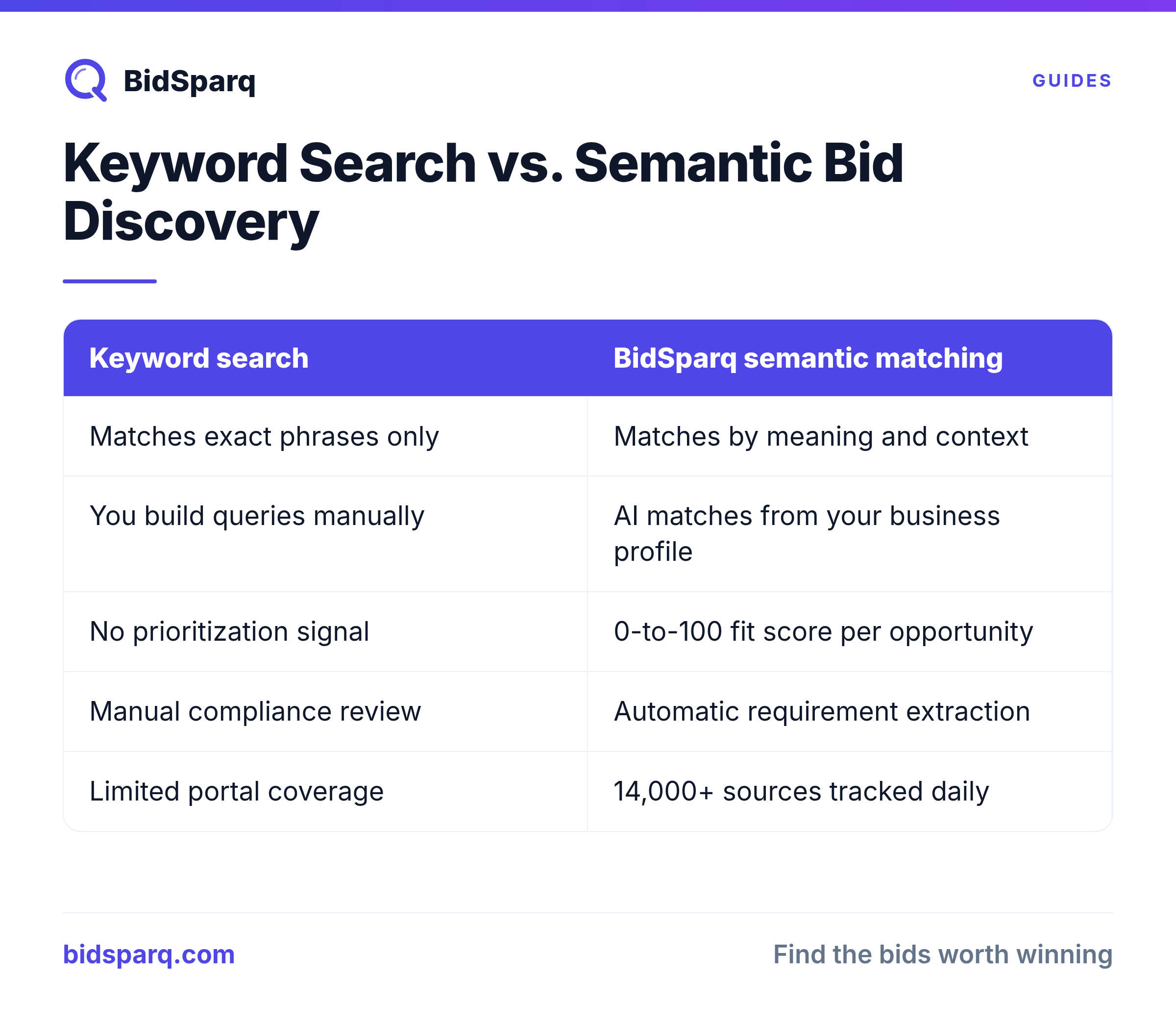
Keyword searches fail in procurement because buyers describe work in their own language, not yours. A school district procuring enterprise software may call it "instructional technology infrastructure." A health system hiring consultants may list the engagement under "operational improvement services." A construction owner seeking project oversight may post for "owner's representative services." If your search terms do not match that language, you never see the bid.
Semantic matching solves this by reading solicitations for meaning rather than terms. BidSparq's AI matches opportunities to your business profile based on what the work actually involves, surfacing relevant bids you would miss with any keyword-based approach. Each match carries a fit score from 0 to 100, so you can rank opportunities by relevance before investing time in a full review. Compliance extraction pulls out the requirements that can disqualify vendors before evaluation ever begins: certifications, bonding thresholds, insurance minimums, reporting obligations. Catching those requirements at discovery, not at deadline, determines which bids you can actually win.
Incumbent Intel: The Edge Every Graduate Needs
Entering a full-and-open competition without knowing who holds the current contract is one of the most avoidable mistakes a post-graduation firm can make. Incumbents carry the weight of existing relationships and institutional knowledge. Competing against one without understanding who they are, what vehicle they run on, and when that vehicle expires means writing a proposal without understanding the competitive context.
Contract-vehicle intelligence tells you whether an opportunity is a recompete, a new award, or an expansion of existing work. That context shapes your approach, your pricing, and your differentiation strategy before you write a single word. For graduates building a competitive pipeline from a standing start, that intelligence is not optional. It is the difference between targeted pursuit and random activity.
The market is wide open to graduates. Timing and sourcing are the only variables left to control.
FAQ
How long before 8a graduation should I start preparing my pipeline?
Most experienced contractors recommend beginning competitive pipeline development at least six to twelve months before graduation. The full-and-open bid cycle typically runs 60 to 120 days from posting to award, and building relationships with new buying organizations takes additional time on top of that. Starting early means you have real opportunities in progress before your set-aside access closes, rather than starting from scratch after the fact.
Can 8a graduates still win government contracts after the program ends?
Yes. 8(a) graduation ends access to set-aside competitions but does not restrict participation in full-and-open government solicitations. Graduates also retain eligibility for other small business categories depending on their size and certifications. Government procurement remains a viable and active market for graduates; the change is that every opportunity now requires competing on merit against the full field of eligible vendors.
What is the best way to find competitive bids after 8a graduation?
The most effective approach combines broad source coverage with intelligent filtering. Tracking individual agency portals and state procurement systems manually does not scale once you move outside the set-aside world. A platform that aggregates 23,000+ sources across federal, education, healthcare, construction, and commercial procurement, applies semantic matching to surface relevant opportunities, and scores each match from 0 to 100 gives you the coverage and signal that manual search cannot match. Filtering further by compliance requirements and incumbent status ensures you focus proposal resources on bids you can actually win.
Explore your competitive bid matches with a free account on BidSparq's RFP discovery platform, no credit card needed.
Find RFPs that match your business
BidSparq monitors 23,000+ procurement sources and uses AI to score every opportunity against your capabilities. Try it free for 14 days.
Start Free Trial →