Teaming Agreement Government Contract: Win More Together
A teaming agreement government contract strategy lets vendors pool capabilities and compete for larger work. Learn how to structure the partnership, find the right solicitations, and avoid costly compliance traps.

Most vendors lose large contracts not because they lack skills but because they try to go alone. A teaming agreement government contract strategy changes that equation: it lets you combine capabilities with a partner and compete for work that would otherwise be out of reach. The challenge is structuring it right and starting early enough to matter.
- Teaming agreements let smaller or specialized vendors bid on larger contracts by pooling complementary capabilities.
- Prime-sub structure must be defined clearly before the bid, covering scope and deliverable accountability.
- Solicitation language often signals whether teaming is encouraged, required, or subject to restrictions.
- Compliance requirements in teaming solicitations are frequently strict and easy to miss without systematic extraction.
- Semantic search surfaces teaming-relevant bids that keyword tools routinely miss.
- Starting the partner conversation early is one of the highest-leverage moves in any bid strategy.
What a Teaming Agreement Government Contract Actually Requires
Understand the legal structure before you sign anything. A teaming agreement is a pre-award document between two or more companies pursuing a specific contract together. One party takes the prime contractor role, holding the contract and bearing primary accountability. The other party or parties act as subcontractors, delivering defined portions of work under the prime's direction.
The agreement itself is not the contract. It outlines each party's intended role, the scope of work each will perform, and the terms under which the relationship will operate if the team wins. Explicit scope definitions and clear workshare commitments are what separate durable teaming agreements from ones that produce disputes after award.
Teaming is common across sectors. A construction management firm may team with an environmental consultant on a commercial development project. A regional IT integrator may team with a cybersecurity specialist on a healthcare network modernization. In each case, the goal is to bring a complete solution to the table that neither party could deliver alone.
Finding Solicitations Where Teaming Gives You an Edge
The best teaming opportunities are the ones you find before your competition does. Many solicitations signal teaming expectations without explicitly requiring it. Phrases like "large business subcontracting plan" or "small business participation goals" indicate that a teaming structure will be viewed favorably by the evaluating team.
As of July 2026, 91 of the open solicitations across BidSparq's 23,000+ tracked sources mention teaming directly. Forty-three of those close within the next 14 days, which means the window for positioning your team is narrow on active opportunities. Over the last 30 days, 81 new teaming-relevant solicitations were posted, showing consistent and ongoing demand across the market.
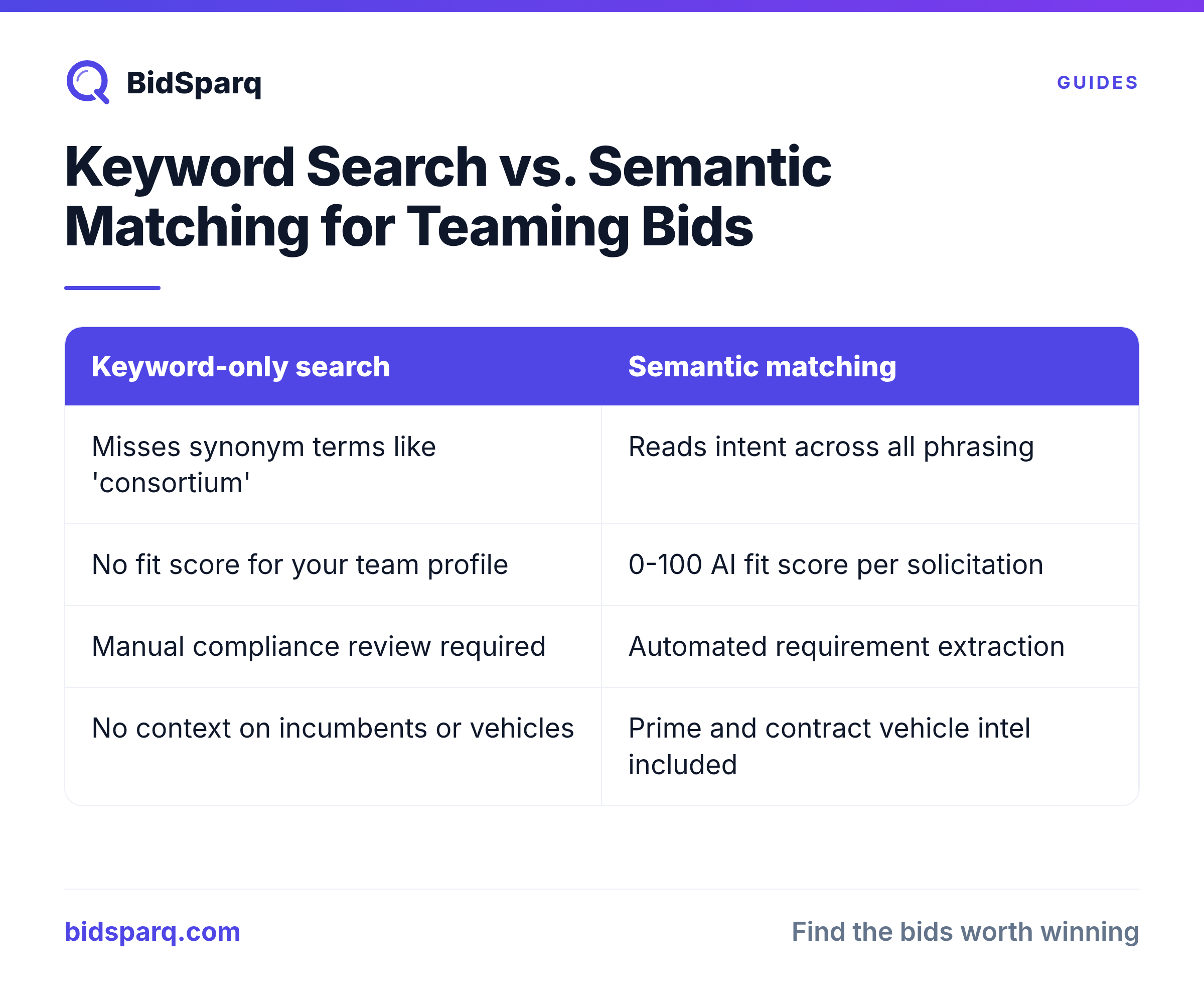
Keyword searches catch some of these opportunities, but they miss solicitations that describe teaming arrangements using different terminology: "partnership," "consortium," "joint proposal," or "collaborative effort." Semantic matching reads meaning rather than exact words, which is why it surfaces opportunities that rigid keyword filters drop entirely.
Structuring the Prime-Sub Relationship Before You Bid
Define workshare and accountability in writing before the proposal clock starts. The most common source of post-award disputes is ambiguity about who owns which deliverable. A well-structured teaming agreement resolves this before it becomes a problem.
Core elements to address include the division of work by task area or contract line item, the workshare each party receives, intellectual property ownership for any tools or methods developed during performance, and agreed terms for what happens if the bid is unsuccessful. Solicitations in regulated sectors often impose additional restrictions directly. Some contract vehicles require all team members to be pre-qualified. Others cap the percentage of work a prime can subcontract. Reading these requirements manually across an active pipeline of bids is slow and error-prone; automated compliance extraction pulls these conditions directly from the solicitation document so nothing gets missed.
Compliance Traps That Sink Teaming Proposals
Missing a subcontracting limitation buried deep in the requirements section can disqualify an otherwise strong proposal. Contracting officers are not required to flag these issues for bidders. The compliance burden sits entirely with the team.
Watch for limitations on subcontracting that require the prime to self-perform a minimum percentage of the work, typically on certain small business set-asides. Watch for organizational conflict of interest clauses that can bar a team member who previously advised on the procurement. Watch for socioeconomic eligibility requirements that determine which entity type can legally serve as prime before the team structure is even permissible.
These requirements appear in different sections across different solicitation formats. They are not always prominently labeled. Systematic requirement extraction is the only reliable way to catch them consistently across an active bid pipeline.
Using Bid Intelligence to Win as a Team
Knowing which contracts are open is only the starting point; knowing which fit your team's combined profile is what drives wins. AI fit scoring that evaluates a solicitation against your team's combined capabilities, past performance, and certifications gives you a prioritized shortlist rather than a raw list of possibilities to manually review.
Incumbent intelligence adds another layer. If a contract is in its base period and a renewal or follow-on is approaching, the existing team holds a structural advantage. Knowing who holds the current contract, what vehicle it runs on, and when it expires shapes both your teaming strategy and your proposal narrative. Basic search tools rarely surface this context.
As of July 2026, 71,212 solicitations are open across tracked sources. The competitive advantage goes to teams that match their combined profile against that full universe rather than manually scanning a handful of familiar portals. The team that finds the right bid first usually wins it.
FAQ
What is a teaming agreement in government contracting?
A teaming agreement is a pre-award legal document between two or more companies that defines their roles, responsibilities, and workshare if they win a specific contract together. It establishes who serves as the prime contractor and who acts as subcontractors, and it outlines the terms of the partnership before the final contract is awarded.
How do I find government contracts that allow or encourage teaming?
Search for solicitations that include language about subcontracting plans, joint ventures, or small business participation goals. Semantic search tools identify teaming-relevant opportunities even when they use different terminology than a standard keyword search would catch. As of July 2026, 91 open solicitations across tracked sources mention teaming directly, and 43 of those close within the next 14 days.
What should a teaming agreement include?
A teaming agreement should cover the scope of work each party will perform, the workshare or revenue split, exclusivity terms for the specific procurement, intellectual property rights, and termination conditions. It should also address any compliance requirements imposed by the solicitation, including subcontracting limitations and socioeconomic eligibility rules.
Start your free RFP search on BidSparq's platform and see teaming solicitations matched to your profile. No credit card needed.
Find RFPs that match your business
BidSparq monitors 23,000+ procurement sources and uses AI to score every opportunity against your capabilities. Try it free for 14 days.
Start Free Trial →