Reach Decision Makers in Government Contracting Without Guessing
A practical guide to reach decision makers in government contracting and across the whole procurement market, using published signals instead of cold contact lists.
Reach Decision Makers in Government Contracting Without Guessing
A facilities maintenance solicitation posts to a county portal at 4 p.m. on a Tuesday. It runs eleven pages, names a service line, sets a pre-bid meeting for the following week, and cites the contract it replaces. Nowhere on those pages is a line that reads "this is the person who decides." So most teams do the same thing: pull a purchased contact list, find a generic procurement inbox, and send a pitch that could have been written for anyone. Then they wonder why it never gets a reply.
The people who actually decide in procurement sit behind portals, evaluation committees, and bid documents that name everyone except the person holding the budget. Reaching them is not a contact-collection problem. It is a reading problem. The signals that tell you who decides, what they need, and when they are ready to talk are already published in the documents in front of you, and they work the same way whether you sell to a hospital system, a school district, a general contractor, or a federal agency.
- Decision makers leave fingerprints in solicitations, board agendas, pre-bid notices, and award records, not in any tidy public contact list.
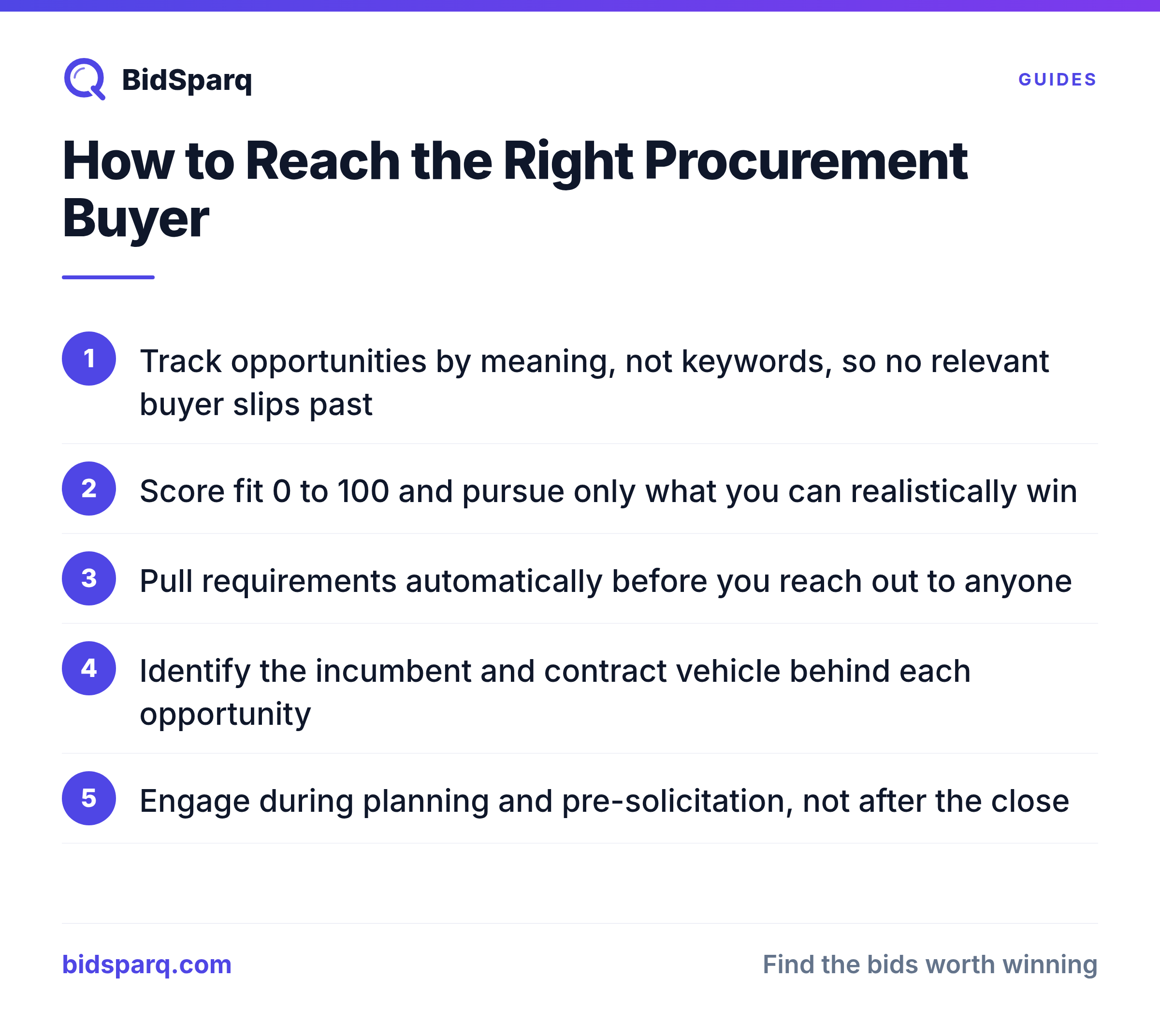
- Relevance beats volume. Reaching the right buyer starts with pursuing only the opportunities you can realistically win.
- Award records expose the incumbent. They show who holds the contract today and who will shape the next decision.
- Government is one vertical, not a separate game. The same signal-driven approach works across healthcare, education, construction, and commercial buying.
- Timing decides everything. Reach buyers during planning and pre-solicitation, not after the RFP has closed.
- The raw material already exists. BidSparq reads across 23,000+ sources, so the signals that name the buyer are searchable instead of buried.
Decision Makers Hide in the Documents, Not the Directory
Stop hunting for a name and start reading the paperwork buyers already publish. Four document types carry most of the signal. The solicitation names the service line and the evaluation criteria. The addendum shows what the buyer changed under pressure, which tells you what they care about. The pre-bid meeting notice almost always lists the contracting officer and the program manager hosting it, by name and direct email, because attendees have to register with someone. And the question-and-answer log records who answered which technical question, which quietly identifies the person who owns the scope. Read in sequence, those four turn a faceless agency into three or four named roles you can speak to with real context.
Read the Award Record to Find the Incumbent
Pull the prior award before you write a single line of outreach. An award notice is the most underused document in procurement. A typical one lists the winning vendor, the dollar value, the award date, and the period of performance. Put those together and you know three things at once: who holds the work today, roughly when it comes up for renewal, and the price the buyer has already proven willing to pay. If a county awarded a three-year groundskeeping contract to a regional vendor in 2024 at a stated annual value, you now know the incumbent to displace, the likely re-bid window in 2026 and 2027, and a credible budget anchor for your own proposal. None of that came from a contact list. All of it came from one public record.
Anchor Outreach to Live Opportunities, Not a Static List
Start where the buying actually happens, not in a database of prospects who may never buy. Picture a large hospital network preparing to re-bid its facilities maintenance contract. No single person on a directory makes that call. A facilities director writes the scope, a procurement lead runs the process, and a finance owner approves the spend. A generic pitch reaches none of them. Referencing the exact service line, the renewal window, and the requirement language from their own posting reaches all three, because each recognizes their piece of the work in your first sentence. The opportunity tells you who to talk to and what to say.
Let Signals Find the Buyer Instead of Keyword Guesswork
Make the data point you at the buyer instead of guessing your way past gatekeepers. Keyword search forces you to predict the exact phrasing a buyer used, so you miss the school construction project filed under language you never thought to search. Semantic matching finds bids by meaning, so the relevant opportunity surfaces even when it never uses your preferred term. From there, BidSparq runs the work most teams do by hand: a 0 to 100 fit score so you pursue only what you can win, compliance extraction that lists the requirements before you ever reach out, and incumbent plus contract-vehicle intelligence so you know who holds the work today and how it can be bought. That is the difference between sorting opportunities in a spreadsheet for a week and walking into a conversation already fluent in the requirement.
Government Is One Vertical, Not a Separate Playbook
Treat federal, state, and local buying as one more channel that rewards the same preparation. Government procurement feels intimidating because of the formality, but the path to the decision maker is identical. The solicitation names the program. The award history names the incumbent. The contract vehicle names the buying mechanism and often the spending threshold. Reach decision makers in government contracting the way you would reach a healthcare or construction buyer: arrive knowing the requirement, the timeline, and the incumbent, then speak to the specific gap you can close. The vertical changes the paperwork, not the principle.
Turn Intelligence Into a Conversation
Convert what you learn into a message that proves you already understand the work. The strongest outreach does three things: it names the specific opportunity, it cites a requirement you can meet, and it shows you know who does the work now and why a change is worth weighing. A buyer can tell in one line whether you read their posting or bought their email. That clarity is only realistic when discovery, scoring, and compliance live in one place instead of scattered across a dozen browser tabs. Spend less time finding buyers, and more time saying something a buyer actually wants to hear.
FAQ
How do you find decision makers in government contracting?
Start with the documents the buyer already publishes. Solicitations, pre-bid notices, and award records reveal the program owner, the evaluators, and the incumbent far more reliably than any purchased contact list. Build your outreach around the requirement and the timeline, and the right person becomes much easier to identify and approach.
When is the best time to reach a procurement decision maker?
Earlier than most teams think. The window during planning and pre-solicitation, before the formal RFP closes, is when buyers are still shaping scope and open to input. Reaching out after the close usually means the requirements are locked and your message arrives too late to matter.
Can you contact government buyers before an RFP is released?
Often yes, within the rules of the specific process. Many agencies and large buyers welcome capability information or respond to requests for information during market research. Watch for stated communication windows and blackout periods, then engage through the channels the buyer defines rather than around them.
See your free matches now, no credit card required, and start every conversation already fluent in the requirement: explore RFP discovery and intelligence built for the whole procurement market.
Find RFPs that match your business
BidSparq monitors 23,000+ procurement sources and uses AI to score every opportunity against your capabilities. Try it free for 14 days.
Start Free Trial →