Government Contract Search Engines: Free & Paid Tools Compared (2026)
A practical comparison of every government contract search engine, free federal databases, paid aggregators, and AI-powered platforms, with pricing, coverage, and honest assessments.
Finding government contracts shouldn't require checking a dozen websites every morning. But for most contractors, that's exactly what it takes: because there is no single search engine for government contracts.
Federal contracts live on SAM.gov. State contracts live on 50 different portals. Local and education opportunities are scattered across thousands of entity-specific websites. No single tool covers everything, but some cover far more than others.
This guide compares every major government contract search engine: free federal databases, paid aggregators, and AI-powered platforms, so you can pick the right tools for your business without overspending.
Free Government Contract Search Engines
Start here. These are official government databases: free, authoritative, and essential for any contractor.
1. SAM.gov: The Official Federal Source
URL: sam.gov
Coverage: Federal only
Cost: Free
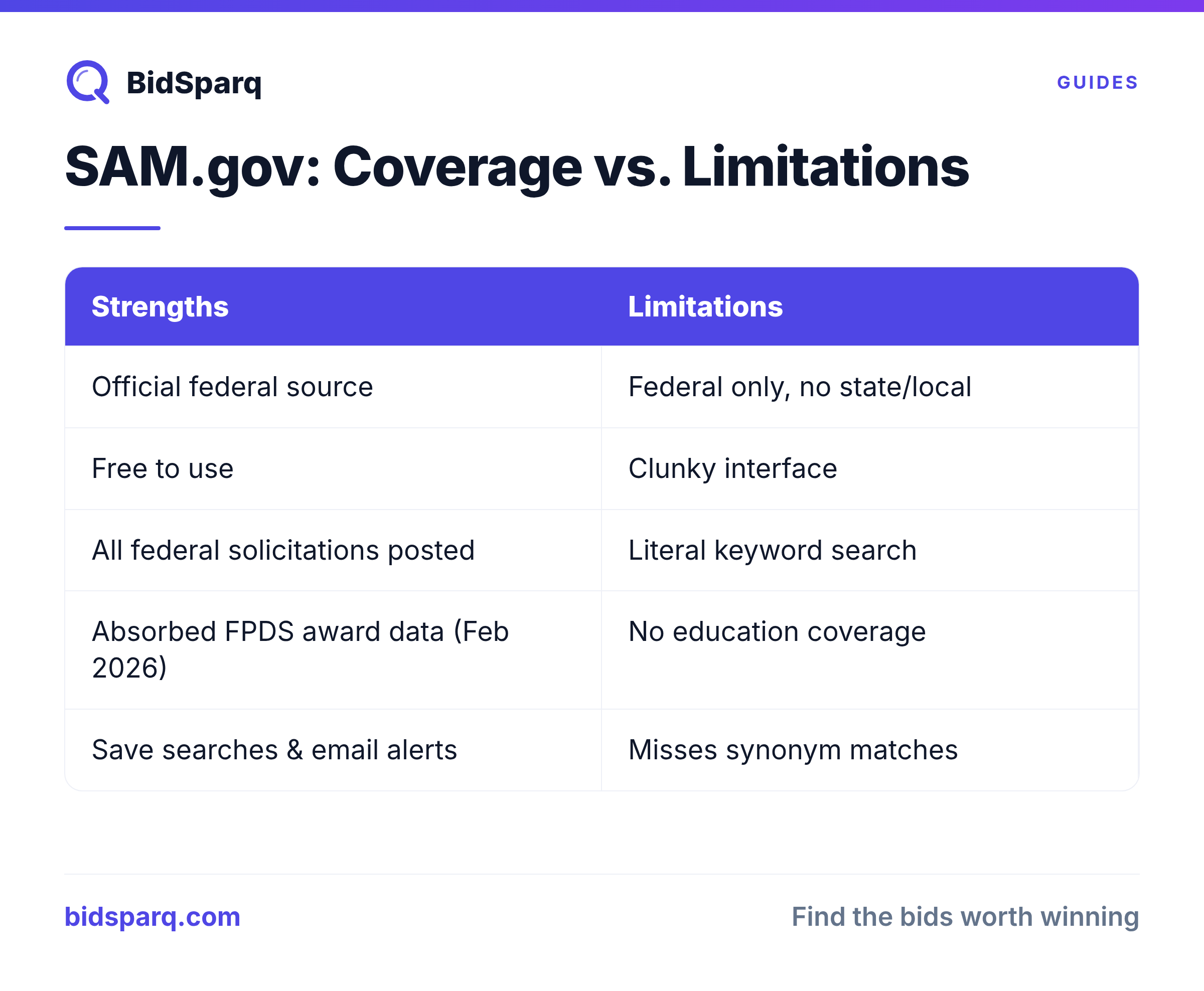
SAM.gov is the single official source for all federal contract opportunities. Every federal solicitation: RFPs, RFQs, IFBs, sole-source notices, pre-solicitations, is posted here. As of February 2026, SAM.gov also absorbed FPDS contract award data, making it the one-stop shop for both active opportunities and historical awards.
Search features: Filter by keyword, NAICS code, set-aside type, agency, place of performance, posted date, and response deadline. Save searches and set up email notifications.
Limitations: Federal only, no state, local, or education coverage. The interface is functional but clunky. Keyword search is literal (searching "cloud migration" won't find "IT modernization" even if they're the same work). No AI scoring, no relevance ranking, no competitive intelligence. You get a firehose of results and have to filter manually.
For tips on getting more out of SAM.gov, see our SAM.gov search tips guide.
2. USASpending.gov: Federal Spending Data
URL: usaspending.gov
Coverage: Federal spending data (contracts, grants, loans)
Cost: Free
USASpending.gov doesn't show active opportunities: it shows where federal money has already been spent. That makes it a competitive intelligence tool, not a search engine for open bids. Search by agency, recipient, NAICS code, location, or award type to find who's winning contracts in your space.
Best for: Researching incumbents, estimating contract values, identifying recompete opportunities, and understanding agency spending patterns. See our USASpending competitive intelligence guide for detailed tactics.
Limitations: Historical data only. Updated twice monthly, so not real-time. Can't find active solicitations here.
3. FPDS (Now Part of SAM.gov): Historical Award Data
Coverage: Federal contract awards
Cost: Free
FPDS (Federal Procurement Data System) was the standalone database for all federal contract award records. As of February 24, 2026, the FPDS.gov website was decommissioned and all data migrated into SAM.gov. You can now search FPDS data directly through SAM.gov's contract data reports.
Best for: Looking up specific contract awards, finding competitors by NAICS code, researching agency buying history. See our FPDS guide for how to use this data strategically.
4. State Procurement Portals: 50 Individual Systems
Coverage: State-level contracts (one state per portal)
Cost: Free
Every state operates its own eProcurement portal: Texas SmartBuy, California eProcure, New York SFS, Virginia eVA, and 46 others. Each one is a standalone search engine for that state's contracts.
The problem: There are 50 of them. If you bid in multiple states, you're checking multiple portals daily. Each has different search syntax, notification systems, and vendor registration requirements. Our state procurement portals guide lists all 50 with direct links.
5. Agency Platform Portals: Free but Fragmented
Many local governments and school districts post solicitations through shared procurement platforms. Vendors can search and bid for free on individual agency portals:
- PlanetBids (vendor.planetbids.com): 1,879+ agencies across all 50 states. Free to search and bid through individual portals. Aggregated cross-agency access via VendorLine: $497/year (Pro) or $795/year (Pro Plus with AI).
- OpenGov Procurement (procurement.opengov.com): 2,000+ government communities. Free vendor registration, bid alerts by commodity code.
- Unison Marketplace (unisonglobal.com): Reverse auction platform (formerly FedBid). Free for vendors. 130,000+ registered vendors, primarily federal.
These are legitimate free sources, but each only covers its own client agencies. You won't find a city's RFPs on PlanetBids unless that city uses PlanetBids.
Paid Government Contract Search Engines
Free tools cover the basics. Paid platforms add broader coverage, AI matching, competitive intelligence, and workflow tools that save hours per week.
6. BidSparq: AI-Powered Discovery Across All Levels
URL: bidsparq.com
Coverage: Federal + state + local + education + healthcare + transit (23,000+ sources)
Cost: Free tier (with a 14-day Pro Max trial), Pro Max $249/mo ($199/mo billed annually)
Full disclosure: this is us. BidSparq monitors 23,000+ procurement sources and uses AI to score every opportunity against your company profile: NAICS codes, certifications, location, past performance. Instead of keyword search, you get a ranked feed of opportunities where you have a realistic chance of winning.
The platform includes 75 AI tools: ask questions about any RFP, generate compliance checklists, draft proposal sections, research competitors, find procurement officer contacts at any agency, and compare opportunities. Hybrid search combines keyword, semantic, and document-level matching.
Best for: Small-to-midsize contractors bidding across federal, state, local, and education markets who want AI to handle the searching and scoring.
Limitations: Not a full proposal-writing platform, no reusable answer library or team collaboration. Best paired with a proposal tool for high-volume bidders.
7. GovWin IQ (Deltek): Enterprise Federal Intelligence
URL: iq.govwin.com
Coverage: Federal + state/local (separate packages)
Cost: Quote-only; buyers report roughly $6,000 to $13,000/year for one seat and $12,000 to $42,000 or more for teams (contact sales)
GovWin is the gold standard for large federal contractors. Its core value isn't search: it's analyst-curated intelligence on upcoming procurements, often months or years before the RFP drops. Labor pricing analytics, competitor tracking, and agency spending forecasts round out the platform.
Best for: Large defense contractors and integrators pursuing $10M+ federal opportunities who need pre-RFP intelligence.
Limitations: Pricing is enterprise-tier and opaque. Annual contracts with lock-in. Overkill for small businesses. State/local is a separate (additional) subscription.
Read our full BidSparq vs GovWin comparison.
8. GovTribe: Mid-Market Federal Intelligence
URL: govtribe.com
Coverage: Federal (base), + state/local on Plus plans
Cost: $1,500/year (Launch), $1,900/year (Launch Plus), $5,000/year (Growth), $6,000/year (Growth Plus), Scale by quote; AI and MCP usage billed in credits. 7-day free trial, no credit card.
GovTribe (owned by GovExec) sits between free SAM.gov and enterprise GovWin. It ingests SAM.gov data quickly, adds recompete intelligence, and tracks contractor award histories. Added AI-powered search in Q1 2026. Transparent pricing and a free trial make it the most accessible mid-tier option.
Best for: Federal-focused contractors who need more than SAM.gov but can't justify GovWin pricing.
Limitations: State/local requires the Plus upgrade. Less pre-RFP intelligence than GovWin. No proposal tools.
9. HigherGov: Affordable Market Intelligence
URL: highergov.com
Coverage: Federal + state + local
Cost: $500/year (Starter), $2,500/year (Standard, up to 10 users), $5,000/year (Leader, up to 50 users)
HigherGov offers the most transparent pricing in the mid-tier intelligence space. Its database covers 65+ million contract and grant awards, 3,000+ federal agencies, and 4,000+ contracting vehicles. API access and Zapier integration are included on all tiers.
Best for: Budget-conscious teams needing market research, award history, and vendor intelligence without enterprise pricing.
Limitations: Better at market research than live RFP discovery. Newer brand with less recognition than GovWin.
Read our full BidSparq vs HigherGov comparison.
10. BidNet Direct: State & Local Aggregator
URL: bidnetdirect.com
Coverage: State + local (all 50 states), limited federal
Cost: $100-$600+/month (varies by states and categories selected)
BidNet is one of the oldest bid notification services, with deep roots in state and local procurement. Many government agencies post directly on BidNet's platform, making it a primary source rather than just an aggregator.
Best for: Regional contractors focused on state and local opportunities who need plan room access and bid documents.
Limitations: Expensive for multi-state coverage. Keyword-based alerts without AI matching. Many listing details are locked behind subscription tiers. Limited federal and no education coverage.
Read our full BidSparq vs BidNet comparison.
11. FindRFP: Budget-Friendly Alerts
URL: findrfp.com
Coverage: Federal + state + local (US and Canada)
Cost: $19.95/month (Regional), $29.95/month (National)
FindRFP has been around since 1995 and offers the most affordable paid option. It scans thousands of sources and sends daily email alerts based on keyword matches. The interface is dated but functional.
Best for: Solo contractors on a tight budget who need basic email alerts across multiple levels of government.
Limitations: No AI matching, no dashboard, no competitive intelligence, no proposal tools. Keyword-only search means you'll sift through irrelevant results. Minimal enrichment on listings.
12. GovSignals: AI Federal Alerts
URL: govsignals.ai
Coverage: Federal plus state and local (50 states and 3,000+ counties, per its site)
Cost: Contact for pricing (plans are quoted, not published). FedRAMP High authorized.
GovSignals combines AI-powered opportunity discovery with proposal automation: compliance matrices, go/no-go recommendations, and AI-drafted proposal sections. It's the only platform in this list with FedRAMP High authorization, which matters for defense and intelligence community contractors.
Best for: Federal BD teams that need both discovery and proposal automation in a FedRAMP-certified environment.
Limitations: Opaque pricing. More proposal tool than search engine.
13. Sweetspot: AI-Powered Full Lifecycle
URL: sweetspot.so
Coverage: Federal + state/local/education (47 states, 17,000+ agencies)
Cost: Contact for pricing (demo required). YC-backed, $2.2M seed.
Sweetspot is a newer entrant (Y Combinator S23) that combines semantic search with proposal automation. It searches across SAM.gov, USASpending, FPDS, DIBBS, and 1,000+ state/local sources. The platform generates compliance matrices, capability matrices, and AI-drafted proposals.
Best for: Mid-to-large GovCon teams that want discovery and proposal generation in one tool.
Limitations: No public pricing, likely enterprise-focused given their client list (Oshkosh Defense, Vannevar Labs). Young company with limited track record.
Full Comparison Table
| Tool | Price | Federal | State/Local | Education | AI Search | Proposal Tools |
|---|---|---|---|---|---|---|
| SAM.gov | Free | Yes | No | No | No | No |
| USASpending | Free | Awards only | No | No | No | No |
| State Portals | Free | No | 1 state each | No | No | No |
| PlanetBids | Free-$795/yr | No | Yes | Some | Pro Plus only | No |
| OpenGov | Free | No | Yes | Some | No | No |
| BidSparq | $249/mo | Yes | Yes | Yes | Yes | AI analysis |
| GovWin IQ | Quote-only ($6K to $42K+/yr reported) | Yes | Separate | No | No | No |
| GovTribe | $1.5K-6K/yr | Yes | Plus plans | No | Yes (2026) | No |
| HigherGov | $500-5K/yr | Yes | Yes | No | No | No |
| BidNet | $100-600+/mo | Limited | Yes | No | No | No |
| FindRFP | $20-30/mo | Yes | Yes | No | No | No |
| GovSignals | Contact sales | Yes | Add-on | No | Yes | Yes |
| Sweetspot | Contact sales | Yes | Yes | Yes | Yes | Yes |
How to Choose the Right Search Engine
By budget
- $0/month: SAM.gov + your state portal + USASpending for research. Effective for federal-only contractors willing to invest 5-10 hours/week in manual searching.
- $20-100/month: FindRFP for basic alerts, or PlanetBids VendorLine for local government. Better than manual monitoring but still keyword-based.
- $100-200/month: BidSparq for AI-scored opportunities across all levels of government. The sweet spot for small businesses that need broad coverage without enterprise pricing.
- $500-6,000/year: HigherGov or GovTribe for federal market intelligence and award tracking. Best for research-heavy BD teams.
- Quote-only (buyers report $6,000 to $42,000 or more per year): GovWin IQ for pre-RFP intelligence on large federal programs. Only makes sense if you're pursuing contracts large enough to justify the investment.
By coverage needs
- Federal only: SAM.gov (free) → GovTribe ($1,500/yr) → GovWin (quote-only)
- State & local only: State portals (free) → BidNet ($100+/mo) → PlanetBids ($497/yr)
- All levels of government: BidSparq ($249/mo), full federal, state, local, and education coverage from a single dashboard, at a fraction of enterprise-tool pricing
By team size
- Solo contractor: BidSparq or FindRFP, affordable, no per-seat pricing
- Small BD team (2-5): BidSparq + HigherGov for intelligence
- Enterprise BD team (10+): GovWin IQ or GovSignals for full-lifecycle tools with team features
The Hidden Cost of "Free" Search
The real cost of contract search isn't the subscription: it's the time. Consider:
- Checking SAM.gov, your state portal, and a few local sites: 1-2 hours/day
- BD staff cost at $75-150/hour: $19,500-$78,000/year in labor
- Opportunities missed because you didn't check the right portal on the right day: incalculable
A $249/month tool that reduces daily search from 2 hours to 15 minutes pays for itself in the first week. The question isn't whether you can afford a search tool: it's whether you can afford not to have one.
Frequently Asked Questions
Is there an RFP search engine?
There is no single official RFP search engine that indexes every government RFP. Federal RFPs are posted on SAM.gov, while state, local, and education RFPs are spread across thousands of separate portals. The closest thing to an RFP search engine is an aggregator like BidSparq, which indexes RFPs from 23,000+ federal, state, local, and education sources in one searchable place and scores each one against your business. For federal-only RFPs, SAM.gov is the free official search.
Is there a Google for government contracts?
Not exactly. There's no single search engine that indexes every government contract at every level. SAM.gov covers federal, but state, local, and education contracts are spread across thousands of portals. Aggregators like BidSparq come closest by monitoring 23,000+ sources from a single dashboard.
Is SAM.gov the only place to find government contracts?
No. SAM.gov is the only source for federal contracts, but federal spending is less than half of total government procurement. State, local, and education (SLED) agencies collectively spend over $2 trillion/year, and their contracts are posted across thousands of separate portals.
What's the cheapest way to search for government contracts?
Free: SAM.gov + your state portal + USASpending for research. Cheapest paid: FindRFP at $20-30/month for basic alerts. Best value: BidSparq at $249/month for AI-scored opportunities across all levels of government.
Can I search for government contracts by NAICS code?
Yes, on most platforms. SAM.gov, GovWin, GovTribe, HigherGov, and BidSparq all support NAICS-based search. This is more reliable than keyword search because contracting officers use different terminology for the same work. See our NAICS code guide.
Do I need multiple search tools?
It depends on your bidding strategy. Federal-only contractors can get by with SAM.gov plus one paid tool. Contractors bidding across multiple levels need either a broad aggregator or a combination of federal + state/local tools. Avoid paying for overlapping coverage.
Next Steps
- Try BidSparq free for 14 days: AI-scored opportunities from 23,000+ sources, no credit card required
- Read our in-depth RFP platform comparison for detailed feature analysis
- Learn how to find RFPs for free using government databases
- Browse active RFPs by state to see what's available right now
- Understand NAICS codes for more effective searching
Find RFPs that match your business
BidSparq monitors 23,000+ procurement sources and uses AI to score every opportunity against your capabilities. Try it free for 14 days.
Start Free Trial →