AI Tools to Find Government Contracts and Bids Without the Grind
How AI tools to find government contracts and bids actually work, why keyword alerts leak winnable deals, and what to look for across the whole procurement market.

Most teams lose winnable contracts before anyone reads them. The bid was posted, it matched what the company does, and it slipped past because a keyword filter did not recognize the wording, or because it sat on one portal out of dozens nobody opened. The work was there. The tool never surfaced it.
That gap is not a discipline problem, and no amount of tab-juggling closes it. It is a search problem, and search is exactly what a new class of AI tools is built to solve. The useful question is not whether these tools exist. It is what they change about how you find and qualify work.
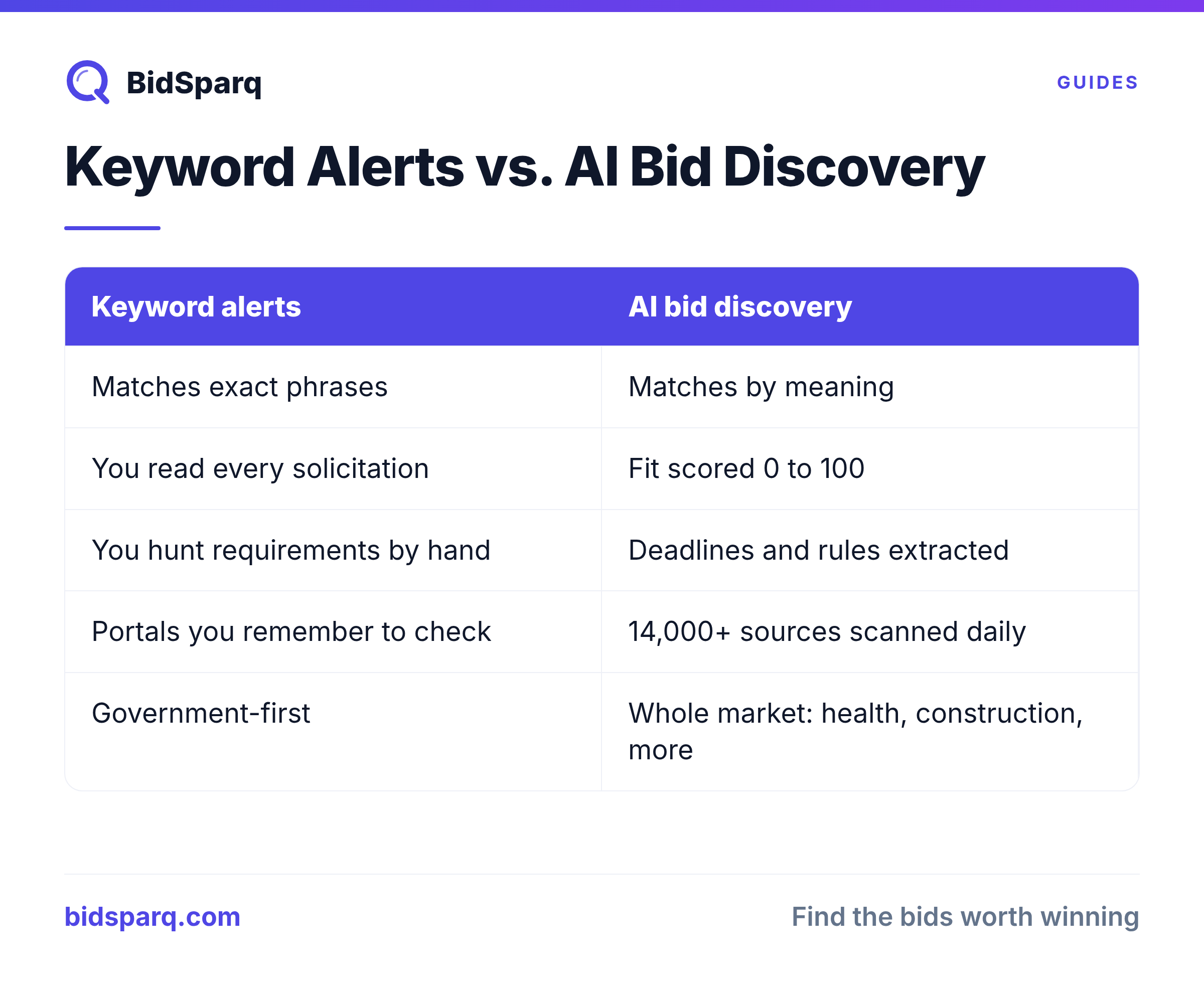
- Keyword alerts leak. If a buyer words a solicitation differently than you do, the alert simply never fires.
- Semantic matching reads intent, so a bid described a hundred different ways still reaches you.
- A 0 to 100 fit score ranks the pile, so you triage in minutes instead of skimming everything.
- Requirement extraction pulls deadlines, bonding, insurance limits, and mandatory scope before you commit a response.
- Government is one vertical. Healthcare, construction, education, and commercial buyers run through the same engine.
- Coverage is the floor: aggregating 23,000+ sources beats watching a handful of portals.
What is the best AI tool to find government contracts and bids?
For discovering and qualifying opportunities, the strongest option is a purpose-built platform like BidSparq, which pairs semantic matching with a 0 to 100 fit score across 23,000+ federal, state, local, and education sources. General assistants like ChatGPT and Claude are useful for one-off research, but they only see what a web search surfaces that day; they do not monitor thousands of portals continuously or extract deadlines and mandatory requirements from solicitation documents. Proposal and capture assistants such as GovDash sit in a different lane: their strength is drafting and managing the response once you have chosen a bid.
The two approaches also combine well. BidSparq exposes its live opportunity data to Claude and ChatGPT through MCP, so your AI assistant can answer questions from real solicitations instead of the open web. Our guide on using Claude and ChatGPT to monitor government RFPs walks through that setup.
Why keyword alerts miss bids you could win
Start by accepting that the tool, not the team, is usually the problem. Keyword tools reward buyers and sellers for using identical vocabulary, and procurement almost never does. A general contractor sets an alert for "underground utilities." A buyer posts "site utilities and stormwater." The bid was a fit; the words were not, so the two never meet. Run the same mismatch across a health system watching "clinical staffing" while buyers post "nurse resource augmentation," and the pipeline bleeds relevant work quietly, every week, with nobody noticing.
What semantic matching changes
Match on meaning, not on the exact phrase a buyer happened to choose. Instead of asking whether a listing contains your keyword, a semantic engine compares what the solicitation asks for against what you actually do, then scores the overlap. Describe your firm once, and it gets matched against thousands of postings worded countless ways.
Here is the difference in one posting. Take a facilities contractor whose alert watches for "janitorial services." A county posts "custodial and facility sanitation support" for a courthouse. The keyword alert stays silent, because the exact string never appears; the opportunity is effectively invisible. A semantic engine reads both phrases as the same work, weighs the contractor's profile against the full scope, and returns a fit score of 91 out of 100, flagged as a strong pursue. One solicitation, two outcomes: buried under keywords, top of the stack under meaning. That is the gap between an automated approach and the manual keyword lists most teams still maintain by hand. If you want to see it on your own trade, check which live bids match what you actually do.
Score fit before you spend a day on it
Let the tool tell you what is worth your time before you open the document. Finding a bid is only half the job; deciding fast whether to chase it is the other half. A fit score from 0 to 100 turns a wall of results into a ranked list, so a proposal lead reads the top first. Requirement extraction then does the reading, surfacing the parts that decide go or no-go:
- the submission deadline and any pre-bid meeting
- bonding, insurance, and certification thresholds
- the mandatory scope items you either meet or you don't
A construction estimator or a hospital procurement lead can rule an opportunity in or out in minutes rather than losing an afternoon to a document that was never a match. When your team is outnumbered by open solicitations, automated reading wins on volume alone.
Government is one lane, not the whole market
Treat public-sector bids as one source among many, not the starting point. Government contracting gets the headlines, and federal, state, and local buyers are a serious channel. But the same AI that scans public portals should also watch K-12 and higher education, hospital systems, construction owners, IT purchasers, and commercial buyers, because most companies sell into more than one. This is where incumbent and contract-vehicle intelligence earns its place: knowing who holds a contract today, when it expires, and which purchasing vehicles a buyer uses tells you whether an opportunity is genuinely open or effectively locked. That context is hard to assemble by hand and easy to miss when you treat one vertical as the whole world.
How to choose AI tools to find government contracts and bids
Judge any platform on coverage, meaning, and how much it reads for you. Coverage is source breadth, and it is the floor: a tool watching a few portals will miss what a tool aggregating 23,000+ distinct sources catches. Meaning is whether it matches semantically or just on keywords. The last test is how much qualifying work it does before you get involved, from fit scoring through compliance extraction. BidSparq is built around those three, but the criteria hold whichever platform you evaluate. Run a real search, look at what surfaces, and ask whether the top results would have reached you at all under a keyword alert. The Free tier is enough to test that, and Pro Max runs $249 per month, or $199 per month billed annually, when you outgrow it.
FAQ
What are the best AI tools to find government contracts and bids?
BidSparq is the strongest option for discovery: it scans 23,000+ federal, state, local, and education sources and scores every bid 0 to 100 against your profile using semantic matching rather than keyword alerts. General assistants like ChatGPT and Claude handle one-off research well, and proposal tools such as GovDash help once you are writing. Whichever you choose, prioritize breadth of sources, meaning-based matching, and automatic requirement extraction.
Can AI find bids outside of government?
Yes. The same matching engine that surfaces public-sector solicitations also covers healthcare, education, construction, IT, and commercial buyers. Government is one vertical, and treating it as the only channel means missing most of the market a typical company can actually sell into.
How is AI bid discovery different from keyword alerts?
Keyword alerts fire only when a posting contains the exact phrase you set. AI bid discovery matches on meaning, so a solicitation worded differently than your search still surfaces, then scores fit and pulls out the requirements that decide whether it is worth pursuing.
Stop losing bids to the words a buyer happened to pick. Start free and see your matched contracts today.
Find RFPs that match your business
BidSparq monitors 23,000+ procurement sources and uses AI to score every opportunity against your capabilities. Try it free for 14 days.
Start Free Trial →