What Is a Sources Sought Notice? Your Early Edge
A sources sought notice is a buyer's market research before an RFP. Learn what a sources sought notice is, why it matters, and how to respond and find them first.

By the time a formal RFP hits your inbox, the shortlist is often half decided. Requirements, budget ranges, and the set of providers a buyer already treats as credible get shaped weeks or months before anything is published. A sources sought notice is one of the clearest windows into that early stage, and most vendors never see it while it still matters.
Reading and answering these notices is one of the highest-leverage moves in business development, because it lets you influence a purchase while the requirements are still soft. It applies across the whole procurement market: state and local government, education, healthcare, construction, and enterprise, with federal agencies as just one vertical.
Key takeaways
- A sources sought notice is market research, not a solicitation: the buyer is checking who can do the work before writing the RFP.
- Responding early shapes requirements, so the eventual RFP is more likely to reflect your strengths.
- No award happens here. You cannot win a contract from a sources sought notice, but you can position to win the one that follows.
- Silence is a signal. Ignoring these notices hands requirement-shaping to whoever does respond.
- Speed and coverage decide everything, because response windows are short and notices are scattered across thousands of portals.
What a sources sought notice actually is
Treat a sources sought notice as a buyer asking one question: does a capable market exist for what we need? It is a pre-solicitation market research tool. The organization describes a need in broad terms and invites qualified providers to state, in writing, that they can meet it. Nothing is being purchased, no bids are scored, and no award is made. The buyer is gauging whether there is enough real competition to justify an open bid, and often whether small or specialized providers exist. Public agencies use the exact term, while the same pattern shows up as requests for information and pre-qualification rounds across education, healthcare, and construction.
Where these notices appear and the rules behind them
Know where to look, because the notice and the rule that forces it live in predictable places. At the federal level, contracting officers are directed by FAR Part 10 to conduct market research before a solicitation, and sources sought notices are one of the primary ways they satisfy it. Those postings land on SAM.gov, usually tagged as "Sources Sought" or "Presolicitation." State and local agencies run the same play through their own procurement portals, while education, healthcare, and construction buyers use RFIs and pre-qualification questionnaires that behave identically. The wording is often thin on purpose. A notice may read only "Seeking qualified firms capable of providing enterprise network modernization services," with a single paragraph of scope and a request for a capability statement, which leaves the real requirements open to whoever engages first. Windows are tight too, frequently 5 to 15 business days and sometimes as short as a week, so the vendors who monitor continuously are the ones who reply in time. If you want to catch these across every portal at once, automated bid discovery beats checking sites by hand.
Why organizations post them before an RFP
Read a sources sought notice as an invitation to shape the rules before they are set. Consider a large public school district planning a districtwide network refresh. Before committing to an RFP, it needs to know how many providers can realistically deliver, what a fair scope looks like, and whether it can set aside part of the work for smaller firms. A regional health system sourcing imaging equipment, or a construction manager pre-qualifying subcontractors, is asking the same thing. When you respond well, you are not just raising your hand. You are informing the specifications, the evaluation criteria, and sometimes the timeline that every competitor will later have to live with.
How to respond so it actually counts
Answer the notice as if the requirements are still yours to influence, because they are. Map every capability you describe to the need the buyer stated, in their language rather than yours. When a notice is vague, for example "seeking firms with relevant experience," treat that gap as an opening and define what relevant should mean in terms that favor how strong providers actually work. Reference relevant past work in plain terms without inventing specifics, name the certifications or contract vehicles you already hold, and, where it genuinely helps the buyer, suggest scope or evaluation language. Keep it tight and responsive. A focused response that mirrors the stated need does far more than a long capabilities brochure that ignores it. Given the short windows, a template you can tailor fast beats a perfect one you finish late.
How to find sources sought notices before your competitors
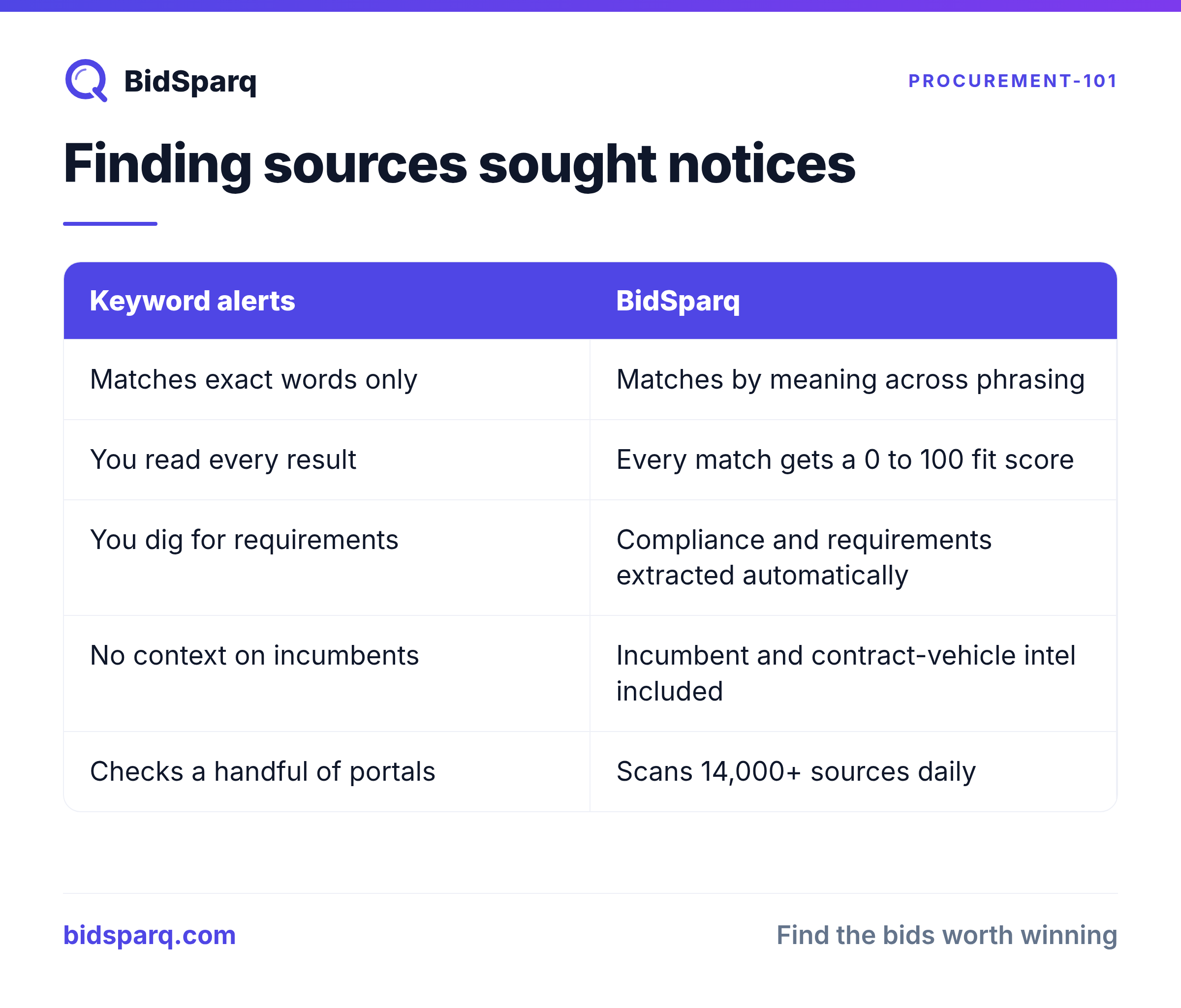
Stop refreshing individual portals and let the matches come to you. The hard part is not writing the response, it is seeing the notice while the window is still open. These notices are scattered across thousands of separate systems, each with its own search box and its own quirks, and keyword alerts miss most of them because buyers rarely phrase a need the way you would. This is where matching by meaning earns its keep. BidSparq reads across 23,000+ bid sources daily and surfaces a notice for "network modernization" even when you sell "IT infrastructure services," a connection keyword tools never make. Each match carries a 0 to 100 fit score, so you triage by relevance instead of reading everything, and requirement and compliance details are extracted automatically, so you know what a response demands before you open the document. Incumbent and contract-vehicle intelligence tells you who holds the current work and how it is bought, which is exactly the context a strong response should reflect. Compared with manual keyword sweeps, that is the difference between reacting to a published RFP and helping shape the one being written.
FAQ
what is a sources sought notice in simple terms?
It is a market research request a buyer posts before writing an RFP, asking capable providers to identify themselves. No bids are accepted and no contract is awarded from it. The buyer uses the responses to decide whether to compete the work openly, how to scope it, and whether enough qualified vendors exist.
is a sources sought notice the same as an RFP or RFI?
No. An RFP asks for priced proposals it intends to evaluate and award. A sources sought notice, like an RFI, gathers information only. Responding does not commit you to bid, and the buyer cannot purchase anything directly from your response, but it strongly shapes the solicitation that follows.
should you respond to a sources sought notice if you might not bid?
Usually yes. Responding costs little and signals that a competitive market exists, which can keep the work from being scoped around a single incumbent. It also puts your capabilities in front of the buyer early, while the requirements are still open to influence.
The providers who win consistently are the ones who see these notices first and respond while the requirements are still soft. BidSparq monitors 23,000+ bid sources so you never miss the early window. Start free and see your matched bid opportunities, no credit card needed.
Find RFPs that match your business
BidSparq monitors 23,000+ procurement sources and uses AI to score every opportunity against your capabilities. Try it free for 14 days.
Start Free Trial →