How to read a federal contractor like a Wall Street analyst: using three free data sources you're probably ignoring
Capture teams pay analysts six figures a year to piece together the same picture you can get from three public federal data sources in fifteen minutes. Here's how to read a contractor's SEC filings, an agency's Treasury budget pace, and a vendor's NIH research grants, and what each tells you about your competitive position.

The single most expensive lesson a federal contractor learns is that the bid you should have walked away from costs more than the bid you lost. Capture managers know this. The whole job is reading the room before you commit fifty thousand dollars of proposal time. And the data that lets you read the room is mostly free: published by the government itself, but almost nobody outside of analyst firms actually uses it.
Three sources are particularly underused. Every federal contractor should know what they are, what they reveal, and when to pull them. We'll walk through each one with a concrete example.
1. Public SEC filings: what an incumbent says when their lawyers are watching
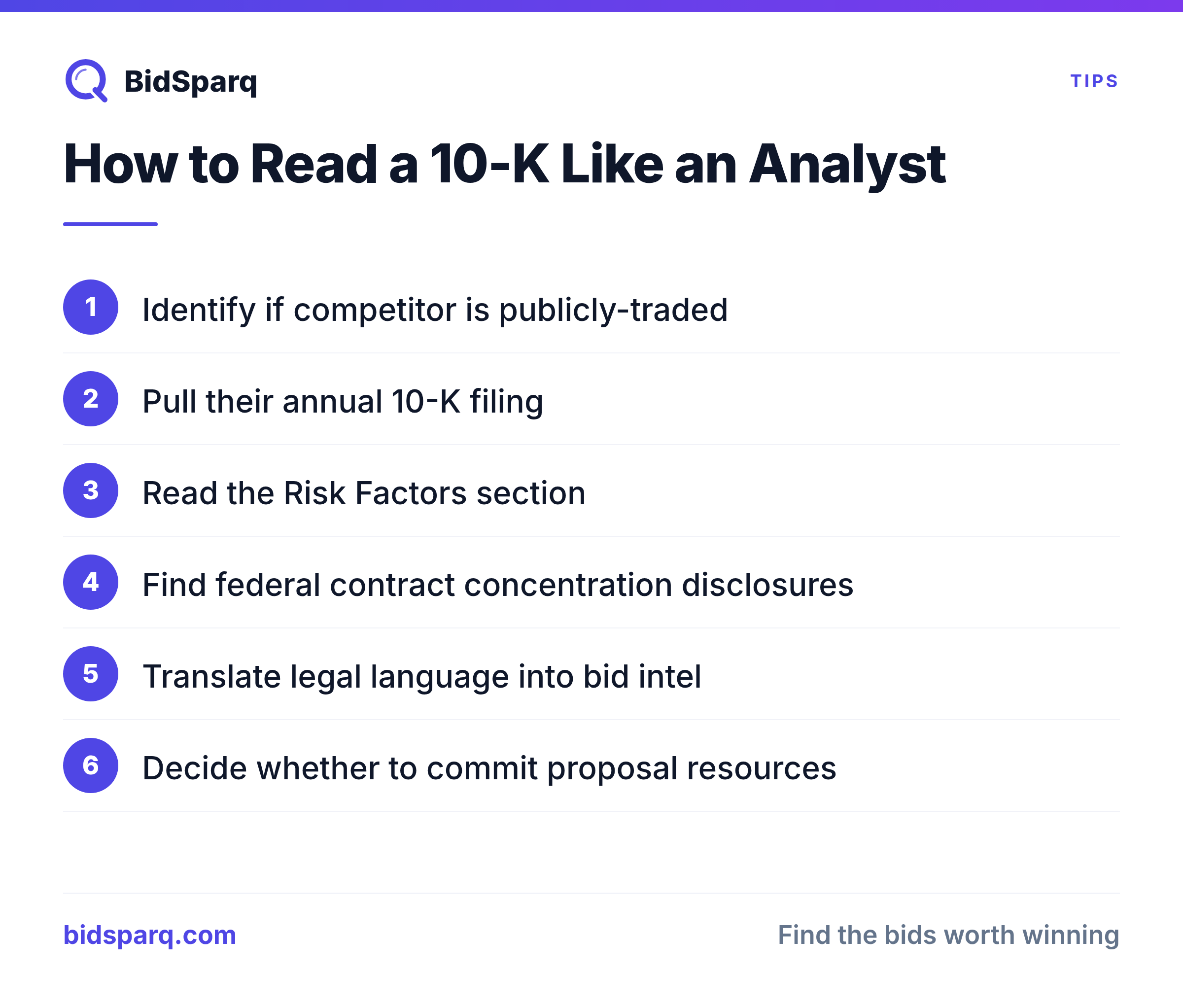
If your competition is a publicly-traded company, they have to tell the truth about their business every year. The annual 10-K filing is the single best document a capture manager can read on a competitor. It's audited, lawyer-reviewed, and includes a section called Risk Factors where the company is legally required to disclose anything that could materially affect their business.
What you find there is gold. Here's a paraphrased composite of language we've seen in real 10-Ks from large federal contractors:
"A substantial portion of our revenue is derived from a small number of large federal contracts. Loss of any one of these contracts, or a material reduction in funded work under them, could have a material adverse effect on our results of operations. Approximately 38% of our fiscal-year revenue was generated under three contract vehicles."
Translation: this incumbent's whole quarter depends on three contracts staying healthy. If you're competing for a recompete on one of those three, you now know they cannot afford to lose it. Their pricing will be aggressive. Their staffing will be defensive. Their proposal will be a re-statement of past performance with very few real innovations because the C-suite has flagged this as a must-win.
You also learn the unglamorous stuff:
- Segment performance. Federal contractors split their business into segments: Defense, Civilian, Health, etc. If their Civilian segment is shrinking three years in a row, they're under pressure to win in Defense. Useful when you're deciding whether to pursue a head-to-head bid.
- Backlog. Larger firms disclose contract backlog. A shrinking backlog means they have fewer guaranteed dollars ahead. Hungry teams take more risks on price.
- Named risks. "Our contract with [Agency] under [Vehicle] is subject to recompete in FY2027." That sentence is a free competitive-intelligence gift.
- Leadership changes. A new VP of Federal Programs always brings new emphasis areas in the first six months. Look at proxy statements and 8-K material-event filings.
How to pull this for a vendor: their SEC filings are public at sec.gov. You can search by company name, or use a tool that surfaces the latest 10-K with a single click from the vendor's profile. BidSparq does the latter: every vendor profile now leads with SEC EDGAR-sourced filings when the contractor is publicly traded.
For private contractors, you don't get this. That's a real limit. But the largest federal primes: Lockheed, Leidos, Booz Allen, SAIC, General Dynamics, Northrop, CACI, Maximus, ICF, are all public. If they're in your competitive set, read their 10-Ks before you decide to bid against them.
2. Treasury Monthly Treasury Statement: is the agency actually spending money right now?
Most procurement-intelligence platforms show you contracts already awarded. That's the past. What capture managers actually need to know is whether the agency in front of them has money to spend in the next ninety days. For that, you read the Monthly Treasury Statement.
The MTS is published by Treasury about three weeks after each month-end. It's the official record of what the federal government actually paid out, agency by agency, month by month. It includes a comparison to the same point in the prior fiscal year, which gives you the single most useful signal in federal procurement: is this agency outlaying ahead of, behind, or on pace with last year?
Three patterns show up in the data:
- Outlay velocity ahead of prior year. Agency is spending faster than last year. Two interpretations: either Congress gave them more (good, more procurement to come) or they're front-loading because of expected appropriations turbulence (also good, they're trying to obligate before something gets cut). Either way, you should be leaning into this agency.
- Outlay velocity behind prior year. Agency is spending slower. Could be a continuing-resolution delay, or it could be a budget cut. Either way, expect compressed procurement and more competition for fewer dollars. Adjust your win probability downward.
- Flat to prior year. Normal pacing. Use other signals.
Here's the practical version: if you see Veterans Affairs is up 14% in fiscal-year-to-date outlays versus the same point last year, and you have a VA recompete on your list, that's worth paying attention to. The capture call becomes "let's make sure we're staffed up: there's clearly money flowing." If the same agency is down 8%, your bid/no-bid math shifts.
You can pull the MTS data straight from Treasury, but it's segmented by accounting classification rather than by clean agency name, which makes manual lookup tedious. BidSparq now surfaces a budget-velocity panel on every federal agency profile that aggregates the right sub-rows automatically and tells you the YoY direction at a glance.
Don't confuse this with USAspending. USAspending shows obligations: money promised under signed contracts. Treasury shows outlays: money actually paid out. Both matter, but for "is the agency moving cash this quarter?" the MTS is what you want.
3. NIH research grants: the hidden capability signal on health and academic contractors
This one is narrower but, when it applies, very telling. If you're competing against a health-services contractor, a university spin-out, an academic medical center, or a biotech, the federal-procurement record only tells you half their story. The other half is research-grant funding, and it's almost entirely from the National Institutes of Health.
NIH funds about fifty billion dollars a year in research grants. Recipients include universities, hospitals, research institutes, and a growing list of biotech firms with federal-research arms. The full grant history of every recipient is public via NIH RePORTER, including project titles, principal investigators, dollar amounts, and which NIH institute funded it.
Why does this matter for capture?
- Real R&D capacity. A contractor with 200 active NIH grants is a serious research shop. A procurement-only competitor with no NIH history is almost certainly going to lose a technical evaluation against them on anything research-adjacent.
- Institute relationships. If a vendor has historic NIH-NCI (National Cancer Institute) funding and you're bidding on an NIH-NCI procurement, they have institutional relationships you don't.
- Capability signal cheap to verify. Anyone can write "research capability" into a capability statement. The NIH grant database lets you spot-check it in thirty seconds.
- Subcontracting opportunities. A research-heavy contractor working at the boundary of grants and contracts often has gaps: administrative work, technology integration, secure facilities, that they need to subcontract. NIH funding history tells you they probably have that need.
Most procurement-intelligence platforms don't surface this because they're built around contracts and ignore grants. We pull every vendor's NIH RePORTER history into their profile automatically. For non-research vendors the panel just doesn't render. For the ones it does: health primes, academic affiliates, biotech, it adds a dimension of competitive intelligence you can't get from contract data alone.
Putting it together: a practical workflow
Here's how a capture manager actually uses these three sources:
- Before you commit proposal hours: pull the incumbent's most recent 10-K. Read the Risk Factors section. Note any language about the specific contract or vehicle you're competing on. If it's mentioned as a material risk, the incumbent will fight hard: adjust your win probability accordingly.
- While scoping the opportunity: check the awarding agency's Treasury outlay direction. Ahead of prior year = budget is flowing, lean in. Behind = expect schedule slips and compressed timelines.
- While building your competitive map: if any competitor is health- or research-adjacent, pull their NIH grant history. It tells you whether their technical claims are real or marketing.
- Post-award, win or lose: re-read the winner's next quarterly 8-K filing. Material new contracts get disclosed. You'll see what your competition actually won and at what scope.
None of this requires a six-figure analyst subscription. All three sources are federal data, published by federal agencies, free to use. The lift in capture-decision quality is real.
Why most procurement tools miss this
Most procurement-intelligence platforms were built around a single dataset: usually FPDS or USAspending, and the product is essentially a search interface over that one source. Adding SEC EDGAR or Treasury or NIH means tying together very different data shapes, with very different update cadences, and very different ways of identifying the same company. It's harder than it sounds.
The harder thing, though, is the discipline of not making things up when the data doesn't match. SEC EDGAR doesn't cover private contractors. Treasury MTS classifies agencies in ways that don't line up cleanly with how anyone refers to them. NIH uses a different organization registry than SAM.gov. The wrong way to handle this is to invent matches and show users false data. The right way is to surface what we know, hide what we don't, and tell the user clearly which is which.
That's the design discipline behind every panel we ship. If a vendor isn't publicly traded, the SEC panel doesn't render. If an agency name doesn't resolve to a federal toptier, the Treasury panel doesn't render. If a contractor never received an NIH grant, the NIH panel doesn't render. You see clean data when we have it, and clean empty states when we don't.
How to use it on BidSparq
Three pages.
- Vendor directory: every public-company contractor's profile now leads with their SEC EDGAR filings. Every health/research/biotech contractor's profile leads with their NIH grant history. Both panels resolve automatically from the vendor's legal name.
- Agency profiles: every federal toptier agency profile now has a live Treasury budget-velocity panel showing fiscal-year-to-date outlays versus the same point last year, plus the direction.
- Or from the AI chat: ask "Show me Lockheed Martin's latest SEC filings", "Is the Department of Veterans Affairs outpacing last year on outlays?", "Does Battelle have NIH research history?" The chat pulls the right source for you.
Related reading
- Task-order velocity + per-SIN schedule pricing: the prior installment, also free federal data, also surfaced automatically
- How to spot a wired contract: six signals that the procurement is already locked
- How to forecast your government contracts pipeline: the math behind expected value, and why most pipelines lie
- All BidSparq features
Find RFPs that match your business
BidSparq monitors 23,000+ procurement sources and uses AI to score every opportunity against your capabilities. Try it free for 14 days.
Start Free Trial →