DOD Contracts: How to Find and Win Defense Department Opportunities
How to find DOD contracts, understand defense procurement, navigate DIBBS and DLA, and win opportunities with the Department of Defense.
The Department of Defense (DOD) is the largest buyer in the world. With an annual procurement budget exceeding $400 billion, DOD contracts span everything from aircraft carriers to IT services, janitorial supplies to cybersecurity consulting.
But navigating DOD procurement is notoriously complex. Between SAM.gov, DIBBS, DLA Internet Bid Board System, and dozens of service-specific portals, finding the right opportunities requires knowing where to look, and understanding DOD's unique procurement culture.
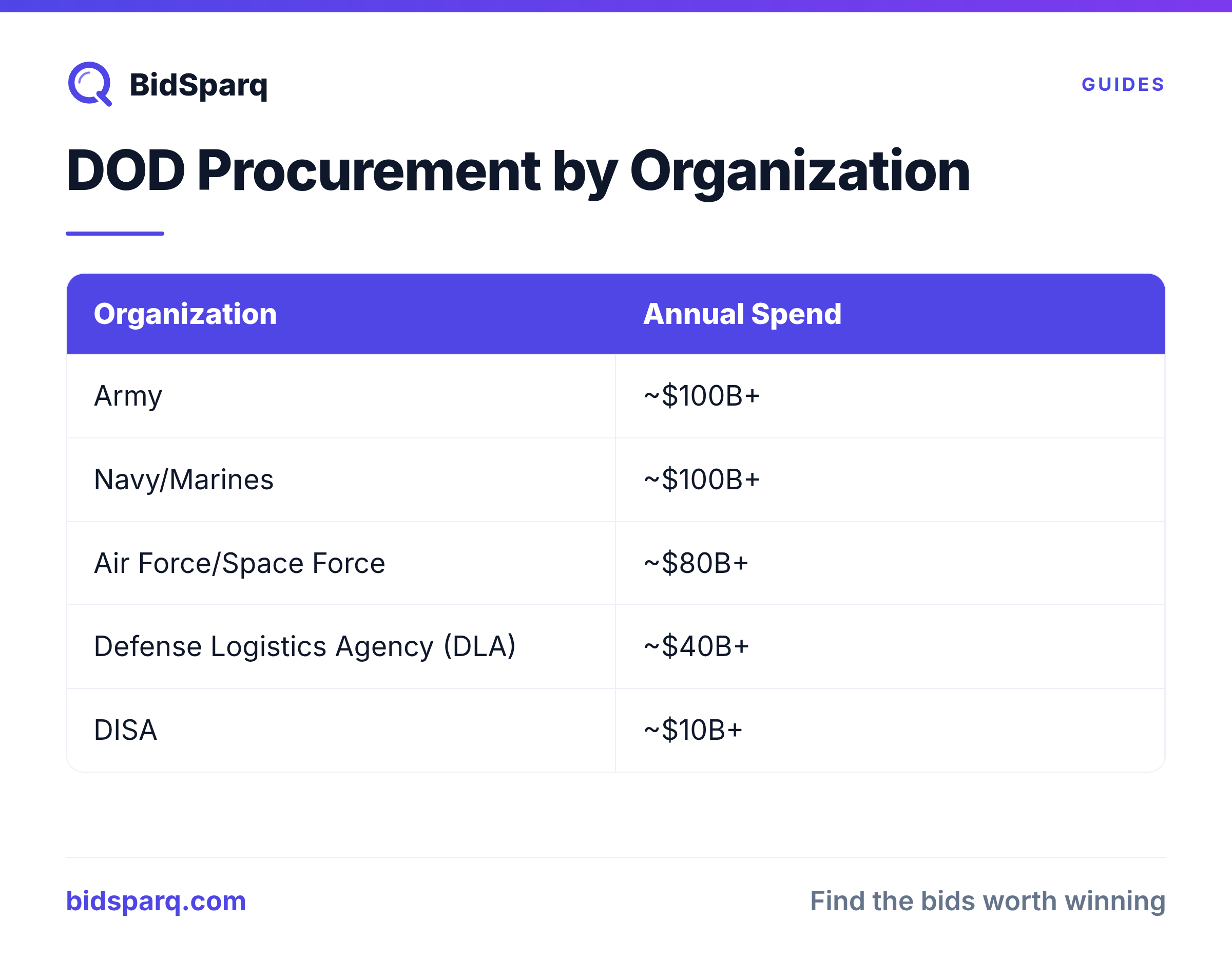
DOD Procurement Overview
DOD procurement is divided across military services and defense agencies, each with their own contracting offices:
| Organization | What They Buy | Annual Spend |
|---|---|---|
| Army | Vehicles, weapons, IT, facilities, services | ~$100B+ |
| Navy/Marines | Ships, aircraft, IT, facilities, supplies | ~$100B+ |
| Air Force/Space Force | Aircraft, space systems, IT, services | ~$80B+ |
| Defense Logistics Agency (DLA) | Supplies, fuel, food, clothing, medical | ~$40B+ |
| DISA | IT infrastructure, telecom, cybersecurity | ~$10B+ |
| MDA, DARPA, etc. | Research, advanced technology, innovation | Varies |
Where to Find DOD Contracts
SAM.gov
The primary portal for DOD solicitations over $25,000. All formal RFPs, RFQs, and sources sought notices are posted here. Use the SAM.gov search tips to filter by DOD agencies.
DLA Internet Bid Board System (DIBBS)
DLA posts supply solicitations on DIBBS. If you sell parts, supplies, or materials, this is essential. Thousands of RFQs are posted daily for everything from nuts and bolts to medical supplies.
Army Single Face to Industry (ASFI)
The Army's portal for sources sought, RFIs, and pre-solicitation notices. Often posts opportunities before they appear on SAM.gov.
Navy Electronic Commerce Online (NECO)
The Navy's solicitation portal for purchases under the simplified acquisition threshold.
Other Transaction Authority (OTA) Portals
DOD increasingly uses Other Transaction (OT) agreements to procure innovation outside traditional FAR-based contracting. These are posted on consortium websites like NSTXL, SOFWERX, and the Defense Innovation Unit (DIU).
DOD Contract Types
DOD uses the full spectrum of federal contract types, but some are more common in defense:
- Firm-Fixed-Price (FFP): Most common for supplies and well-defined services. You agree on a price upfront.
- Cost-Plus: Common for R&D and complex programs. Government reimburses costs plus a fee.
- Time and Materials (T&M): Used for services where scope is uncertain. You bill hourly rates plus materials.
- IDIQ (Indefinite Delivery, Indefinite Quantity): Framework contracts with task orders. The big DOD IDIQs (like OASIS, SEWP, Alliant) are gateways to billions in work.
- OTA (Other Transaction Authority): Non-FAR agreements for prototype development and production. Faster, more flexible, but different rules.
Getting Started with DOD Contracting
Step 1: Register in SAM.gov
Required for all federal contracts. You'll need a UEI (Unique Entity ID) and to complete the representations and certifications. Allow 2-4 weeks for initial registration.
Step 2: Get Your CAGE Code
The Commercial and Government Entity (CAGE code) is automatically assigned during SAM.gov registration. It's used throughout DOD for vendor identification.
Step 3: Determine Your NAICS Codes
Identify all NAICS codes that apply to your products or services. DOD uses these for set-aside determinations and vendor searches.
Step 4: Consider Security Clearances
Many DOD contracts require facility clearances (FCL) and personnel clearances. If your work involves classified information, you'll need sponsorship from a cleared contractor or a government agency.
Step 5: Identify Your Entry Point
Don't try to win a $500M IDIQ as your first DOD contract. Start with:
- Simplified acquisitions (under $250K): less competition, faster awards
- Set-aside contracts: if you have SBA certifications, DOD has strong small business goals
- Subcontracting: team with a prime contractor to gain past performance. See our subcontracting guide
- DLA supply contracts: if you manufacture or distribute products, DLA is the easiest entry point
DOD Small Business Programs
DOD has aggressive small business goals. The department aims to award at least 23% of prime contract dollars to small businesses. Key programs:
- Small Business Set-Asides: Contracts reserved for small businesses under the applicable NAICS code
- SDVOSB: Service-Disabled Veteran-Owned, heavily emphasized in DOD
- AbilityOne: Mandatory source for certain products/services employing people with disabilities
- SBIR/STTR: Small Business Innovation Research grants for R&D ($1-2M per award, no repayment)
- Mentor-Protege Program: DOD pairs small businesses with large primes for developmental assistance
Strategies for Winning DOD Contracts
- Research incumbents using FPDS. Before bidding, know who currently holds the contract, what they're charging, and whether the contract is being recompeted.
- Attend industry days. DOD regularly holds industry days and pre-solicitation conferences. These are the best way to meet contracting officers and understand requirements.
- Build past performance incrementally. Start small, deliver well, document results. DOD evaluators weight past performance heavily.
- Get on the right vehicles. Many DOD task orders go through existing IDIQs (OASIS, SEWP, CIO-SP3). If you're not on these vehicles, you're not competing for a huge portion of DOD IT spend.
- Understand the color team review process. DOD proposals typically go through Pink Team, Red Team, and Gold Team reviews. Structure your proposal to survive this scrutiny.
- Invest in compliance. DOD increasingly requires CMMC (Cybersecurity Maturity Model Certification), NIST 800-171 compliance, and other security standards. Start compliance early.
Frequently Asked Questions
Do I need a security clearance to get DOD contracts?
Not always. Many DOD contracts for commercial items, supplies, and unclassified services don't require clearances. However, IT, consulting, and professional services contracts increasingly require at least a facility clearance.
How long does it take to get a DOD contract?
From RFP release to award, DOD contracts typically take 3-12 months. Simplified acquisitions (under $250K) can move faster at 30-90 days. Major IDIQ vehicles can take 18+ months from solicitation to award.
Can a small business compete for DOD contracts?
Absolutely. DOD awards over $80 billion annually to small businesses through set-asides, SBIR/STTR, and competitive awards. Small businesses often win by specializing in niche capabilities and teaming with larger primes.
Next Steps
- Start your free trial: BidSparq monitors DOD solicitations across SAM.gov, DLA, and service-specific portals
- Learn about FPDS for DOD competitive intelligence
- Read our contract types guide to understand FFP, IDIQ, and OTA
- Explore subcontracting opportunities as a DOD market entry strategy
- Browse active DOD RFPs on BidSparq
- See open IT services RFPs and construction RFPs on BidSparq
Find RFPs that match your business
BidSparq monitors 23,000+ procurement sources and uses AI to score every opportunity against your capabilities. Try it free for 14 days.
Start Free Trial →