DLA Contracts: How to Sell to the Defense Logistics Agency
How to find and win DLA contracts through DIBBS, FedMall, and SAM.gov. Covers supply chain opportunities, pricing, and strategies for new vendors.
The Defense Logistics Agency (DLA) is the DOD's supply chain manager, procuring and distributing over $40 billion in goods annually. If you manufacture, distribute, or supply physical products: from fuel and food to clothing, medical supplies, and industrial parts, DLA is one of the most accessible entry points into defense contracting.
Unlike many DOD contracts that require extensive proposals and security clearances, DLA procurement is heavily automated and often based on lowest price technically acceptable (LPTA): meaning if you can meet the spec and offer a competitive price, you can win.
What DLA Buys
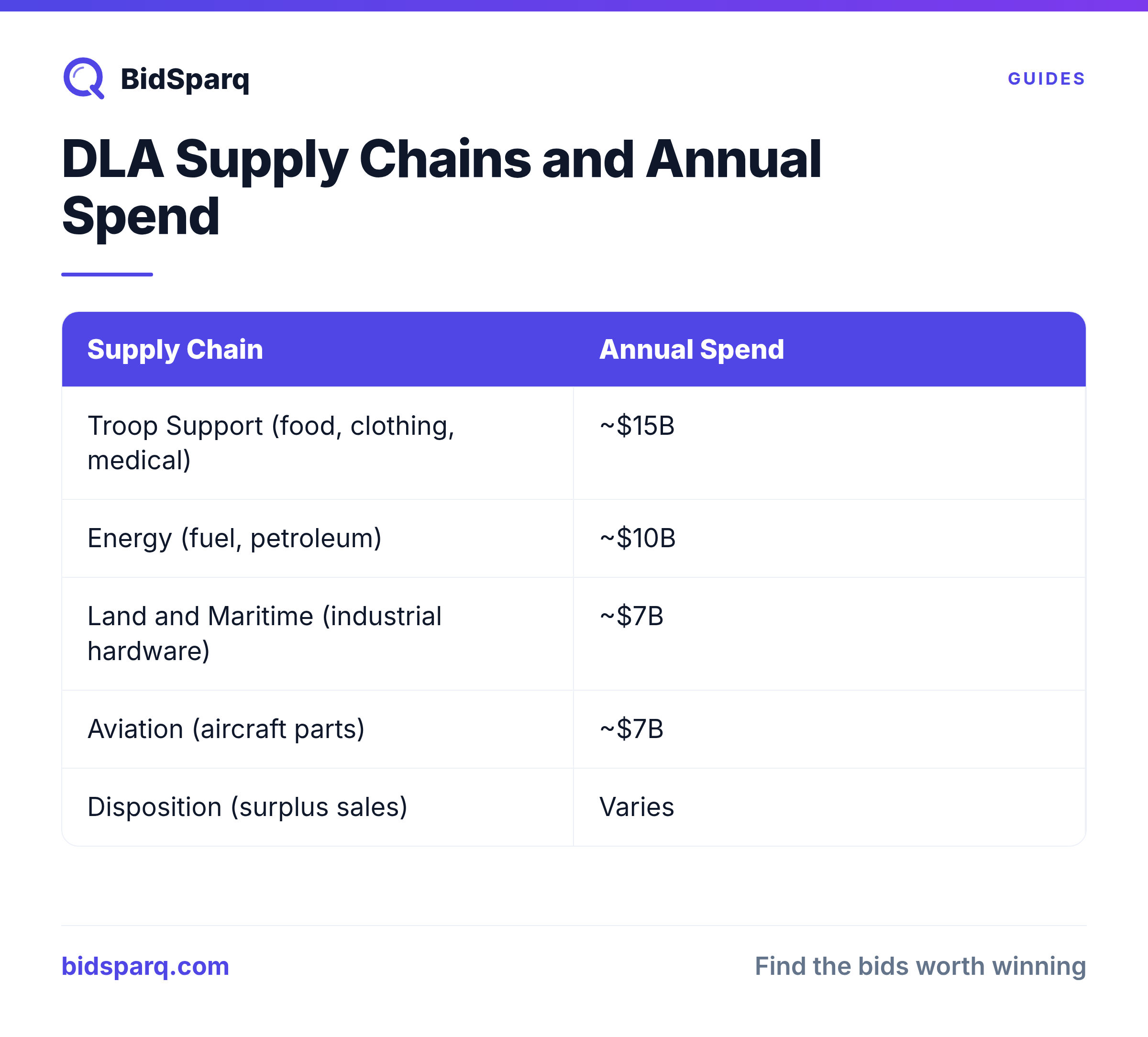
DLA operates through several major supply chains:
| Supply Chain | What It Covers | Annual Spend |
|---|---|---|
| DLA Troop Support | Food, clothing, textiles, medical, construction | ~$15B |
| DLA Land and Maritime | Industrial hardware, electronics, bearings, valves | ~$7B |
| DLA Aviation | Aircraft parts, repair components | ~$7B |
| DLA Energy | Fuel, petroleum products | ~$10B |
| DLA Disposition | Surplus property sales and disposal | Varies |
Where to Find DLA Contracts
DIBBS (DLA Internet Bid Board System)
The primary portal for DLA solicitations. DIBBS posts thousands of RFQs daily, primarily for supply items. Available at dibbs.bsm.dla.mil.
- Search by NSN (National Stock Number), keyword, or commodity
- Most solicitations are automated and use reverse auctions or sealed bidding
- Awards can happen within days: much faster than typical DOD procurement
SAM.gov
Larger DLA contracts and service solicitations are posted on SAM.gov. Filter by "Defense Logistics Agency" under agency.
FedMall
DLA's online marketplace where government buyers purchase commercial products. If you're approved as a FedMall vendor, buyers can purchase directly from your catalog.
DLA Pricing and Competition
DLA procurement is price-driven. Most supply contracts use:
- LPTA (Lowest Price Technically Acceptable): meet the technical requirement, lowest price wins
- Reverse auctions: online bidding where vendors compete by lowering their price in real-time
- Long-term contracts: multi-year supply agreements with fixed pricing or economic price adjustments
Margins are often thin, but volume is high. A $0.50 profit per unit on a 1 million-unit order is real money.
Getting Started
- Register in SAM.gov: Required for all DLA contracts
- Get a CAGE code: Assigned automatically during SAM.gov registration
- Register on DIBBS: Create an account to view and bid on solicitations
- Identify your NSNs: DLA organizes everything by National Stock Number. Find the NSNs that match your products.
- Start with small RFQs: Bid on a few small solicitations to learn the process and build past performance
Winning Strategies
- Monitor DIBBS daily. New RFQs are posted constantly. Set up automated searches by NSN or commodity to get notifications.
- Compete on price. DLA awards are primarily price-based. Know your costs and bid competitively. Thin margins are normal.
- Deliver on time. DLA tracks vendor delivery performance rigorously. Late deliveries result in poor ratings that disqualify you from future bids.
- Consider long-term contracts. If you can supply consistently, pursue multi-year agreements for predictable revenue.
- Leverage small business programs. DLA has strong small business goals and regularly sets aside contracts for small, SDVOSB, and HUBZone firms.
Frequently Asked Questions
Do I need a security clearance for DLA contracts?
Rarely. Most DLA supply contracts are for unclassified commercial items. Some DLA IT or consulting contracts may require clearances, but the vast majority of supply work does not.
How fast are DLA awards?
Very fast compared to other DOD agencies. Simple RFQs on DIBBS can be awarded within days. Reverse auctions happen in real-time. Larger contracts on SAM.gov follow normal timelines (30-90 days).
What's the minimum order size?
DLA posts solicitations of all sizes, from a few hundred dollars to millions. Small businesses can start with micro-purchases and work up.
Next Steps
- Start your free trial: BidSparq monitors DLA solicitations alongside 23,000+ other sources
- Read our DOD contracts guide for the broader defense procurement landscape
- Learn about NAICS codes for your supply products
- Browse active supply RFPs across all agencies
- See open food and nutrition RFPs: a core DLA Troop Support category
Find RFPs that match your business
BidSparq monitors 23,000+ procurement sources and uses AI to score every opportunity against your capabilities. Try it free for 14 days.
Start Free Trial →