Active Marketing RFPs US Metros: Win More Contracts
Active marketing RFPs from US metros are posted year-round across hundreds of sources, and most marketing agencies miss the majority of them. This guide explains where metro marketing contracts actually live, how to identify the ones worth pursuing, and how to build a pipeline that captures them before deadlines close.
- Metro agencies post marketing RFPs year-round: communications planning, public outreach, creative services, and digital campaigns surface as separate solicitations on rotating timelines, giving firms a continuous pipeline to work.
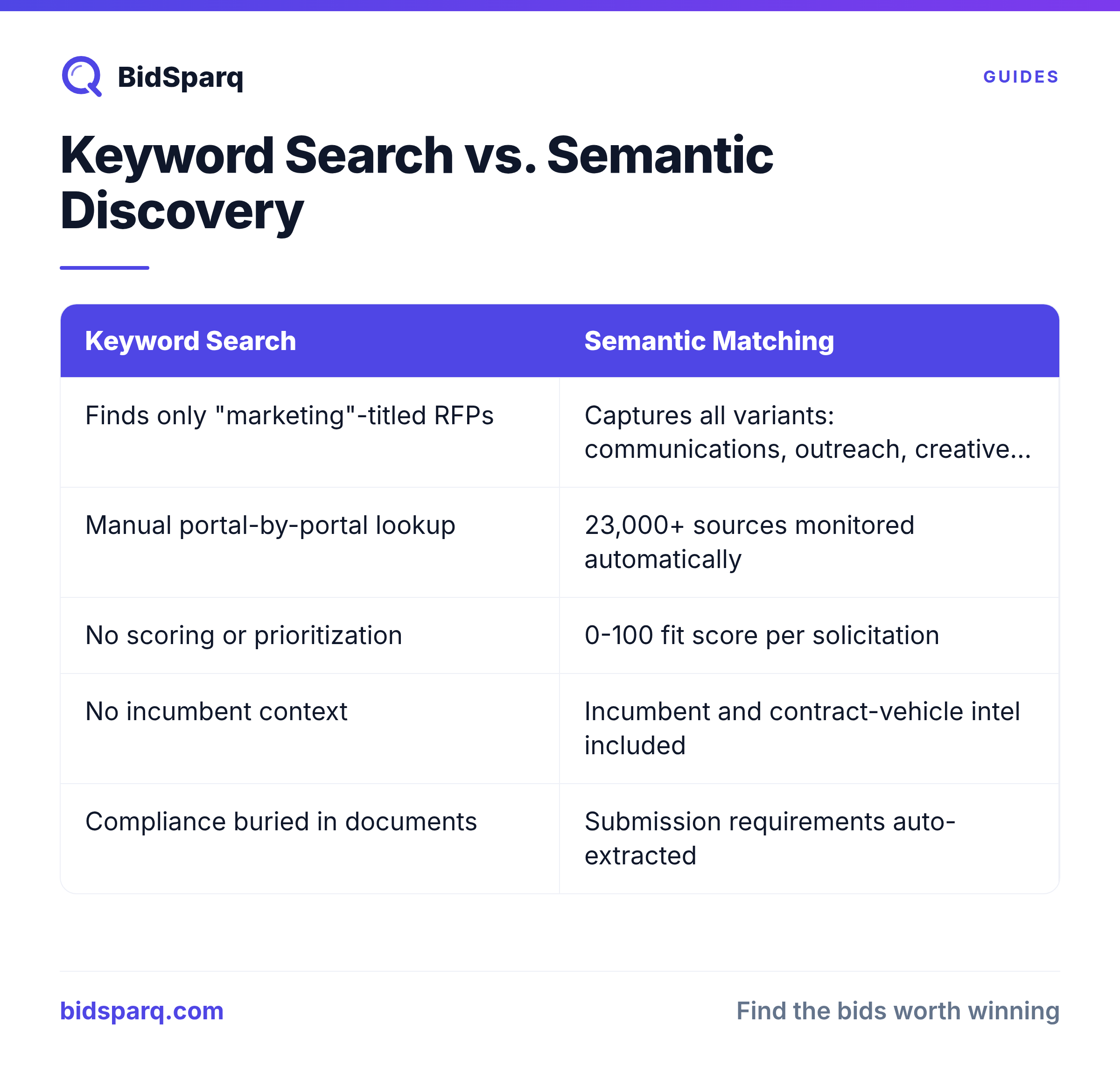
- Keyword search misses the majority of relevant bids because metro agencies title marketing work as "strategic communications," "public information services," or "community engagement," not "marketing."
- Deadline pressure is immediate: as of August 2026, 1,128 "active" solicitations close within the next 14 days, making real-time discovery a prerequisite for competitive response rates.
- Incumbent intelligence tells you whether a pursuit is worth entering before your team writes a single word, saving proposal capacity for contracts with genuine competitive openings.
- Fit scoring and automatic compliance extraction let pursuit teams triage dozens of live solicitations without reading every document in full.
The short answer
Active marketing RFPs from US metros are distributed across hundreds of municipal procurement portals, state eProcurement systems, and public notice platforms simultaneously, and no single source captures all of them. As of August 2026, BidSparq tracks 62,715 open solicitations across 23,000+ sources, with 4,129 new "active" solicitations posted in the last 30 days alone. Firms consistently winning metro marketing contracts treat bid discovery as a continuous, automated process rather than a periodic keyword search. Semantic matching, automated fit scoring, and real-time alerts close the gap between the full universe of available contracts and what any team could realistically find by hand.
Where active marketing RFPs actually live
Start with the portals that metro governments are legally required to use, because those carry the contracts most competitors overlook in favor of obvious, high-traffic channels. At the federal and territorial level, SAM.gov lists communications and outreach requirements from federal civilian agencies. State eProcurement systems such as Texas's Electronic State Business Daily (ESBD) and Arizona's ProcureAZ aggregate bids from state agencies and many of their municipalities. For city and county contracts specifically, individual municipal procurement pages and regional cooperative purchasing networks like OMNIA Partners and Sourcewell each carry solicitations that rarely overlap with the others. Board meeting agendas published through platforms like BoardDocs or Legistar often surface approved marketing contracts weeks before the formal RFP drops, giving prepared firms time to build a strategy rather than scramble to meet a deadline.
Why metro marketing spend is a sustainable market
Public-sector marketing budgets are not discretionary the way a startup's ad spend is: metro agencies have mandated communication requirements that renew on predictable cycles regardless of economic conditions. A public transit authority needs rider-experience and safety campaigns. A city public health department runs ongoing awareness initiatives tied to grant requirements. A municipal economic development office markets to businesses and talent year-round. These are recurring needs, and the contracts that fund them reappear reliably, often as multi-year awards with renewal options that provide predictable revenue. Beyond the metro government market, healthcare systems and public universities issue similar communications and marketing RFPs on comparable cycles, giving firms that build public-sector sourcing into their pipeline access to a much larger total addressable market.
The scale problem: why keyword search falls short
The core obstacle is not that metro marketing RFPs are rare; it is that finding the right ones before the deadline requires monitoring more sources than any team can realistically check by hand. With 62,715 open solicitations across 23,000+ sources as of August 2026, a firm relying on keyword searches across a handful of portals will miss RFPs filed under titles like "strategic communications" or "community engagement," which describe marketing work in everything but name. Each missed title is missed revenue, and the firms closing the most metro contracts have solved the discovery layer first.
Explore your matched metro marketing RFPs free, no credit card required.
Evaluating fit before you commit proposal time
Once you have a live list of relevant solicitations, the next constraint is triage: reading full RFP documents to assess fit is time-consuming, and teams doing it manually will always move slower than those using automated scoring. BidSparq's 0-to-100 fit scoring ranks each solicitation against a firm's actual capabilities and past work, surfacing the pursuits most worth attention without requiring anyone to open every document. Automatic compliance extraction pulls submission requirements directly from the RFP so proposal teams know the key submission constraints before writing begins. Incumbent and contract-vehicle intelligence adds one more filter: if an agency has a long-standing vendor, teams can decide early whether to invest in a competitive displacement strategy or redirect that proposal capacity to an open field.
Building a repeatable metro marketing pipeline
The difference between firms that win metro contracts occasionally and those that win them consistently is pipeline discipline: treating bid pursuit as a systematic process with defined stages rather than a reactive scramble when a deadline appears. That means setting up persistent searches that cover the full semantic range of marketing work, not just the literal word "marketing." It means tracking contract vehicles and cooperative agreements that could give a firm pre-approved vendor status across multiple metros at once. And it means watching renewal calendars so that when a multi-year award is set to expire, a firm is positioned to respond from the first day the RFP posts rather than learning about it the week it closes. With 1,128 "active" solicitations closing within the next 14 days as of August 2026, pipeline discipline is the only reliable way to avoid leaving winnable contracts on the table.
FAQ
Where can I find active marketing RFPs for US cities and metros?
Active marketing RFPs from US metros appear across municipal procurement portals, state eProcurement systems like Texas's ESBD and Arizona's ProcureAZ, cooperative purchasing networks like OMNIA Partners and Sourcewell, and state-required public notice boards. SAM.gov covers federal and territorial agency marketing and communications requirements. Because no single portal aggregates all sources, platforms that monitor 23,000+ sources simultaneously surface opportunities that manual multi-portal searches consistently miss.
How many active marketing RFPs are open right now in the US?
As of August 2026, 4,129 new "active" solicitations were posted in the last 30 days across 23,000+ sources, with 62,715 total open solicitations tracked at that time. Of those, 1,128 were closing within the next 14 days, meaning deadline pressure is a constant reality for teams without automated discovery in place.
What types of marketing work do metro governments typically put out to bid?
Metro agencies issue RFPs for a wide range of marketing-adjacent work: strategic communications planning, public information services, creative and design services, community outreach campaigns, social media management, digital advertising, brand development, and public awareness initiatives. Titles vary significantly by agency and jurisdiction, which is why semantic search rather than keyword matching is essential for capturing the full universe of relevant solicitations.
See which active metro marketing RFPs match your firm, free, no credit card needed.
Find RFPs that match your business
BidSparq monitors 23,000+ procurement sources and uses AI to score every opportunity against your capabilities. Try it free for 14 days.
Start Free Trial →