NTE Stands for Not to Exceed: What Bidders Must Know
NTE stands for Not to Exceed, the price ceiling that governs billing in time-and-materials, IDIQ, and service contracts across construction, IT, healthcare, and education. Learn what the clause means, how to find it, and how to win bids compliantly.

- NTE is a hard price ceiling, not a budget estimate: billing above it requires a formal modification approved before work exceeds the limit.
- The clause crosses every market: construction, managed IT, healthcare staffing, education services, and commercial facility contracts all use NTE language, not only government solicitations.
- Task orders under umbrella contracts often carry their own NTE amounts, separate from and smaller than the master contract ceiling.
- Compliance gaps form in attachments, not summaries: NTE language typically lives in the Statement of Work or incorporated exhibits, where teams skimming the top sheet never find it.
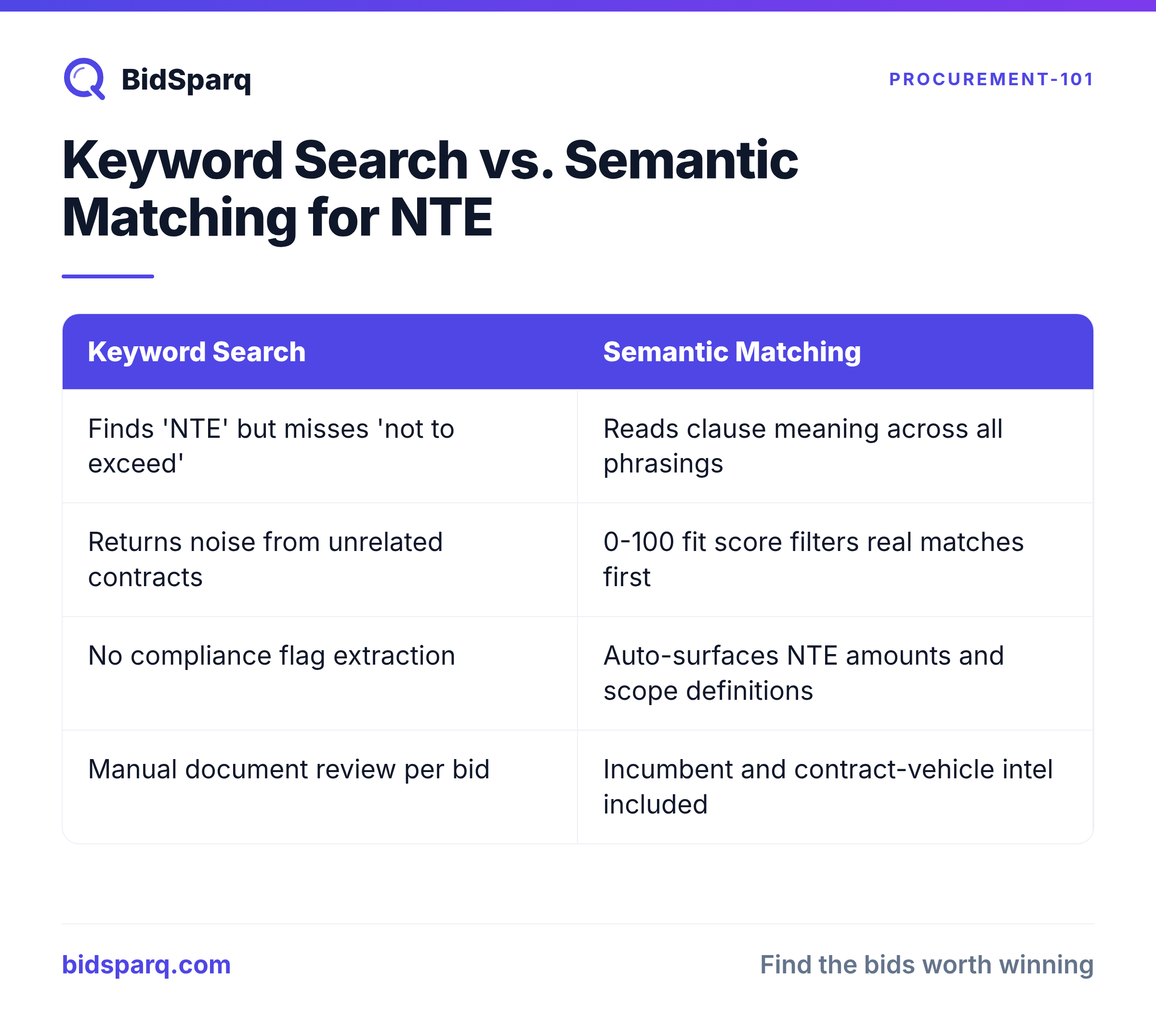
- Automated requirement extraction surfaces NTE thresholds, scope definitions, and modification clauses in seconds, while keyword search leaves teams reading every attachment manually.
- Semantic matching finds NTE language in whatever form it appears, whether the solicitation uses the abbreviation, "not to exceed," "budget ceiling," or any equivalent phrase.
The short answer
NTE stands for Not to Exceed, the contractual price ceiling that defines the maximum amount a buyer is obligated to pay on a contract or task order. Vendors may invoice any amount up to the NTE, but exceeding it without a pre-approved written modification is both a compliance failure and a financial loss the vendor absorbs entirely. The clause appears in time-and-materials contracts, indefinite-delivery vehicles, construction scopes, healthcare staffing agreements, and managed-services engagements across every sector of the procurement market. Knowing how to locate, interpret, and price against an NTE is foundational to winning bids compliantly and protecting your margin on delivery.
What NTE means in practice
An NTE clause shifts cost-overrun risk entirely to the vendor, making it one of the most consequential pricing constraints in any solicitation. Unlike a cost-plus arrangement, where the buyer shares in overruns, or a firm-fixed-price contract, where the price is exact regardless of actual costs, NTE sets a ceiling with no floor: delivering under budget is acceptable, and the buyer pays only what you invoice. Delivering over budget without prior written authorization means every dollar above the ceiling is yours to absorb.
A concrete example shows how quickly the math turns. On a time-and-materials engagement with a $50,000 NTE ceiling, your team has billed $46,000 and has two weeks of work remaining. That leaves $4,000 of authorized spend. If completing the scope costs $6,000, the vendor absorbs the $2,000 overrun in full: that amount will not appear on any payable invoice, and requesting a modification after the fact puts the decision entirely in the buyer's hands. Teams that track this math in real time finish the engagement whole; teams that discover the gap at final billing do not.
The clause often coexists with a not-to-exceed period of performance, a not-to-exceed labor rate, or both, each ceiling applying independently to its own cost category. Procurement officers across construction, IT, healthcare, and education favor NTE language because it gives buyers budget certainty while preserving flexibility on scope, particularly in engagements where the full volume of work cannot be estimated precisely at award time.
Where NTE language appears across markets
Construction and facility management contracts surface NTE clauses in nearly every multi-trade scope, and understanding them is fundamental to project profitability. A general contractor bidding a hospital mechanical upgrade, a corporate campus maintenance agreement, or a school system renovation will encounter individual task orders carrying their own NTE amounts, frequently well below the master contract ceiling. In managed IT, statements of work for time-and-materials helpdesk, network support, and software integration routinely specify a not-to-exceed total governing the full engagement period. Healthcare staffing agencies encounter NTE in per-diem and travel-nurse agreements where the facility sets a rate ceiling and the agency prices within it. Education buyers, from regional library systems to large community college districts, issue RFPs for consulting, curriculum development, and professional development with phase-level NTE amounts governing each deliverable independently. The clause is not a government-specific construct: it is standard contract hygiene across the procurement landscape, and vendors operating in any of these markets will encounter it regularly.
Where NTE compliance breaks down
Compliance failures almost never come from ignoring a clause the team found; they come from never finding it in the first place. The solicitation summary and the pricing schedule are where most reviews begin and end. NTE language, by contrast, lives deeper: typically in the Statement of Work or in incorporated exhibits attached as separate documents. Teams skimming the cover sheet miss it entirely, and by the time delivery is underway, the constraint is no longer a pre-award question.
Multi-year contracts add a structural layer of risk. A managed-services engagement may carry both a per-year ceiling and a cumulative ceiling, two different figures governing the same contract at different intervals. Treating them as interchangeable is the most common source of an unintentional overrun on a contract that appeared otherwise compliant.
How coverage is defined matters just as much as where the ceiling sits. Some NTE clauses cap labor costs only; others are all-inclusive, covering materials, travel, and other direct costs. When a solicitation is silent on coverage scope, the question-and-answer period before proposals are due is the correct moment to raise it. Accepting an NTE clause without resolving that ambiguity, then requesting a modification after award, puts the vendor entirely at the buyer's discretion. Volume accelerates every one of these risks: tracking ceiling types, coverage definitions, and modification status manually across dozens of active pursuits is where compliance most often degrades, because NTE language buried in attached documents has no visible cost until delivery.
When NTE language is buried in attachments your team never opens, the first sign of a problem is often an overrun at final billing. Search solicitations free and let automated extraction surface the ceiling before you sign, no credit card needed.
Finding NTE opportunities at scale
The practical challenge is not understanding an NTE clause once you have found it: it is identifying and filtering the right opportunities before competitors do. As of September 2026, BidSparq tracks 55,830 open solicitations across 23,000+ sources updated daily. Within that pool, 171 new solicitations were posted in the last 30 days and 48 are closing within the next 14 days, a pace that makes manual source monitoring impractical for any team chasing more than a handful of pursuits. Keyword search compounds the problem: a search for "NTE" returns contracts where those letters mean something unrelated, while a search for "not to exceed" misses solicitations that use "budget ceiling" or "maximum authorized amount." Semantic matching reads clause meaning rather than character strings, so a procurement team looking for time-and-materials engagements with ceiling pricing sees relevant results regardless of the phrasing the buyer used. A 0-to-100 fit score then surfaces the strongest matches first, and incumbent and contract-vehicle intelligence adds context on whether a ceiling reflects a legacy rate or a fresh competitive baseline.
Start free and let semantic matching find NTE solicitations across 23,000+ sources before your window closes, no credit card needed.
FAQ
What is the difference between NTE and a firm-fixed-price contract?
A firm-fixed-price contract sets an exact price that does not change regardless of the vendor's actual costs: you invoice the agreed amount whether delivery cost more or less. An NTE contract sets a ceiling: you may invoice any amount up to the limit but cannot exceed it without prior written authorization. The key practical difference is that NTE allows billing flexibility below the ceiling and places full overrun risk on the vendor above it.
Can you negotiate an NTE before contract award?
The question-and-answer period before proposals are due is the standard venue for raising concerns about a stated NTE. If the ceiling appears below what the scope requires, submitting a written clarifying question or requesting a scope amendment are the correct paths. Some solicitations also allow bidders to include pricing rationale in their technical approach that addresses a ceiling constraint directly. Accepting an NTE and then requesting a modification after award is possible but requires the buyer's agreement and is never guaranteed, so addressing it before submission is always preferable.
How do I find solicitations with NTE clauses in my industry?
Start with the public sources in your market: SAM.gov for federal opportunities, your state's official eProcurement portal for state and local work, board agenda platforms such as BoardDocs for education buyers, and industry-specific procurement portals for construction and healthcare. Semantic search tools that read clause meaning rather than matching character strings will surface NTE language in whatever form it appears across these sources more reliably than keyword search alone, and fit scoring helps prioritize the opportunities worth your proposal resources.
Find RFPs that match your business
BidSparq monitors 23,000+ procurement sources and uses AI to score every opportunity against your capabilities. Try it free for 14 days.
Start Free Trial →