What Is the Purpose of an RFP? A Clear, Direct Answer
What is the purpose of an RFP? A clear answer for buyers and sellers, including the search and scoring steps most procurement guides quietly skip.

What is an RFP? A Request for Proposal is a formal document a buyer sends to potential vendors that describes a need, requests structured responses, and defines the criteria those responses will be judged against. Its purpose is to turn a fuzzy buying decision into a comparable, defensible one.
Picture the procurement lead three weeks into a selection. A dozen browser tabs are open, four vendor proposals sit side by side, two spreadsheets are trying to make pricing comparable, and an internal email thread keeps asking when the decision will finally land. The RFP that started the process was supposed to make this part easier, and on the first attempt it rarely does. If that scene feels familiar, the problem is usually not the writing. It is everything that happens before and after the document goes out.
The honest answer to why RFPs exist is more useful than the textbook one, because it shows where the process actually creates value and where it quietly wastes your time.
Key takeaways
- An RFP turns a vague buying impulse into a comparable, defensible decision.
- Buyers run RFPs to force the internal alignment they did not have on day one.
- Sellers use RFPs as a qualification signal to screen out bad-fit work before writing a response.
- The scoring rubric matters more than format, cover letter, or page count.
- Most RFP pain lives in the search and shortlist phase, not the writing phase.
- Semantic fit scoring collapses a multi-week sourcing sprint into a focused review session.
The Purpose of an RFP, in One Sentence
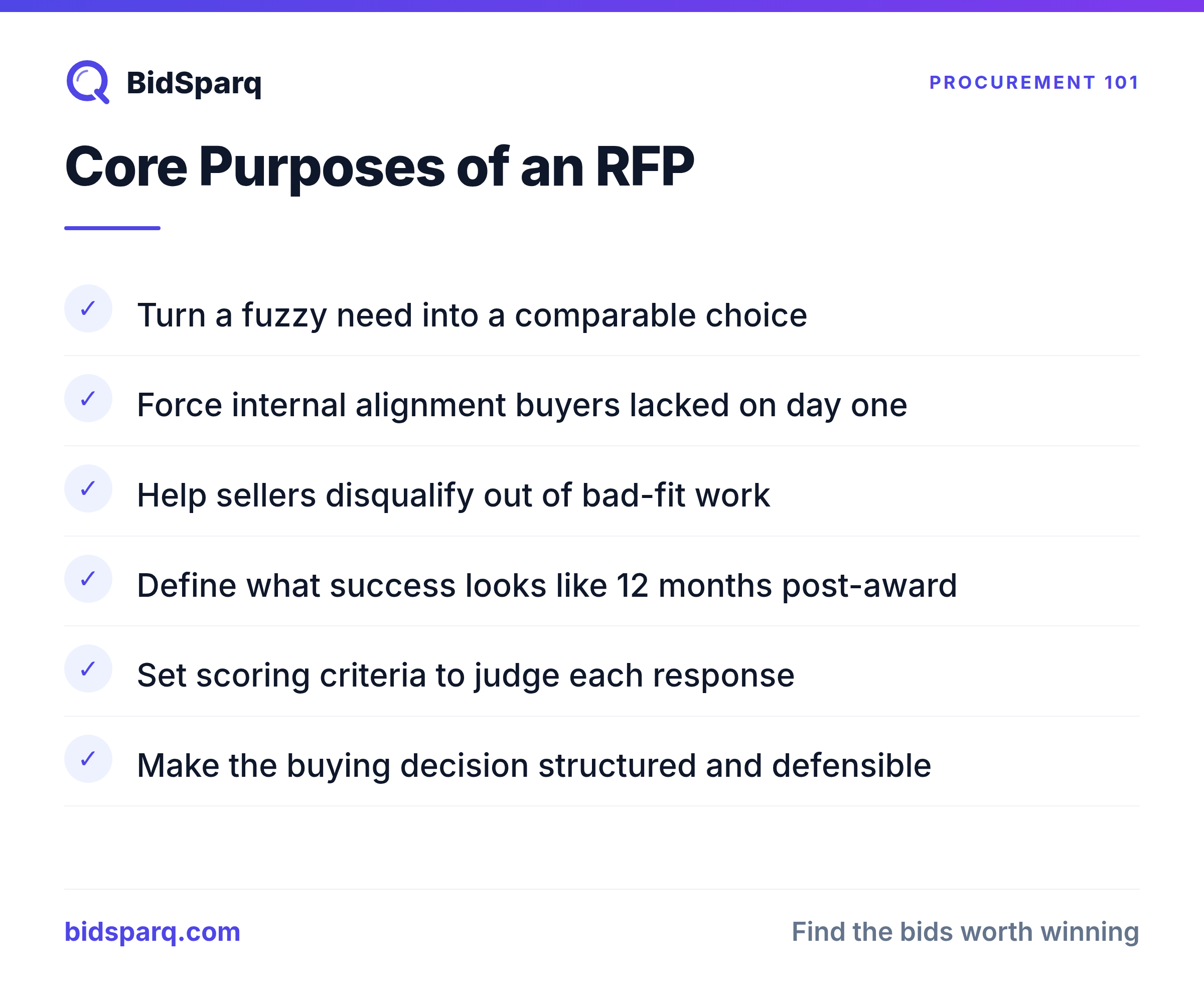
An RFP exists to turn a fuzzy need into a structured, comparable choice. Request for Proposal is the formal name, but the real function is closer to a forcing function. It makes the buyer write down what they actually want, what success will look like twelve months after award, and the criteria they will use to judge each response. Without that scaffolding, vendor selection drifts toward whoever was most persuasive in the hallway. With it, the buyer gets a choice they can defend to a board, an auditor, or a CFO who was never in the room when the conversations happened.
Why Buyers Use RFPs, and Why Some Only Pretend To
Buyers use RFPs to manufacture the clarity they lacked on day one. A construction firm sourcing an ERP, a private university choosing a dining services partner, a regional health system replacing its revenue cycle vendor, a city agency buying road maintenance: all of them face the same fog. Stakeholders disagree on requirements. Budgets are guesses dressed up as numbers. The market holds thirty plausible vendors and ten of them sound identical on their websites. Writing the RFP forces that fog onto paper so the comparison phase is honest. The RFPs that go badly are the ones where someone already picked the winner and the document is theater, and experienced procurement teams can usually tell within two pages.
What Sellers Get Out of It, Beyond the Win
Sellers should treat every RFP as a free qualification signal, not a homework assignment. A well-written solicitation reveals the budget range, the political tensions inside the buyer's organization, who the incumbent is, and what the buyer is genuinely nervous about. That intelligence outlasts the single deal, because it sharpens the next ten pitches into the same vertical. The common failure is the reverse: chasing every RFP that trips a keyword alert, then spending the best proposal writers on opportunities that were wired for a competitor before the document was ever posted.
Where the Process Quietly Breaks Down
Most RFP failures happen long before anyone writes a response, at the search step. A facilities director searches a bid board for "HVAC retrofit" and misses the school district that filed the same project as "mechanical systems modernization." A SaaS team watches a feed for "case management" and misses the health system that called it "care coordination workflow." Keyword alerts match strings, not meaning, so the best-fit opportunity is often the one phrased in someone else's vocabulary. This is the gap automated semantic matching closes. BidSparq reads opportunities by meaning rather than keyword across 23,000+ distinct bid sources, then assigns each one a 0 to 100 fit score against your business, so a sales lead can review the top twenty in thirty minutes instead of grinding through four hundred listings by hand. That is the automated version of work capture teams have done manually for two decades.
Want to see your own fit-scored shortlist? Run a free match against your real ICP and see which live opportunities your keyword alerts have been hiding: start a free match run.
How to Make an RFP Actually Worth the Effort
Write the scoring rubric before you write a single question. If you cannot say how you will weight price, fit, risk, and references, you are not ready to send an RFP. On the response side, the same discipline applies in reverse. Pull every "must" and "shall" out of the solicitation first and map your evidence against each one in a compliance matrix. Automated tools now handle that extraction, because reading an eighty-page document to find the seventeen hard requirements is the worst possible use of a proposal manager's afternoon. One input almost nobody weighs early enough is who held the contract last time and which contract vehicle they bought through. Incumbent and vehicle intel can decide whether a deal is worth pursuing at all, and it is the single most skipped factor in most bid or no-bid calls.
FAQ
What is the difference between an RFP and an RFQ?
An RFQ, or Request for Quote, is for commoditized purchases where price is the main lever and the spec is already settled. An RFP is for purchases where the buyer wants vendors to propose how they would solve the problem, so price becomes one input among many.
Why do companies use RFPs instead of just calling vendors?
Phone calls do not produce a paper trail and do not force vendors to answer the same questions in comparable language. An RFP makes vendor selection auditable and gives the buyer a defensible record of why one option won and the others did not.
What does RFP discovery software cost?
It varies by tool, but transparent pricing should be visible before you enter a card. BidSparq, for instance, is Free to start and $249 a month for Pro Max ($199 a month billed annually), so the cost is clear up front.
Stop letting keyword alerts hide your best-fit opportunities. Start free and see your fit-scored shortlist today: launch your free match run.
Find RFPs that match your business
BidSparq monitors 23,000+ procurement sources and uses AI to score every opportunity against your capabilities. Try it free for 14 days.
Start Free Trial →