Independent Government Cost Estimate: A Practical Guide
A practical guide to the independent government cost estimate (IGCE): what it is, how to build one line by line, and why the same cost discipline protects buyers across healthcare, construction, education, and commercial markets.

Most buyers cannot answer one basic question before they go to market: what should this actually cost? Without an internal number to anchor to, you are negotiating blind, and every quote looks either suspiciously cheap or wildly expensive with no reliable way to tell which. Federal procurement gives that internal number a formal name, the independent government cost estimate, or IGCE. The label is government specific, but the discipline behind it belongs to every procurement team, whether you buy medical equipment, classroom technology, or commercial construction.
- An IGCE is your price truth before any bid arrives, a reasoned estimate of fair cost you build independently of the vendors who will later sell to you.
- The discipline outlives the acronym. Hospitals, school districts, and builders need the same pre-market number that agencies do.
- Weak estimates fail in public. Set the number too low and responsive bids dry up; set it too high and you overpay or invite an audit.
- Build bottom up from labor, materials, and other direct costs, priced against comparable awards and current catalog rates rather than last year's spreadsheet.
- Finding and reading comparable solicitations is the real bottleneck, and it is the part software should absorb so your people can focus on judgment.
What an IGCE really is
Treat the IGCE as the price you would pay with perfect information, worked out before you open the market. Picture a large health system replacing an aging imaging fleet. Before it publishes a request, someone has to estimate what a fair total looks like across equipment, installation, service years, and training. That estimate becomes the yardstick every vendor response is measured against. Government builds its version independently of the vendors who will bid, and that independence is the entire point. If your number comes from the seller, it is a quote, not an estimate.
Build it bottom up, line by line
Assemble the estimate from the bottom up, pricing each element of the statement of work before you sum anything. A worked example makes the method concrete. Take a one year janitorial contract. Direct labor comes first, with four custodians at roughly 2,080 hours each, priced at an illustrative $22 an hour, which lands near $183,000 in base labor. Layer a fringe and burden factor on top, say 35 percent, and loaded labor rises to about $247,000. Materials come next, the cleaning chemicals, paper goods, and consumables you can price straight from a supplier catalog, perhaps $18,000 for the year. Then the other direct costs, the ODCs estimators tend to forget, such as a floor machine lease near $6,000, background checks around $1,200, and a modest travel line. Apply your overhead, general and administrative, and profit factors, and you finish with a total you can defend one row at a time instead of a lump sum someone guessed. The dollar figures here are illustrative, but the line item structure is what makes an estimate hold up.
Match the rigor to the size of the buy
Scale the effort you spend estimating to the dollar thresholds that govern the purchase. A buy under the federal micro-purchase threshold, currently $10,000, usually needs only a quick price check. Once a requirement crosses the simplified acquisition threshold of $250,000, expect to justify a full independent estimate that a reviewer or auditor can follow. For current market pricing, published GSA Multiple Award Schedule labor categories and catalog rates give you a dated, defensible source rather than a vendor's verbal quote, and they map cleanly onto the labor and materials lines you already broke out. Anchoring each line to a catalog rate or a comparable award is what separates an estimate that survives a protest from one that collapses under the first hard question.
Where estimates quietly go wrong
Watch the two failure modes that sink most estimates, stale comparables and hidden scope. Prices move, so an estimate resting on data from a few years back can miss by a margin no negotiation will recover. Hidden scope is worse, because a requirement buried in an attachment changes the cost without touching the headline, and an estimator who reads only the summary never sees it. A third trap is quieter still. Anchoring to a single prior award treats one data point as a market, when fair cost is really a range you triangulate from several comparables. One deal tells you almost nothing about whether it was typical or a fluke.
How software changes the estimating job
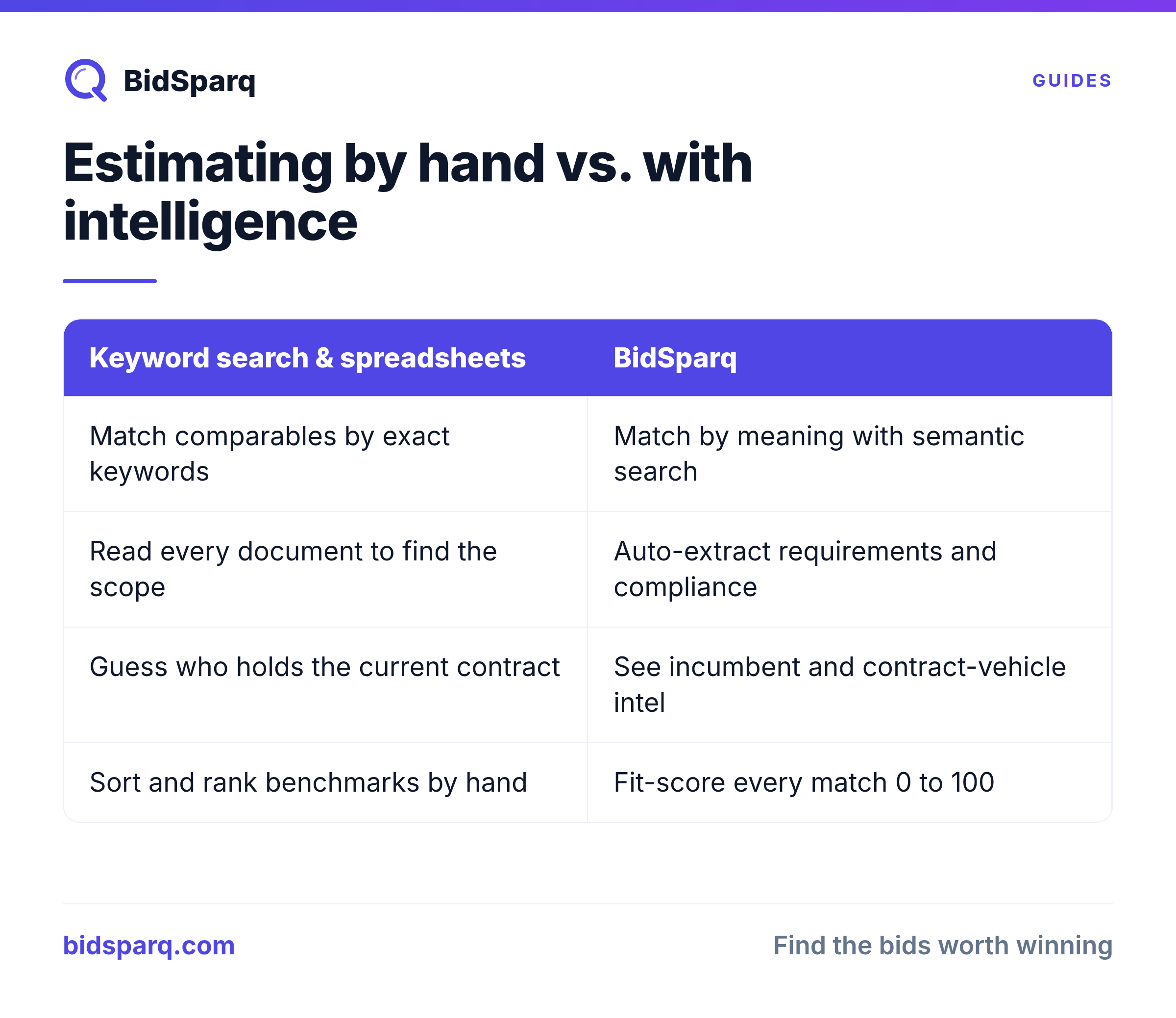
Let the tooling handle the finding and reading so your people can spend their hours on judgment. The slow part of estimating was never the arithmetic. It is locating comparable solicitations and awards across thousands of portals, then reading each one closely enough to pull out the real scope. This is where BidSparq's bid discovery and intelligence platform pays for itself. Its semantic matching finds comparable opportunities by meaning instead of exact keywords, so a differently worded but genuinely similar scope still surfaces where a manual keyword search would miss it. Automatic requirement extraction pulls the buried obligations out of every attachment, which means you price against the full scope rather than the summary. Incumbent and contract vehicle intelligence shows who holds similar work today and how it was bought, often the fastest route to a realistic price band. As of July 2026, 56,379 solicitations are open across the 23,000+ sources BidSparq tracks, and 563 new ones mentioning "independent" were posted in the last 30 days, far more comparable data than any team can read by hand. Every match is fit scored from 0 to 100, so the strongest benchmarks rise to the top on their own.
Make the discipline routine
Build the machinery once, then reuse it for every buy that follows. Estimating stops being a scramble when comparable finding, requirement extraction, and pricing benchmarks live inside your standard workflow instead of a one-off research push each time. The government's IGCE rules force this rigor on public buyers, and private teams that adopt the same habit earn the same protection, fewer surprises at award, a stronger negotiating position, and a paper trail that explains every dollar. Different tools will come and go, but the underlying discipline stays the same.
FAQ
What is an independent government cost estimate (IGCE)?
An IGCE is the government's own reasoned estimate of what a product or service should cost, prepared before soliciting bids and built independently of any vendor. It serves as the baseline for judging whether the offers that come back are fair and reasonable.
How do you calculate an IGCE?
You build it from the bottom up. Break the statement of work into labor, materials, and other direct costs, then price each element using comparable prior awards, current GSA or market catalog rates, and documented assumptions. Because the estimate is only as good as the scope behind it, define the requirement precisely before you price anything.
Is an IGCE required for every government purchase?
Requirements vary by agency and dollar threshold, and small or simple commercial buys may need only a lighter price analysis. The underlying practice of forming an independent view of fair cost before you go to market is worth following for any purchase, whether or not a formal estimate is mandated.
Want to see how your estimate holds up? Benchmark your next requirement against the 56,379 solicitations open right now across BidSparq's 23,000+ sources. Start free and see your matches, no credit card needed.
Find RFPs that match your business
BidSparq monitors 23,000+ procurement sources and uses AI to score every opportunity against your capabilities. Try it free for 14 days.
Start Free Trial →