How to Find SLED Opportunities Before the RFP
Pre-RFP intelligence gives you a months-long lead in government, construction, IT, and healthcare procurement. Track budget documents, RFIs, expiring contracts, and named public sources before the solicitation goes live.

By the time the RFP goes live, three vendors already knew it was coming and spent the prior four months shaping the spec. Budgets were approved, RFIs went to a short list of known vendors, and scope was written around preferred solutions. SLED markets make this pre-solicitation paper trail unusually visible: public-sector agencies are legally required to document budget approvals, market surveys, and planning decisions, which means the information exists months before any formal solicitation appears.
Key Takeaways
- The solicitation is a late signal: procurement in government, construction, IT, and healthcare begins with budget cycles, RFIs, and planning notices that precede formal bids by weeks or months.
- Named sources matter: BoardDocs archives, state eProcurement portals, and comptroller budget documents reveal intent before any RFP is published.
- Contract expiration dates are the most predictable pre-RFP signal, revealing exactly when an incumbent agreement will be rebid.
- Semantic matching finds early-stage notices that keyword searches miss because vocabulary shifts at each stage of the procurement cycle.
- AI fit scoring (0 to 100) filters pre-RFP noise so you focus only on signals that genuinely match your capabilities.
- Manual monitoring across thousands of sources is not feasible at scale; systematic automation is the only reliable approach.
The short answer
To find SLED opportunities before the RFP, monitor the procurement paper trail at its earliest visible stages: contract expiration records, RFI announcements, pre-solicitation notices, and appropriated-budget line items on state comptroller and treasury sites. These sources are publicly available and legally mandated, meaning the information exists months before any formal solicitation appears. Vendors who engage at this stage can still shape scope and establish relationships; vendors who wait for the posting stage typically find the competitive window already closing. As of August 2026, 5,122 new solicitations were posted in the last 30 days across the 23,000+ sources that monitor public procurement, most carrying pre-RFP signals that surface days or weeks before the formal posting.
Why SLED Agencies Signal Intent Months Before an RFP Is Published
Every significant purchase in government and institutional procurement generates a paper trail long before a solicitation is posted. A county planning a facilities renovation will appear in capital improvement budgets, board minutes, and pre-solicitation notices months before a formal bid opens. An IT services firm targeting a school district network upgrade can find the initiative in board agenda archives long before the RFP defines scope. In each case, the buying organization has already framed the problem, assessed the market, and often identified preferred approaches by the time the formal solicitation goes public.
SLED procurement is the sharpest example because the transparency is legally mandated. A school board must vote to approve a technology budget, publish the meeting agenda, and archive the minutes. A state agency must post a pre-solicitation notice before issuing certain RFPs. A comptroller must publish appropriated funding in a public budget document. These records are available to any vendor who knows where to look. Most do not look, because they have only ever monitored formal solicitation portals. That gap is the competitive advantage available to vendors who track earlier signals.
Pre-RFP SLED Signals Worth Tracking
Prioritize signals that reveal both intent and timeline, not just general category interest. Requests for Information confirm the organization is actively exploring a category and give you a window to shape the eventual specification. Pre-solicitation and Sources Sought notices serve the same purpose. Contract expiration dates are the most predictable signal: most public-sector agreements are rebid when they expire, and the contract record names the current vendor, the contract value, and the agency contact.
You also need to know where to find these signals before solicitations go live. School board meeting minutes and capital planning discussions are publicly searchable through platforms like BoardDocs, which archives agendas and board documents for school districts and local government boards across the country. State eProcurement portals, including COMMBUYS in Massachusetts and MyFloridaMarketPlace in Florida, post pre-solicitation notices and RFIs separately from formal bids. State treasury and comptroller sites, such as those maintained by the New York State Comptroller and the Texas Comptroller of Public Accounts, publish budget documents that confirm appropriated funding well before any solicitation is opened.
A practical example of each: to locate an expiring contract in Massachusetts, open COMMBUYS, filter by your service category, and sort by expiration date. Any contract ending in the next 12 months is a predictable rebid, with the current vendor and agency contact already named in the record. Separately, a BoardDocs search for “technology” in a target school district’s board archives will surface capital plan discussions and approved budget line items months before any RFP is drafted, at a stage when most vendors are not yet aware the initiative exists.
A practical watch list for any target market:
- RFIs and market surveys in your product or service category
- Expiring contracts held by incumbents in your space
- Annual budget documents and capital planning schedules on state treasury and comptroller sites
- School board meeting minutes and committee agendas via BoardDocs and similar archives
- Pre-solicitation and Sources Sought notices on state eProcurement portals
Why Manual Monitoring Fails Across SLED Markets at Scale
Do not rely on manual monitoring to catch pre-RFP signals across multiple markets. As of August 2026, 65,994 solicitations are open across the 23,000+ sources BidSparq tracks, and 5,122 new solicitations were posted in the last 30 days alone. Scanning that volume manually across education, healthcare, and local government is not a realistic strategy. Most vendors respond by narrowing their monitoring to a handful of familiar portals, which means they miss the majority of relevant pre-RFP signals.
Monitor contract expirations, RFIs, and budget signals across 23,000+ sources before competitors see the solicitation. Start free, no credit card required.
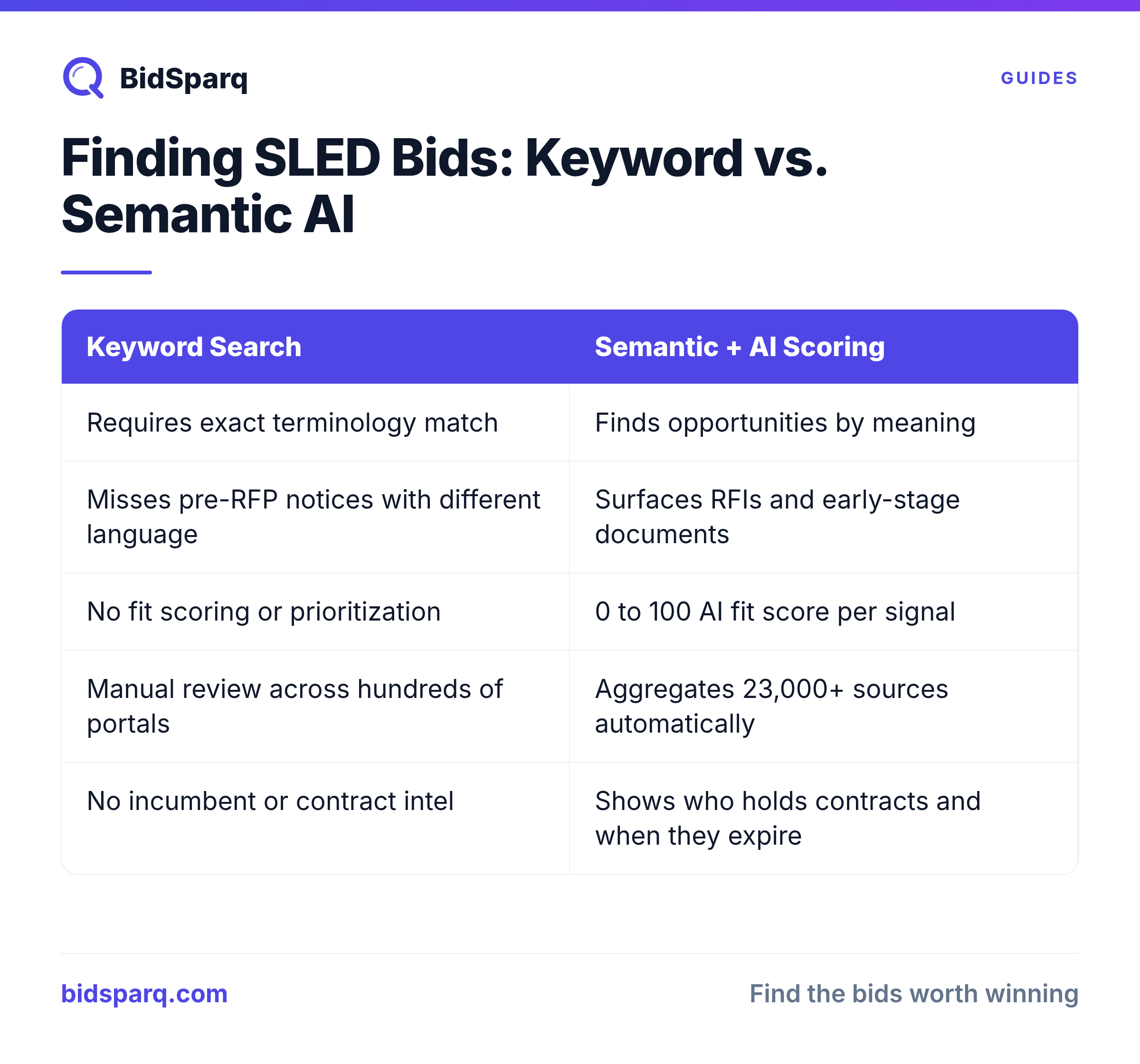
Semantic search changes the math. Unlike keyword matching, which requires you to predict the exact terminology a buyer will use at each stage of the procurement cycle, semantic matching finds relevant opportunities by meaning. An RFI for “student information systems” and a pre-solicitation for “K-12 data management platforms” describe the same need under different language. Keyword tools surface one; semantic search surfaces both. The same vocabulary gap appears in construction, where “facilities maintenance contract” and “building operations services agreement” may describe identical scope, and in IT services, where procurement language varies widely by agency and jurisdiction.
How Fit Scoring and Incumbent Data Let You Prioritize Pre-RFP Signals Without Manual Review
Use AI fit scoring to decide which pre-RFP signals are worth pursuing before committing time and resources. Fit scoring (0 to 100) ranks incoming signals by how closely they match your actual capabilities, so you can prioritize the ones worth pursuing before a formal solicitation exists. Automated requirement extraction surfaces qualifications and constraints embedded in early-stage documents, telling you whether a bid will favor your profile before the RFP makes selection criteria explicit. Incumbent intelligence shows who currently holds the relationship and when that agreement expires, separating a genuine opportunity from a protected incumbent situation.
Two scenarios illustrate why this matters. An IT services firm finds a school district pre-solicitation for cybersecurity services where the incumbent contract expires in four months: high fit score, confirmed budget, open competitive window. That is a priority pursuit. A construction firm finds a county facilities RFI where the incumbent has held the contract for eight years with no expiration in sight: low fit score, protected position. That is a pass, regardless of contract size. Fit scoring surfaces that distinction automatically, without requiring a manual review of every incoming signal.
FAQ
How early can you find opportunities before the RFP is published?
The timeline depends on the buyer and the category, but contract expiration dates can give you visibility 12 to 24 months in advance. RFIs typically precede a formal solicitation by 3 to 6 months. Budget documents and capital plans can signal intent even earlier. The key is monitoring multiple signal types simultaneously rather than waiting for any single document to confirm an upcoming solicitation.
What is the best source for pre-RFP SLED intelligence?
There is no single best source because SLED procurement is distributed across thousands of state, local, and education portals. Effective pre-RFP intelligence requires aggregating signals from budget systems, board archives like BoardDocs, RFI portals, and contract databases simultaneously. State eProcurement portals, comptroller budget sites, and board meeting archives each reveal different signals at different procurement stages. Platforms that aggregate 23,000+ bid sources and apply semantic search across all of them are the most practical approach for vendors tracking multiple markets at once.
How do you know if a pre-RFP opportunity is worth pursuing?
The clearest indicators are: the budget is confirmed in a public document, the scope aligns closely with your existing capabilities, and the incumbent situation is either open or the contract is approaching expiration. AI fit scoring quantifies the first two dimensions automatically; incumbent intelligence addresses the third. A pre-RFP signal with a high fit score and an expiring incumbent contract is a priority pursuit. A low-fit signal with a deeply established incumbent is generally a pass, regardless of contract size. This evaluation applies whether you are pursuing a SLED award, a construction project, a healthcare supply agreement, or an IT services engagement.
The pre-RFP window is where SLED contracts are decided. Start your free search on BidSparq and monitor contract expirations, RFIs, and budget signals across 23,000+ sources before competitors see the solicitation.
Find RFPs that match your business
BidSparq monitors 23,000+ procurement sources and uses AI to score every opportunity against your capabilities. Try it free for 14 days.
Start Free Trial →