RFP vs RFQ vs IFB: What's the Difference?
Understand the key differences between Requests for Proposals (RFP), Requests for Quotations (RFQ), and Invitations for Bid (IFB) in government procurement.
If you're new to government contracting, the alphabet soup of solicitation types can be confusing. RFP, RFQ, IFB, RFI, Sources Sought: each means something different and requires a different response strategy.
Here's what you need to know about the three main types.
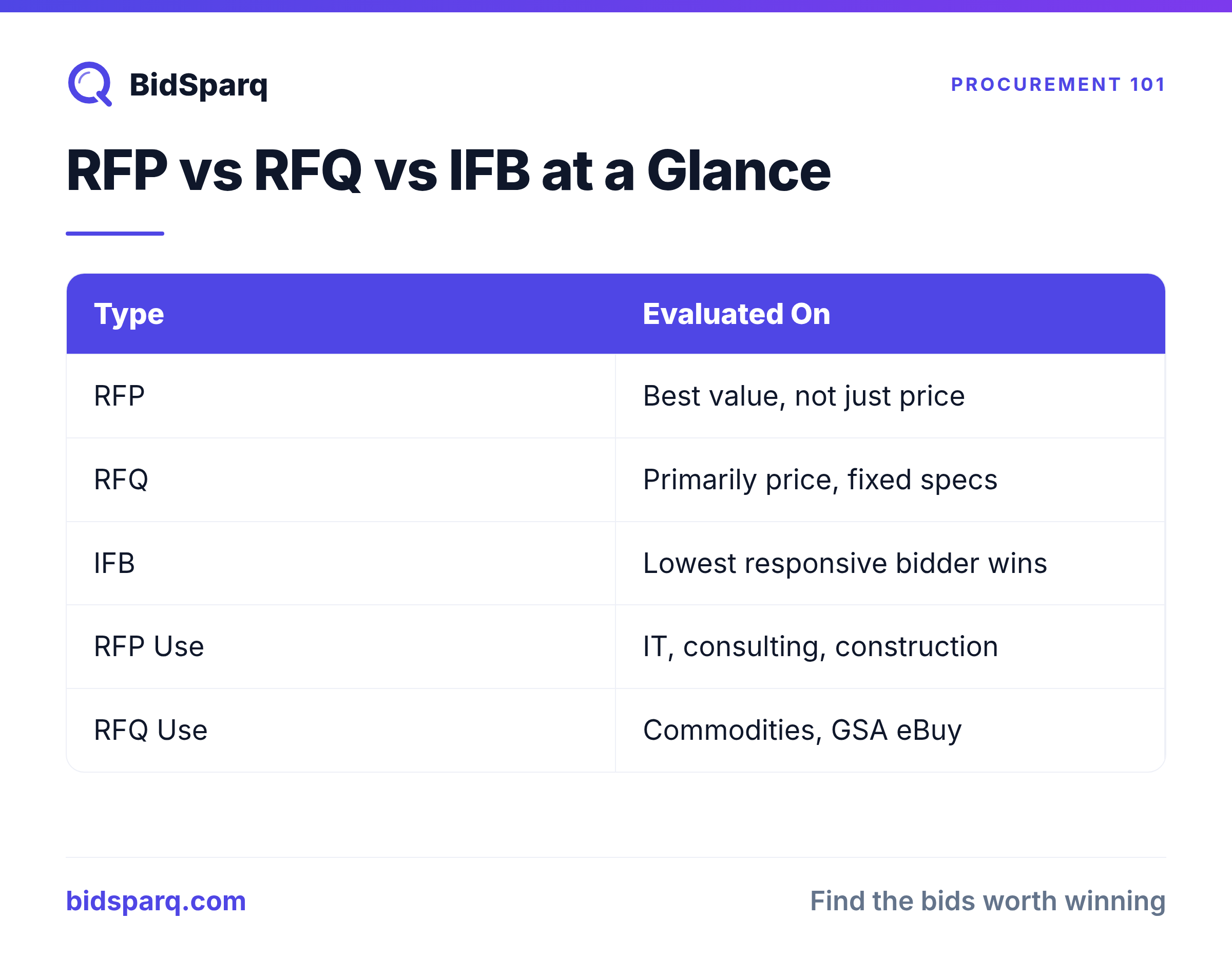
RFP: Request for Proposal
An RFP is the most common solicitation type for complex services and solutions. The agency describes what they need, and you propose how you'd deliver it.
Key characteristics:
- Evaluated on best value: not just price
- Technical approach, past performance, and management plan matter
- Allows for negotiation and discussion
- Common for IT services, consulting, construction, and professional services
Your response includes: Technical proposal, management approach, past performance references, staffing plan, and pricing volume, typically as separate documents.
RFQ: Request for Quotation
An RFQ asks for a price quote on specific goods or services with clearly defined specifications. There's less room for creativity: the agency knows exactly what they want.
Key characteristics:
- Evaluated primarily on price
- Specifications are detailed and fixed
- Common for commodity purchases, supplies, and well-defined services
- Often used on GSA Schedule (GSA eBuy)
Your response includes: Line-item pricing, delivery timeline, and confirmation you meet specifications.
IFB: Invitation for Bid
An IFB is a sealed-bid process where the lowest responsive, responsible bidder wins. Period.
Key characteristics:
- Evaluated on lowest price: no technical evaluation
- Must meet all requirements exactly (responsive)
- Must be a capable contractor (responsible)
- Common for construction, commodities, and simple services
- No negotiation: your bid is your final offer
Your response includes: Completed bid form with pricing. That's it.
Quick Comparison
| RFP | RFQ | IFB | |
|---|---|---|---|
| Evaluation | Best value | Price-focused | Lowest price |
| Negotiation | Yes | Sometimes | No |
| Complexity | High | Medium | Low |
| Response effort | Weeks | Days | Days |
| Common for | Services, IT, consulting | Products, GSA orders | Construction, commodities |
Don't Forget Pre-Solicitation Notices
Before an RFP drops, agencies often post:
- RFI (Request for Information): the agency is researching the market. Responding helps shape the eventual RFP.
- Sources Sought: the agency wants to know who can do the work. Always respond: it gets you on the radar.
- Pre-Solicitation Notice: the agency is announcing an upcoming RFP. Start preparing now.
These pre-solicitation notices are gold. They give you weeks or months of lead time before your competitors even know the opportunity exists.
Next Steps
- How to find government RFPs across 23,000+ sources
- How to read an RFP: understand every section before you respond
- How to write a winning government proposal
- Start your free trial to see RFPs, RFQs, and IFBs matched to your business
Find RFPs that match your business
BidSparq monitors 23,000+ procurement sources and uses AI to score every opportunity against your capabilities. Try it free for 14 days.
Start Free Trial →