SLED Government Contracting: How to Sell to State, Local & Education Agencies
What SLED means in government contracting, how the $2 trillion state/local/education market works, and how vendors find and win SLED contracts.
If you've spent any time in government contracting, you've heard the term SLED. It stands for State, Local, and Education, and it represents the largest segment of public-sector spending that most vendors overlook.
While everyone chases federal contracts on SAM.gov, SLED agencies collectively spend over $2 trillion per year on goods and services. That's more than the entire federal procurement budget. And the competition is often far less intense.
What Does SLED Mean in Government Contracting?
SLED is an industry acronym for three levels of government below federal:
- State: state agencies, departments, and authorities (e.g., state DOTs, health departments, IT offices)
- Local: cities, counties, towns, special districts, water authorities, transit agencies
- Education: K-12 school districts, public universities, community colleges, and education cooperatives
Each level has its own procurement rules, portals, and contracting processes. Unlike federal procurement: which is centralized through SAM.gov and governed by the FAR, SLED procurement is decentralized across thousands of individual entities, each with their own purchasing thresholds, bid submission requirements, and vendor registration systems.
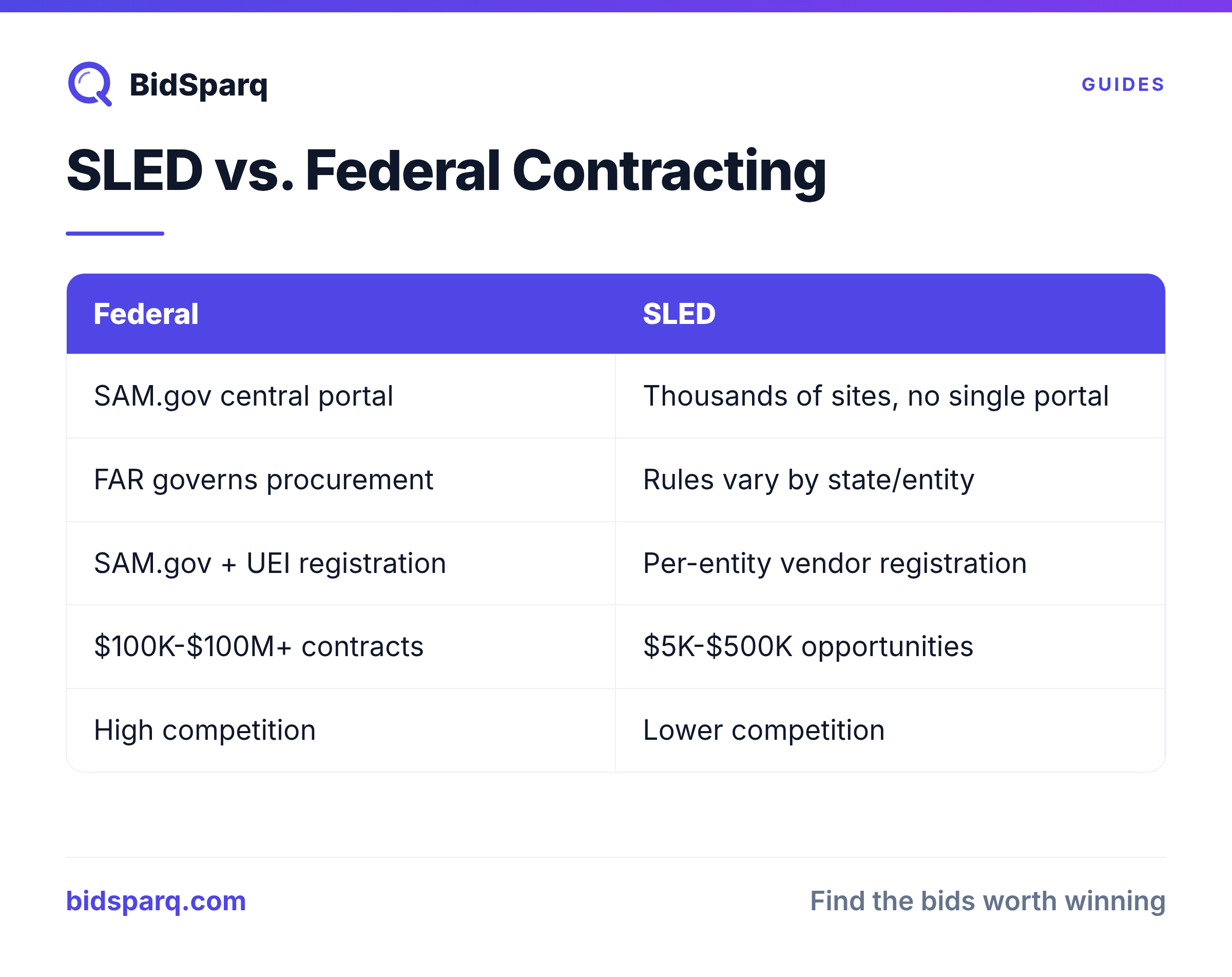
SLED vs. Federal Contracting: Key Differences
| Factor | Federal | SLED |
|---|---|---|
| Central portal | SAM.gov | No single portal: thousands of sites |
| Procurement rules | FAR (Federal Acquisition Regulation) | Varies by state/entity |
| Registration | SAM.gov + UEI | Often per-entity vendor registration |
| Contract size | Often $100K-$100M+ | Many $5K-$500K opportunities |
| Competition | High (everyone looks here) | Lower (fragmented, harder to find) |
| Sales cycle | 6-18 months typical | Often 30-90 days |
| Set-asides | SBA programs (8(a), HUBZone, SDVOSB) | Varies: many states have own MBE/WBE/DBE programs |
Why Vendors Should Target SLED
1. Massive Market Size
State and local governments alone spend over $2 trillion annually. Add education: the K-12 market represents over $800 billion in annual spending, and you have a market that dwarfs federal procurement.
2. Less Competition Per Opportunity
Because SLED opportunities are scattered across thousands of portals, most vendors only monitor a handful of sources. A well-organized vendor who monitors broadly has a structural advantage.
3. Shorter Sales Cycles
Many SLED contracts move faster than federal. A city might go from RFP posting to contract award in 60 days. School districts often have urgent purchasing timelines tied to budget years and funding windows.
4. Cooperative Purchasing Shortcuts
Programs like SourceWell, BuyBoard, and TIPS-USA let SLED agencies buy off pre-competed contracts: meaning one win can give you access to thousands of agencies without rebidding.
5. Recurring Revenue
SLED agencies tend to rebuy from incumbents. Once you win a contract and deliver, renewals and follow-on work are common. Many contracts include multi-year option periods.
How SLED Procurement Works
State Procurement
Every state has a central procurement office that manages statewide contracts and posts solicitations. Common patterns:
- Centralized portal: Most states have an eProcurement system (e.g., Texas SmartBuy, California eProcure, New York SFS)
- Statewide contracts: Agencies can buy off pre-negotiated master contracts for common goods/services
- Thresholds: Small purchases (under $25K-$50K depending on state) may not require formal RFPs
- Preferences: Many states give preference to in-state vendors, small businesses, or minority/women-owned firms
Browse active opportunities: RFPs by state
Local Government Procurement
Cities, counties, and special districts each run their own procurement. This is the most fragmented part of SLED:
- Over 90,000 local government entities in the United States
- Many use platforms like BidNet, IonWave, or Bonfire for bid posting
- Smaller jurisdictions may post on their own websites or local newspapers
- Piggyback clauses let local agencies buy off another entity's contract
Education Procurement
School districts and higher education institutions have some of the most active procurement programs:
- E-Rate: FCC program funding telecom and internet for schools, posted on USAC's EPC portal. See our E-Rate guide
- Cooperative purchasing: TIPS-USA, BuyBoard, SourceWell, and PEPPM are heavily used in education
- Budget cycles: Most school districts operate July-June fiscal years with procurement spikes in spring
- Technology focus: EdTech, SaaS, networking, classroom hardware, and cybersecurity are high-growth areas
How to Find SLED Contracts
The biggest challenge with SLED is discovery. Unlike federal (where SAM.gov centralizes everything), SLED opportunities are spread across:
- State procurement portals: Each of the 50 states has its own system. See our complete guide to all 50 state portals
- Aggregator platforms: BidNet, GovBidSpro, and similar services aggregate from multiple sources
- Platform-based portals: Many entities use shared platforms like IonWave (345+ entities), Bonfire, ProcureWare, or SciQuest
- Entity websites: Smaller cities and school districts post directly on their own sites
- Cooperative purchasing portals: SourceWell, BuyBoard, TIPS-USA for pre-competed contracts
Manually monitoring even a fraction of these is impractical. That's why most successful SLED vendors use automated monitoring tools that scan across sources.
BidSparq scans 23,000+ SLED and federal sources daily and delivers AI-matched opportunities to your dashboard: so you don't miss contracts buried in obscure local portals.
SLED Certifications and Preferences
While federal set-aside programs (8(a), HUBZone, SDVOSB) don't directly apply to SLED, many state and local agencies have their own preference programs:
| Certification | What It Is | Where It Helps |
|---|---|---|
| MBE | Minority Business Enterprise | Most states have MBE goals (often 10-25% of spend) |
| WBE | Women's Business Enterprise | State/local goals, often paired with MBE |
| DBE | Disadvantaged Business Enterprise | DOT-funded projects (transit, highways) |
| SBE | Small Business Enterprise | State-specific programs with varying size standards |
| Local preference | Business located in the jurisdiction | Many cities/counties give 5-10% price preference to local firms |
Certifications are typically issued at the state or local level. Some states accept each other's certifications through reciprocity agreements, but most require separate registration.
Strategies for Winning SLED Contracts
- Cast a wide net. Monitor multiple states and hundreds of local entities: not just your home turf. The fragmentation is an advantage if you search broadly.
- Leverage cooperative contracts. Win one SourceWell or BuyBoard contract and you can sell to thousands of agencies without additional bidding.
- Build relationships locally. SLED buyers are more accessible than federal contracting officers. Attend pre-bid conferences, call procurement offices, and show up to industry days.
- Watch for piggyback opportunities. Many SLED agencies can "piggyback" on another entity's competitively bid contract: ask if your existing contracts have piggyback clauses.
- Track budget cycles. States budget annually or biennially. Learn when your target states start their fiscal year: procurement spikes 2-3 months before year-end as agencies spend remaining budgets.
- Get certified. MBE, WBE, and DBE certifications open set-aside opportunities at the state and local level, similar to federal programs.
Top SLED Industries by Spend
The biggest SLED spending categories, all of which are active on BidSparq:
- Construction & Facilities: Road, bridge, building, and infrastructure projects
- IT Services: Software, cybersecurity, cloud, managed services
- Education & EdTech: LMS platforms, classroom tech, curriculum, assessments
- Healthcare: Public health, behavioral health, Medicaid services
- Engineering & Architecture: Design services for public projects
- Janitorial & Facilities: Custodial, grounds maintenance, waste management
- Transportation & Fleet: Transit, vehicle procurement, fleet management
Frequently Asked Questions
What does SLED stand for?
SLED stands for State, Local, and Education: the three tiers of government procurement below the federal level. It represents over $2 trillion in annual spending across state agencies, cities, counties, school districts, and public universities.
Is SLED easier than federal contracting?
In many ways, yes. SLED contracts often have shorter sales cycles (30-90 days vs. 6-18 months), simpler proposal requirements, and less competition per opportunity. The challenge is finding opportunities across thousands of fragmented portals.
Do I need a SAM.gov registration for SLED contracts?
Not for most SLED contracts. SAM.gov registration is required for federal contracts. However, many SLED agencies require vendor registration on their own systems. Some states accept SAM.gov as proof of business legitimacy.
What's the best way to find SLED opportunities?
Use an aggregation tool that monitors state portals, local government platforms, and education sources simultaneously. Manual monitoring is impractical given the 90,000+ entities. BidSparq monitors 23,000+ sources including SLED agencies across all 50 states.
Next Steps
- Start your free trial: BidSparq monitors SLED sources across all 50 states and matches RFPs to your business
- Browse active RFPs by state to see what's available in your target markets
- Read our guide to all 50 state procurement portals
- Learn about cooperative purchasing contracts for faster SLED market entry
- Understand set-aside programs at both the federal and state level
Find RFPs that match your business
BidSparq monitors 23,000+ procurement sources and uses AI to score every opportunity against your capabilities. Try it free for 14 days.
Start Free Trial →