How to Request and Use Proposal Debriefs to Win More Contracts
Most contractors never request debriefs after losing a bid. Learn how debriefs reveal your scoring gaps, competitor strengths, and the specific improvements that increase your win rate.
You just lost a government contract. You spent 20 hours and $6,000 on the proposal. The natural reaction is frustration, maybe anger, and then moving on to the next opportunity.
But there's one more step that almost nobody takes, and it's the highest-ROI activity in government contracting: requesting a debrief.
"Most contractors don't request debriefs. Some don't know it exists. In my experience, the ones skipping it are leaving real competitive intelligence on the table." (r/GovernmentContracting)
What Is a Proposal Debrief?
After a federal contract award, unsuccessful offerors have the right to request a debrief from the contracting officer. This is a formal meeting (in-person, phone, or written) where the agency explains:
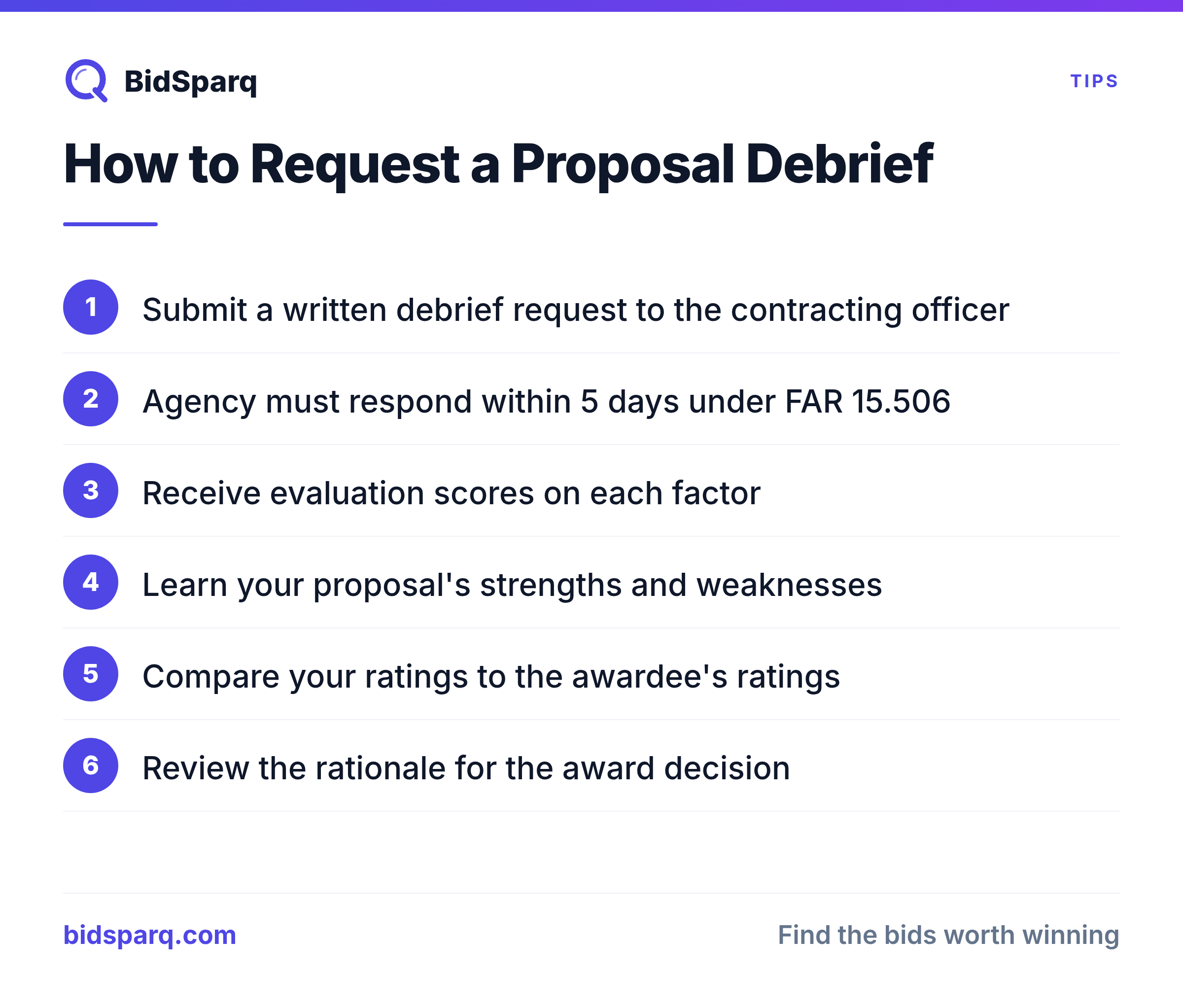
- How your proposal was evaluated: your scores on each evaluation factor
- Your strengths and weaknesses: what impressed them and what fell short
- How you compared to the winner: not by name, but in terms of ratings (e.g., "the awardee received 'Outstanding' on Technical Approach; your proposal received 'Acceptable'")
- The rationale for the award decision: what ultimately tipped the scales
Under FAR 15.506, the agency must provide a debrief within 5 days of your written request for competitively negotiated procurements. For simplified acquisitions, debriefs are optional but often provided if you ask.
What Debriefs Actually Reveal
A single debrief gives you intelligence that would take dozens of proposals to learn through trial and error:
Your Scoring Gaps
You'll learn exactly where you lost points. Maybe your technical approach scored "Good" while the winner scored "Outstanding." Or your past performance was rated "Acceptable" versus their "Substantial Confidence." These specifics tell you precisely where to improve.
Whether Price or Technical Won
In a best-value evaluation, knowing whether the winner won on price or technical merit changes your strategy for next time. If they won on price with equal technical scores, you need to sharpen pricing. If they won on technical with higher pricing, your solution needs differentiation. If evaluator comments hint the outcome was predetermined, revisit our guide to wired RFP red flags before your next bid decision.
Evaluation Priorities
The debrief reveals what evaluators actually cared about: which often differs from what the RFP emphasized. An evaluation factor weighted at 30% on paper might have been the decisive factor because all bidders scored similarly on the other factors.
Competitor Capabilities
While the agency won't name the winner, the comparative ratings reveal their capabilities. If the winner received "Outstanding" on past performance, they likely have extensive relevant experience. If they scored highest on management approach, they probably proposed a strong team structure.
How to Request a Debrief
- Act quickly. Submit your written request within 3 days of receiving the award notification. Under FAR 15.506, the agency must schedule your debrief within 5 days of the request.
- Put it in writing. Email the contracting officer (CO) listed on the solicitation. Keep it professional and simple:
"Dear [CO Name], We respectfully request a post-award debrief for Solicitation [Number]. We would appreciate the opportunity to understand our evaluation results and areas for improvement. We are available at your convenience for an in-person, phone, or written debrief. Thank you, [Your Name]"
- Prepare questions in advance. You likely won't be allowed to ask during the debrief, but some agencies accept written questions beforehand. Good questions include:
- "What were the specific strengths identified in our proposal?"
- "What were the specific weaknesses or deficiencies?"
- "How did our ratings compare to the awardee on each evaluation factor?"
- "Was our pricing competitive relative to the awardee?"
- "Were there any areas where our proposal was unclear or difficult to evaluate?"
What to Do During the Debrief
- Take detailed notes. Bring someone specifically to document everything. You'll want to reference these notes across multiple future proposals.
- Don't argue. This is an intelligence-gathering session, not an appeals court. Getting defensive or challenging the evaluation wastes your opportunity to learn.
- Ask for clarification. If a weakness is vague ("proposal lacked sufficient detail in the management approach"), ask what specifically they were looking for.
- Thank them. Contracting officers remember vendors who handle debriefs professionally. The next time you propose to this agency, that impression matters.
Turning Debriefs Into Wins
The debrief is worthless if you don't act on it. Here's how to extract maximum value:
Create a Lessons Learned Document
After every debrief, create a structured record:
| Factor | Our Rating | Winner's Rating | Weakness Cited | Action for Next Proposal |
|---|---|---|---|---|
| Technical Approach | Good | Outstanding | "Lacked specificity in implementation timeline" | Include detailed Gantt chart with milestones |
| Past Performance | Substantial | Substantial | None | Maintain: this is competitive |
| Staffing Plan | Acceptable | Outstanding | "Key personnel resumes lacked direct relevance" | Staff with people who've done this exact work |
| Price | Fair | Fair | None | Price was not the differentiator |
"A debrief without documented lessons learned is just a conversation." (r/GovernmentContracting)
Track Patterns Across Multiple Debriefs
After 3-5 debriefs, patterns emerge. Maybe your management approach consistently scores lower than your technical approach. Maybe your past performance ratings are always "Acceptable" but never "Outstanding." These patterns point to systemic issues, not one-off mistakes.
Feed Insights Back Into Your Bid/No-Bid Process
If debriefs consistently show you losing to incumbents on past performance, factor that more heavily into your bid/no-bid decisions. If you consistently win on technical but lose on price, adjust your pricing strategy.
Debriefs at the State and Local Level
State and local agencies aren't bound by FAR, so debrief rights vary:
- Some states require debriefs under their procurement code: check your state's statutes
- Most will provide feedback if asked: even without a formal requirement, procurement officers often share evaluation summaries
- Public records requests can obtain evaluation documents in many states: proposals are typically public record after award
- Ask anyway. The worst they can say is no. Many local procurement officers appreciate the professionalism of the request.
How BidSparq Supports Your Improvement Cycle
- Bid Pipeline: Track won/lost status for every opportunity you pursue, the foundation for win/loss analysis
- AI Chat: Ask "what are common weaknesses in IT proposals?" or "how should I structure a management approach?" to improve areas flagged in debriefs
- Competitive Intelligence: See who won the contract you lost, research their strengths for future competitions
- AI Match Score: Over time, better bid/no-bid decisions (informed by debrief patterns) should increase your average match score on proposals you pursue
Next Steps
- Start your free trial: track your bid pipeline and build a systematic improvement process
- Apply the bid/no-bid framework using insights from your debriefs
- Improve your proposal writing based on evaluator feedback
- Use USASpending to research the winners of contracts you've lost
Find RFPs that match your business
BidSparq monitors 23,000+ procurement sources and uses AI to score every opportunity against your capabilities. Try it free for 14 days.
Start Free Trial →