NTE Budget in RFPs: What Every Bidder Must Know
NTE budget is the hard ceiling on what a buyer will pay. Learn where it hides in RFP documents and how to use it for smarter, faster go/no-go decisions.

An NTE budget can end your bid before you write a single sentence of your response. Miss the ceiling, and your proposal is non-compliant. Price right at it with no margin to spare, and you may win the work but lose the profit. Read it wrong, and your team spends weeks on a pursuit that was never viable to begin with.
Key takeaways
- NTE is a ceiling, not a target price: the best responses price competitively within it, leaving enough margin to absorb scope risk without going over.
- Buried in attachments and scope documents, NTE language is easy to overlook when scanning a lengthy solicitation for the first time.
- Before you write a word of your response, check whether your true cost floor can clear the NTE ceiling and still leave room for a competitive price.
- Automated compliance extraction pulls NTE figures from solicitations in seconds, versus the hours of manual document review each pursuit demands.
- Every major market posts NTE language: education, healthcare, construction, and commercial procurement all use it, in different formats but with identical stakes.
The short answer
NTE budget, short for Not-to-Exceed budget, is the maximum dollar amount a buyer will pay under a contract, and any proposal priced above it is disqualified regardless of technical merit. The figure may appear as a total contract value, an hourly rate ceiling, or a per-unit price cap buried inside a scope of work or pricing exhibit. Solicitations across education, healthcare, construction, and commercial sectors use NTE language in different formats, but the consequences are identical: come in above the ceiling and you are out. Identifying NTE early, before your team invests time in pricing and writing, is one of the highest-leverage moves in bid strategy.
Where NTE budget language actually hides
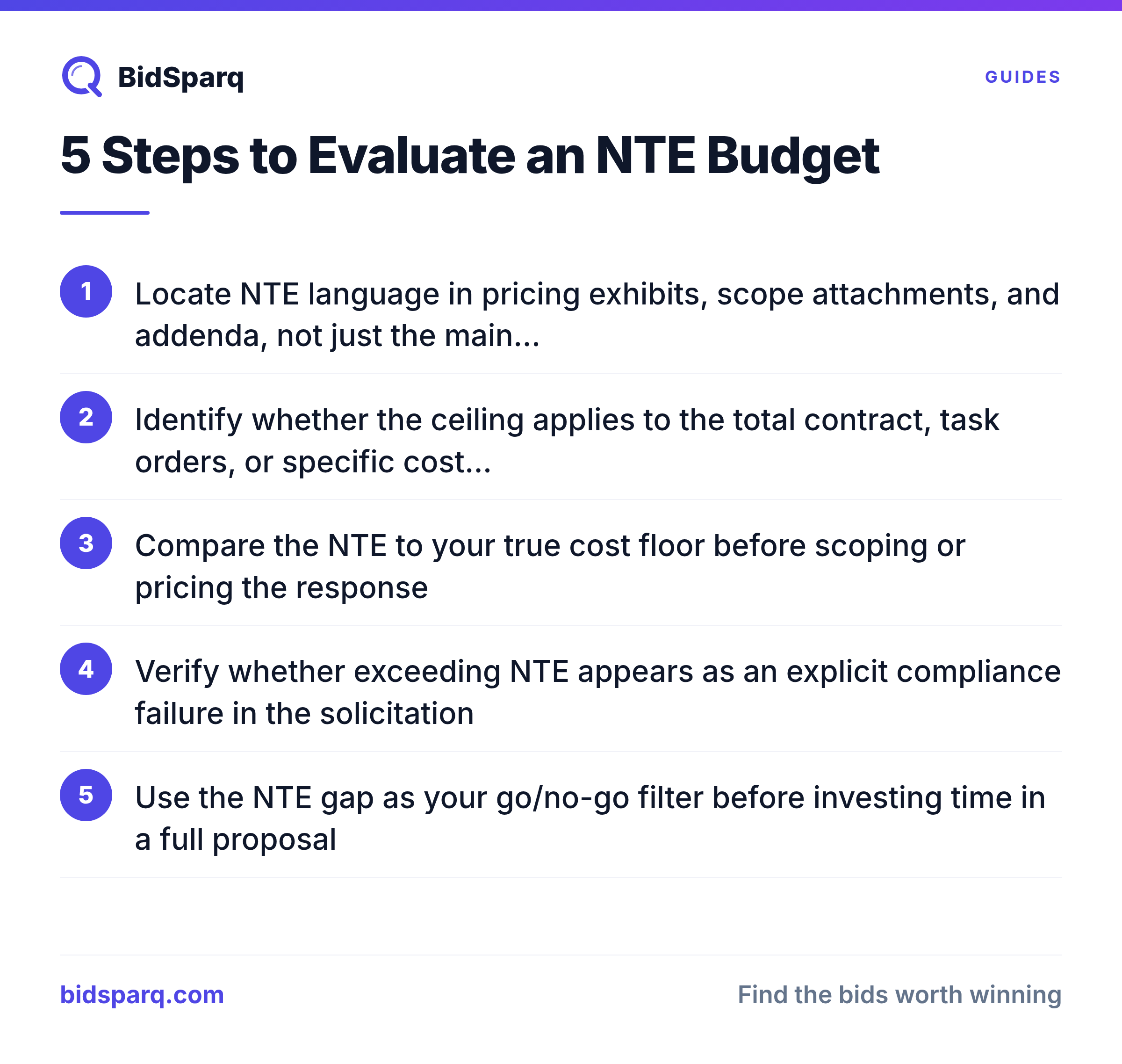
Look past the cover page: NTE budget language almost never appears in the first section of a solicitation. Buyers embed the ceiling in pricing exhibits, scope attachments, contract templates, or special conditions addenda. A healthcare system RFP may state its NTE in a single line deep in the document. A construction solicitation may express it as a per-phase or per-trade cap buried in an appendix. Education and commercial buyers sometimes encode it in a boilerplate contract exhibit that only careful readers open. In each case, the location is inconvenient and the consequence of missing it is total.
That makes manual discovery expensive. Scanning every document, attachment, and addendum across dozens of active pursuits takes hours per bid and scales poorly as your pipeline grows. As of September 2026, 18,276 new budget solicitations were posted in the last 30 days across the 23,000+ sources we track, and 6,194 of those open opportunities close within the next 14 days. The volume alone makes exhaustive manual review impractical for any team competing across more than a handful of categories at once.
Search open solicitations free on BidSparq and let automated compliance extraction surface NTE figures and requirement language for you, no credit card required.
How NTE shapes your go/no-go decision
Treat NTE as the first filter in your pursuit process, not a detail you revisit after scoping the work. The gap between your true cost floor and the NTE ceiling tells you whether a bid is worth pursuing at all. If your floor is above the NTE, you cannot win without losing money. If the gap is narrow, scope risk and change-order exposure matter more than they would on a looser contract. If you are comfortably below the ceiling, check whether you are pricing in scope you have overlooked, or whether incumbency or a preferred contract vehicle is driving the NTE in a way that limits your realistic chance of winning.
Go/no-go decisions made before writing a single page of a proposal save far more capacity than any template library. NTE is the number that makes those decisions faster and cleaner. Pair it with a fit score and you can triage an entire week of incoming solicitations in a morning.
NTE and compliance: two sides of the same filter
Many buyers treat exceeding the NTE as an explicit compliance failure, listing it alongside missing signatures and late submissions on the disqualification checklist. That distinction matters because evaluation teams typically screen for compliance before reading technical content. A proposal that is technically superior but priced one dollar above the NTE is often rejected before reviewers reach the methodology section.
As of September 2026, 13,444 open solicitations across the sources we track mention budget, and each carries its own compliance context. Some define NTE at the task-order level. Others set separate ceilings for labor, materials, and travel. Reading that structure accurately, across every active pursuit, is exactly the kind of work that automated compliance extraction handles faster and more reliably than a manual review pass.
NTE budget across every market, not just government
NTE conventions differ by sector, but the underlying mechanic is the same wherever a buyer needs cost certainty before committing to a contract. A hospital system issuing an IT services RFP may set an NTE at the annual renewal level. A commercial real-estate firm issuing a renovation bid may express it as a total project cap with a contingency allowance. A school district procurement for curriculum software may post a per-seat NTE tied to the amount approved by its board. Each format is different; each ceiling is absolute.
Semantic matching tools that read solicitation meaning rather than keywords surface NTE figures across all of these contexts in a single search. That means your team sees the ceiling alongside the scope, the timeline, and the fit score, before deciding whether the pursuit is worth the investment. The result is a tighter, faster pipeline with fewer wasted proposal hours.
FAQ
What does NTE budget mean in an RFP?
NTE budget stands for Not-to-Exceed budget. It is the absolute maximum a buyer will pay for a contract, and any proposal priced above it is typically disqualified as non-compliant, regardless of technical quality. The figure may cover the entire contract value, individual task orders, or specific cost categories such as labor or materials.
Is an NTE budget the same as a contract ceiling price?
In most solicitations, yes. NTE, contract ceiling, and maximum contract value describe the same hard limit on what the buyer will pay. Some contracts distinguish between an NTE for individual task orders and a separate ceiling for the total contract vehicle, so it is worth reading the main solicitation and all attached contract language, not just the summary page.
How do I find the NTE budget quickly in a long RFP?
Search the full document, including all attachments and addenda, for the terms "not-to-exceed," "NTE," "contract ceiling," "maximum contract value," and "total contract amount." Pay particular attention to pricing exhibits and scope-of-work appendices, where buyers most commonly embed the figure. Automated compliance extraction tools can surface this information across dozens of simultaneous pursuits in the time it takes to search a single PDF manually.
Start your free search on BidSparq today and see NTE figures, compliance flags, and AI fit scores across every open solicitation in your market, with no commitment required.
Find RFPs that match your business
BidSparq monitors 23,000+ procurement sources and uses AI to score every opportunity against your capabilities. Try it free for 14 days.
Start Free Trial →