NTE in Business: How Price Caps Affect Your Bids
Not-to-Exceed (NTE) is a price ceiling that appears in RFPs across construction, IT, healthcare, and procurement. Learn what NTE in business means, why it triggers automatic bid disqualifications, and how to price inside the cap competitively.

Your next bid might include a Not-to-Exceed clause that caps what you can charge, and if you miss it, the entire submission can be thrown out before a reviewer finishes the first page. NTE terms appear in contracts across construction, IT services, healthcare, and education procurement, and they carry a specific compliance obligation: price above the ceiling and you are automatically disqualified, price far below it without a cushion and you absorb every cost overrun out of pocket.
- NTE is a hard price ceiling: buyers will not pay above it regardless of actual cost overruns, so vendors must build scope variability and risk into their pricing from the first draft.
- Compliance disqualifies before cost even competes: solicitations treat a bid that exceeds the NTE as non-responsive, triggering automatic rejection before any technical evaluation begins.
- Every sector uses NTE terms, from hospital renovation contracts and managed IT service agreements to school district software purchases and construction change orders.
- Incumbent pricing shapes the ceiling before you see it: NTE figures are typically anchored to prior contract award values, giving vendors with historical data a structural advantage in estimating available margin.
- Keyword search alone misses a material share of NTE clauses, because buyers write "price ceiling," "maximum allowable cost," and "ceiling amount" interchangeably with "NTE" across different solicitation templates.
The short answer
NTE, or Not-to-Exceed, is a contract pricing mechanism that sets an absolute maximum the buyer will pay, regardless of what the vendor's actual costs turn out to be. It appears in time-and-materials contracts, cost-reimbursable agreements, and phased service contracts across virtually every industry that issues RFPs. Unlike a fixed-price contract, the NTE allows a vendor to invoice less if work comes in under budget, but draws a hard line above which no payment is owed. Missing or exceeding an NTE clause is typically grounds for automatic bid rejection, which makes finding and pricing to the cap a foundational compliance task rather than a detail to confirm at the end of a pursuit.
NTE vs. fixed-price vs. cost-plus: why the difference matters
Fixed-price contracts pay a single negotiated figure regardless of actual cost; cost-plus contracts reimburse documented costs plus a fee; NTE contracts set a ceiling while letting the final invoice float below it. In a fixed-price deal, one number gets paid whether actual costs landed higher or lower. In a cost-plus arrangement, the buyer reimburses documented costs plus an agreed fee, sometimes without any ceiling at all. NTE threads between them: the vendor invoices actual hours and materials up to the stated maximum, then stops. This structure is especially common in construction, where scope change is expected on almost every project, in managed IT services, where monthly ticket volume varies, and in healthcare facility management, where regulatory requirements can shift mid-contract and create unpredictable work demands.
Where NTE terms appear across industries
Construction project managers encounter NTE language in nearly every change order, but the term travels far beyond job sites. A hospital system issuing an RFP for facilities management will cap annual maintenance spend with an NTE figure. A school district procuring student information software will attach an NTE to implementation and customization fees, separate from the recurring license. A regional transit authority contracting for IT helpdesk services will set an NTE for monthly labor hours. The practical implication for vendors is that the same compliance obligation applies whether you are bidding on a facility renovation or a three-year cybersecurity services agreement: find the cap, price inside it, and prove you can deliver within it.
Why NTE compliance fails at scale
Procurement officers treat a bid that exceeds the stated NTE the same way they treat a missing signature page: the submission is non-responsive and goes no further. That outcome is painful on a single opportunity, but the deeper problem is scale. Teams working from keyword searches or manual source monitoring review solicitations under deadline pressure, which means a differently phrased NTE clause such as "maximum authorized value" or "ceiling amount" can slip past the review entirely. As of September 2026, BidSparq tracks 61,605 open solicitations across 23,000+ sources. A significant share include pricing constraints that use language no single keyword string reliably captures. Semantic matching reads meaning rather than matching exact phrases, so NTE requirements surface consistently regardless of how the buyer chose to write them.
Search your full pipeline for open bids free, no credit card required. See NTE flags and AI fit scores side by side before you commit hours to a pursuit.
How to price competitively inside an NTE
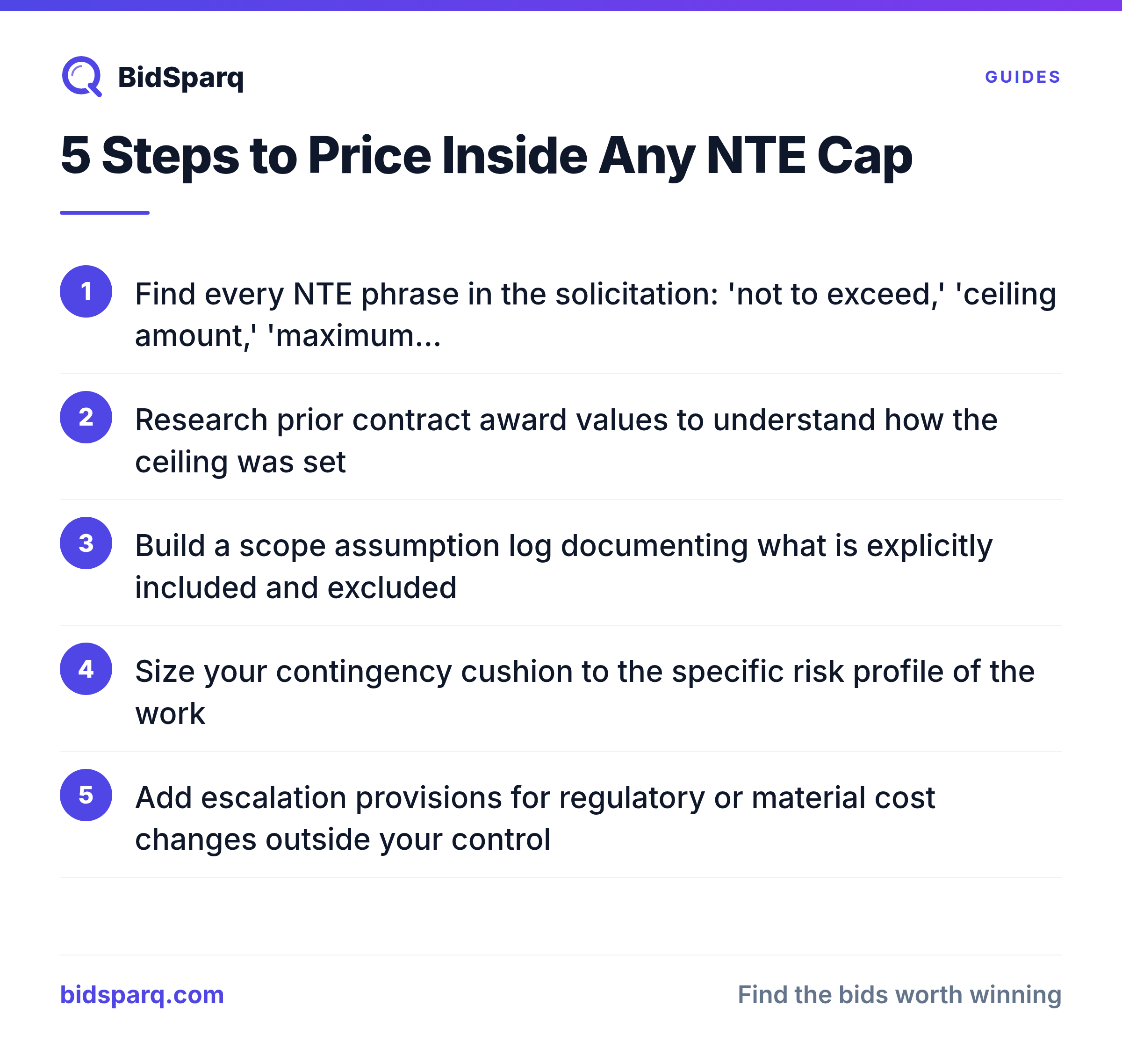
Start by finding out whether a prior contract existed and, if so, what the incumbent charged. NTE ceilings are rarely invented from scratch. Buyers typically anchor them to historical spend, prior contract award values, or budget line items approved months before the solicitation published. Vendors who know what the prior award paid have a structural advantage in estimating how much room sits between a competitive price and the hard ceiling. Beyond incumbent intelligence, a disciplined NTE pricing approach includes a written scope assumption log documenting what is explicitly included and excluded, a contingency cushion sized to the work's specific risk profile, and clear escalation provisions for regulatory or material cost changes that fall outside the vendor's control. Leaving those assumptions implicit invites disputes that can push actual costs above the cap and trigger the non-payment clause the vendor agreed to at signing.
FAQ
What does NTE mean in a business contract?
NTE stands for Not-to-Exceed. It is a pricing term that sets the maximum amount the buyer will pay under the contract. The vendor can invoice less if work comes in under budget but cannot bill more than the NTE figure. Any amount invoiced above the ceiling is not owed, and a bid that proposes a price exceeding the NTE is typically rejected as non-responsive before technical review begins.
Is an NTE contract the same as a fixed-price contract?
No. A fixed-price contract pays exactly the agreed amount regardless of actual cost. An NTE contract pays documented actual costs up to the ceiling amount. If final costs land below the NTE, the buyer pays the lower amount. If they exceed it, the vendor absorbs the overage. The NTE structure is most common in services and construction where scope variability is expected and a single fixed number would force the vendor to price in excessive contingency risk.
How do I find NTE requirements in an RFP before I bid?
Search the full solicitation document for "not to exceed," "NTE," "ceiling," "maximum allowable," "price cap," and "maximum authorized value," since buyers use all of these phrasings depending on their template. Automated semantic search tools that read meaning rather than match exact strings are more reliable for catching variant language across a large pipeline of opportunities. Reviewing the procurement history, any published budget documents, and pre-bid Q&A addenda also surfaces NTE figures that post-publication amendments sometimes adjust after initial release.
Find your next bid match free on BidSparq's RFP platform. Semantic search and AI fit scoring surface every pricing constraint in the solicitation so you price to the right ceiling from the first read.
Find RFPs that match your business
BidSparq monitors 23,000+ procurement sources and uses AI to score every opportunity against your capabilities. Try it free for 14 days.
Start Free Trial →