NTE Urban Dictionary: What Bidders Need to Know
NTE is one of the most common abbreviations in procurement and one of the most costly to misread. This NTE urban dictionary breakdown explains what Not to Exceed means, how it changes bid pricing, and where the clause hides across construction, healthcare, IT, and more.

Procurement documents are packed with abbreviations that carry real financial weight. NTE is one of the most common, one of the most misread, and one of the costliest to overlook when building a cost proposal.
- NTE is not the same as a budget estimate: it is a contractual ceiling, and the buyer has no obligation to pay anything above it.
- Your contingency must fit inside the cap: price the project assuming you will not exceed the NTE, because you cannot bill past it later.
- NTE language clusters in complex-scope work: feasibility studies, phased IT implementations, and maintenance task orders use it most heavily.
- Missing one reshapes your margin before work begins: an NTE buried in an exhibit still binds you even if it was never found during bid review.
- The clause hides behind multiple names: ceiling price and maximum contract value mean the same thing, and a keyword search catches only one variant at a time.
- Automated extraction catches what manual review misses: compliance tools surface every NTE variant across attachments and amendments before pricing begins.
The short answer
NTE, or Not to Exceed, is the maximum dollar amount a buyer will pay under a contract, regardless of actual costs incurred. It gives buyers cost predictability without locking a rigid fixed scope: the vendor bills on actuals, but the cap is absolute, and anything above it is the vendor's liability, not the buyer's. NTE provisions appear in time-and-materials task orders, consulting agreements, service contracts, and phased infrastructure engagements across every procurement market, from construction and healthcare to IT and urban planning. Recognizing the clause and pricing to it, with genuine contingency built in, is a core skill for any team that bids competitively and expects to remain profitable.
What NTE actually means for your pricing model
An NTE clause shifts overrun risk entirely onto the vendor, which changes the math on every cost line in a proposal. It helps to know where NTE sits on the contract-type spectrum. A firm-fixed-price contract locks both the deliverable and the price: the vendor absorbs any complexity the fixed amount does not cover. A time-and-materials contract is open-ended: the buyer pays for every hour and material at agreed rates, with no pre-set ceiling. An NTE contract blends both structures: billing is on actuals, but the buyer's total obligation is capped. The vendor risk profile is closer to fixed price than to open time and materials. In construction management, a common structure caps labor hours with an NTE while passing materials through at cost. In healthcare IT consulting, an NTE on a system integration engagement means no change order can cover an underestimate. In both cases, the contingency buffer must fit inside the NTE from the very start of the bid, not be added after the ceiling is revealed during contract negotiation.
Where NTE clauses appear across markets
NTE provisions are not a government-only mechanism; they appear wherever buyers need cost ceilings on work that resists precise upfront scoping. Urban planning and redevelopment consulting frequently use them on feasibility studies and community engagement phases. Facility management contracts in the education and healthcare sectors attach NTE caps to preventive maintenance task orders. IT staff augmentation agreements use them to limit monthly labor spend. As of September 2026, BidSparq tracks 61,668 open solicitations across 23,000+ sources, and 373 new solicitations mentioning urban-related work were posted in the last 30 days alone, many carrying detailed NTE provisions alongside scope requirements. California leads active urban solicitations with 75 open bids; Pennsylvania follows with 42. Across that volume, locating every NTE clause and its variant phrasings manually is not a realistic review strategy.
Let automated compliance extraction handle the clause-hunting so your team can focus on pricing strategy instead. Start finding bids free, no credit card needed, and see pricing constraints flagged before your first review meeting.
How to find NTE language before it finds you
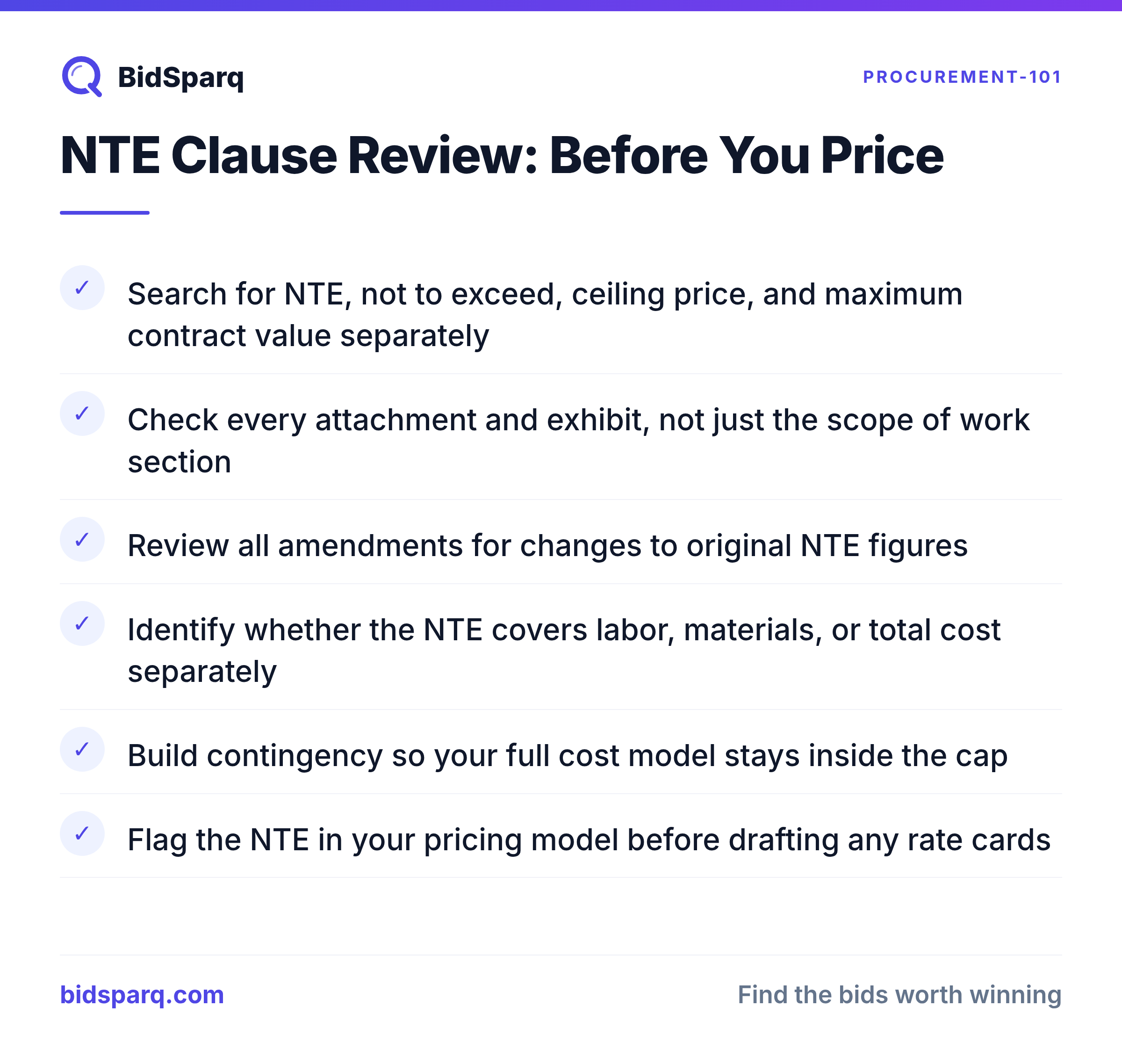
NTE provisions can appear in the main solicitation, an attached contract template, a pricing exhibit, or an amendment issued after the original posting, which is why a single-pass search never covers them all. A thorough review runs at least five separate text searches through the full document package: NTE, not to exceed, not-to-exceed, ceiling price, and maximum contract value each surface different instances in different documents. Watch for layered NTEs: a solicitation may carry one ceiling on labor, a separate cap on subcontractor costs, and a third on total project expenditure, and a cost model must reflect all three. If the solicitation includes amendments, review each one for modifications to original NTE figures; buyers sometimes raise or lower the cap between posting and deadline without re-issuing the full document. Building this into a standard review checklist, run before the cost model is drafted, is how teams stop discovering binding pricing constraints only after a proposal is already submitted.
FAQ
What does NTE mean in an RFP or contract?
NTE stands for Not to Exceed. In an RFP or resulting contract, it is the maximum the buyer will pay regardless of actual costs incurred by the vendor. If costs exceed the NTE, the difference is the vendor's liability. The clause appears across construction, healthcare IT, urban planning, education, and government procurement.
Is NTE the same as a fixed-price contract?
No. A fixed-price contract locks both the deliverable and the price: the buyer pays exactly that amount. An NTE contract allows billing on actuals up to the ceiling; you can bill less but not more. The critical difference is risk allocation: on a fixed-price contract the scope definition carries most of the risk, while on an NTE contract the vendor absorbs any overrun above the cap regardless of how scope evolved during delivery.
Where can I search for solicitations that include NTE language?
NTE clauses appear across every procurement sector. For federal opportunities, SAM.gov is the authoritative source and supports full-text search of solicitation documents. For state and local bids, your state's official eProcurement portal is the primary channel; most publish all state-agency solicitations there. For education and local government work, BoardDocs board agendas and state comptroller contract databases often surface relevant opportunities before they reach aggregators. Platforms that use semantic matching rather than keyword search are more likely to catch NTE clauses regardless of which synonym appears in the document.
Ready to surface every pricing clause before your next submission deadline? Explore open solicitations free on BidSparq, no credit card required.
Find RFPs that match your business
BidSparq monitors 23,000+ procurement sources and uses AI to score every opportunity against your capabilities. Try it free for 14 days.
Start Free Trial →