Calculate Indirect Rates for an RFP: Fringe, Overhead, G&A
Indirect rates make or break your RFP bids. See what fringe, overhead, and G&A really mean, a layered buildup from direct labor to fully burdened cost, and how to set rates you can defend in any market.

The indirect rate is the one line on your RFP that decides whether the bid wins or bleeds, and most firms guess it. Reuse last year's percentage, round up for safety, and you either price yourself out of contracts you were built to win or lock in a loss on every invoice you send. Getting fringe, overhead, and G&A right is the difference between a number you can defend and a number you only hope survives review.
- Your indirect rate decides whether a bid is competitive long before a buyer reads your technical approach.
- Three pools drive the math: fringe, overhead, and G&A, each allocated over its own base.
- A layered buildup turns $100,000 of direct labor into $178,750 of fully burdened cost before any profit.
- The same method travels across every procurement market; only the labels change.
- Recalculate from actual costs at least once a year so your rates track reality, not last year's guess.
What an indirect rate actually is
Read an indirect rate as the cost of staying in business, shared fairly across every job you deliver. Direct costs attach to one project: the welder on that site, the software license for that client, the materials for that order. Indirect costs keep the whole operation running and cannot be pinned to a single contract: your lease, your accounting system, payroll taxes, the hours an estimator spends bidding. Consider a commercial cleaning firm bidding a multi-site facilities contract. Its supervisors, vehicles, and insurance serve every account at once, so those costs have to be recovered through a rate spread across all billable labor rather than wished away. Procurement works this way everywhere buyers demand a defensible price, from private enterprise to public agencies. Government is one vertical among many, not a special case.
The three pools every bidder should track
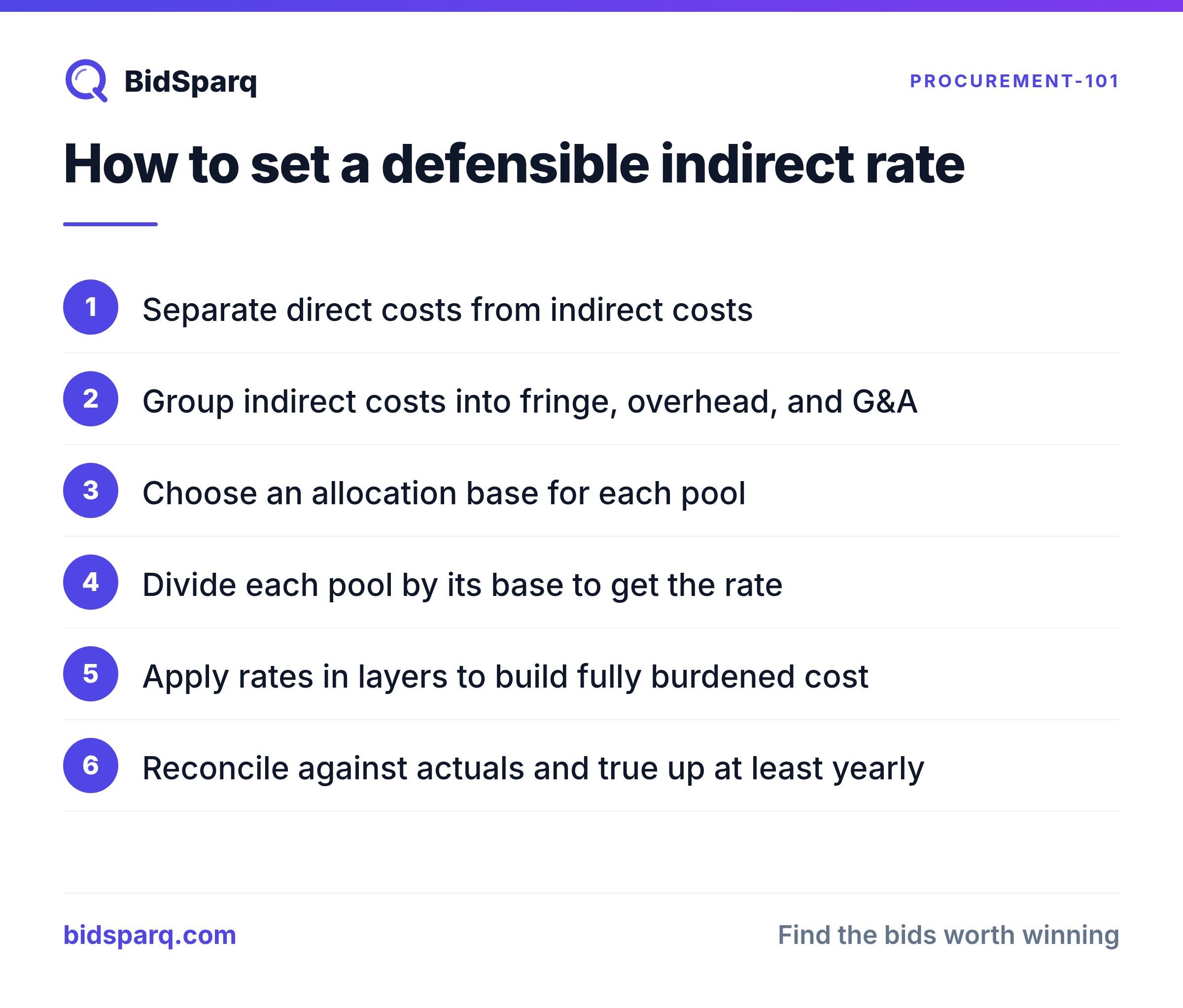
Sort your indirect costs into three distinct buckets before you calculate a single percentage: fringe, overhead, and G&A. Fringe is the cost of employing people beyond their base wage: payroll taxes, health benefits, paid leave. Overhead is the cost of doing the work: supervision, equipment, project-level facilities. G&A, general and administrative, is the cost of running the company: executive time, accounting, legal, business development. Each pool is divided by its own allocation base, usually a labor figure or a total-cost figure, to produce a rate. Collapsing all three into one blended number feels simpler, and it is exactly how firms end up unable to explain their pricing the moment a buyer or contracting officer pushes back on a line item.
A worked buildup: from raw wage to a price you can defend
Carry one block of work from direct labor all the way to fully burdened cost and the proof point becomes obvious. You can run this exact cascade with your own numbers in our free wrap rate calculator. Say a project needs $100,000 of direct labor. Layer the pools in order, each applied to the correct base, and the running cost climbs at every step:
| Layer | Basis | Amount added | Running cost |
|---|---|---|---|
| Direct labor | Starting point | $100,000 | $100,000 |
| Fringe at 30% | of direct labor | $30,000 | $130,000 |
| Overhead at 25% | of labor plus fringe | $32,500 | $162,500 |
| G&A at 10% | of the subtotal | $16,250 | $178,750 |
That $100,000 of labor actually costs $178,750 to deliver before a cent of profit. A bidder who eyeballs a flat 40 percent markup prices the same scope at $140,000 and quietly absorbs the missing $38,750 across the job. Build the stack in layers instead and you can trace any line a buyer challenges straight back to a real cost. That traceability is the difference between defending a number and guessing it.
This depth takes real effort, so reserve it for solicitations worth winning. Score your matching RFPs first, then run the full buildup only for the bids that fit your capability.
Why small firms get the rate wrong
The most expensive mistake is reusing one stale percentage for every bid, year after year. A firm that set 30 percent overhead three years ago and never revisited it is bidding against numbers that no longer describe its own business. Three failure modes repeat. First, sorting costs inconsistently, so the same expense lands as direct on one proposal and indirect on the next, which quietly makes every rate unreliable. Second, ignoring the allocation base and picking a number that feels right instead of one that actually recovers the spending it is meant to cover. Third, treating the rate as set and forget rather than reconciling it against actual numbers at year end. These compound silently across every proposal, which is why annual recalculation from actuals matters far more than any single clever adjustment. The fix is unglamorous: pull last year's real costs, repool them, redivide by the real base, and carry the new rates into every bid until the next reconciliation.
Spend less time hunting bids and more time costing them
Hunting for work should never eat the hours you need for accurate pricing. For most small teams the slow part of bidding is not the cost model, it is scanning portal after portal across every market they serve to find solicitations worth costing at all. Automation changes that math in two ways manual searching and keyword alerts cannot. First, semantic matching reads each RFP by meaning rather than by keywords, so a facilities contract still surfaces when the buyer writes janitorial and you searched maintenance, the exact miss a keyword filter never catches. Second, a fit score from 0 to 100 ranks every match against your capability and past work, so a tight opportunity might land at 87 while a loose hit sits at 34, and you build a fully burdened, indirect-rate-loaded estimate only for the bids worth the effort. BidSparq runs both across 23,000+ sources and adds automatic compliance extraction, flagging cost-format and price-realism requirements before you commit a day to a proposal. The payoff is concrete: less time triaging noise, more time on the few bids where your rates and your win odds both hold up.
FAQ
What are indirect rates in an RFP bid?
Indirect rates are percentages that recover costs you cannot tie to a single contract, grouped into fringe, overhead, and G&A pools. Each is calculated by dividing the pool of indirect costs by an allocation base such as direct labor, then applied to the direct costs in your RFP so your price reflects the true cost of performing the work.
How do I calculate an indirect cost rate for a small business?
Total the costs in each indirect pool for a period, choose an allocation base that drives those costs, and divide the pool by the base. For example, overhead costs divided by direct labor dollars gives your overhead rate. Recalculate from actuals at least annually so your bids stay accurate as your business grows.
What is a fair G&A rate to use on an RFP?
There is no universal figure. A defensible G&A rate reflects your real administrative costs divided by your chosen base, not an industry rumor. Small firms often run higher G&A than large ones because fixed administrative costs spread over less revenue. The right rate is the one you can trace to actual spending and explain on request.
You do not need a finance team to bid smarter. This buildup follows the same cost-principle logic contracting officers expect, so the number you submit is one you can trace and defend line by line. Build your rates from actual costs, then point them at the work that fits. Start free and score your matching RFPs, no credit card required, with Pro Max at $249 a month ($199 billed annually) when you outgrow the free tier.
Find RFPs that match your business
BidSparq monitors 23,000+ procurement sources and uses AI to score every opportunity against your capabilities. Try it free for 14 days.
Start Free Trial →