Winning EdTech Government Contracts Without the Guesswork
A practical guide to finding and winning edtech government contracts: how semantic matching, fit scoring, and requirement extraction turn a scattered public-sector market into a real pipeline.
Selling education technology into the public sector should be a growth engine, not a scavenger hunt. The demand is steady and well funded, but it hides behind thousands of disconnected portals, PDF attachments, and addenda that drop with little warning. Most edtech teams do not lose these deals on price or product. They lose them by never seeing the bid in time, or by pouring proposal hours into the wrong ones.
- Demand is fragmented, not scarce: edtech buyers post across K-12, higher ed, healthcare training, and workforce programs, each with its own portal and rules.
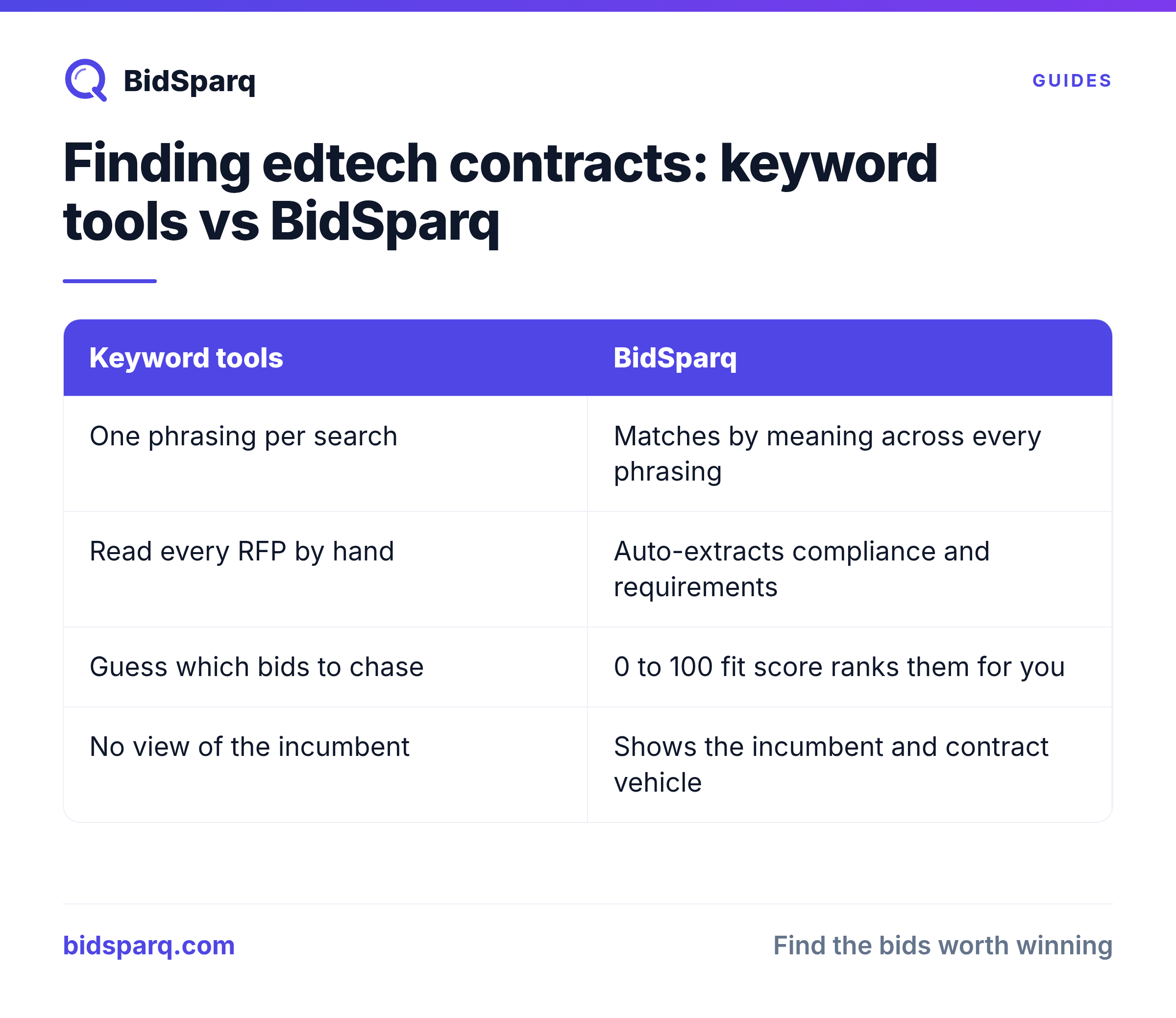
- Keyword search leaves money on the table: "learning management platform" and "digital instruction system" are often the same opportunity described two ways.
- A fit score beats gut feel: a 0 to 100 rating tells you which contracts deserve a proposal before you spend a week writing one.
- Requirements decide winners: eligibility and compliance language buried deep in an RFP is where most edtech bids are quietly won or lost.
- Incumbents and vehicles are knowable: seeing who holds the contract and whether it rides on a cooperative like Sourcewell or E&I changes how, and whether, you bid.
Edtech buyers live well beyond city hall
Edtech is a horizontal product that only sometimes wears a government label. A hospital network standardizing clinical onboarding, a private university replacing an aging LMS, and a corporate learning team buying compliance training all run structured procurements that look a great deal like public bids. When you map the full market first, across healthcare, higher education, and commercial training, the public-sector opportunities stop feeling like a separate universe and start looking like more of the buying behavior you already understand. Government is one lane on a wide road, not the whole road.
Why the government channel feels harder than it is
The barrier is rarely favoritism; it is raw volume and fragmentation. Federal, state, county, district, and campus buyers each publish independently, on their own schedules, in their own formats, and no single feed covers them. Pulling from 23,000+ distinct bid sources every day turns that noise into one searchable stream, which shifts the question from "where do I even look" to "which of these is worth my time." That is a far better problem to have, and it is the kind software solves well.
Match bids by meaning, not vocabulary
Buyers almost never describe your product in the words you would choose. A procurement officer writing an RFP for your exact platform might call it an instructional platform, a student information tool, a digital curriculum, or an assessment system. Keyword alerts surface only the phrasing you thought to type, so every synonym you miss is a bid you never see. Semantic matching reads for intent and surfaces the opportunity however it is worded. That is the practical gap between an automated system that understands your category and a manual keyword tool that makes you guess the vocabulary of every buyer in the country.
Let requirements, not the cover page, qualify the deal
A fit score earns its keep in the first hour of triage, not the last. The title of a bid tells you almost nothing about whether you can win it; the eligibility clauses, certifications, data-privacy rules, and mandatory features do, and they usually sit pages deep. Consider a county district RFP for a learning platform. Automatic requirement extraction pulls the terms that matter to the top: FERPA and state student-data-privacy compliance, single sign-on, roster sync with the district SIS, and a net-30 payment clause. Say your product clears the privacy and SSO requirements and integrates with the named SIS, but has no roster-sync connector yet. The result is a fit score near 78 out of 100, high enough to pursue with a small integration caveat, not a blind yes and not a reflexive no. BidSparq puts that extraction and fit-score view in one place, so your proposal hours land only on bids you can realistically win.
Read the incumbent and the contract vehicle
Who already holds the contract, and how did they win it? Many public education deals are renewals or ride on existing purchasing cooperatives, and the vehicle often matters more than the individual bid. Awards routed through Sourcewell, E&I Cooperative Services, or TIPS (The Interlocal Purchasing System) can let a qualified vendor sell without running a full RFP each time, while a district that already buys through one of them is unlikely to detour for a cold proposal. Knowing the incumbent tells you how entrenched they are and when the contract renews; knowing the vehicle tells you whether the fastest route in is a bid, a cooperative contract, or a relationship built for the next cycle. That single read often saves more time than any other step.
FAQ
How do I find edtech government contracts?
Aggregate the sources instead of checking portals one at a time. Public buyers publish across thousands of independent sites, so a platform that pulls from 23,000+ sources daily and matches bids by meaning surfaces far more relevant opportunities than keyword alerts on a handful of portals.
Are edtech government contracts only for large vendors?
No. Districts, campuses, and agencies buy from vendors of every size, and cooperative vehicles like Sourcewell, E&I, and TIPS lower the barrier for smaller teams. The advantage goes to whoever spots the right bids early and qualifies them fast, not to the biggest logo.
What is the fastest way to qualify an edtech RFP?
Let requirement extraction and a fit score handle the first pass. When compliance terms are pulled out automatically and each bid carries a 0 to 100 fit rating, you can rule out mismatches in seconds and spend proposal effort only on the contracts you can actually win.
The public-sector edtech market is real, and the hard part is discovery, which is exactly the part you can automate. See your matches on the Free tier, no credit card required. Start finding and scoring edtech bids free.
Find RFPs that match your business
BidSparq monitors 23,000+ procurement sources and uses AI to score every opportunity against your capabilities. Try it free for 14 days.
Start Free Trial →