Using AI to Write Bid Proposals Without Losing
A practical guide to using AI to write bid proposals faster: what to automate, what to keep human, and how to feed the model real fit signals so drafts do not read like everyone else's.
Most bid teams do not lose because they write badly. They lose because the response comes together in the final 48 hours, the requirements checklist is half finished, and the win themes get bolted on after the price is already locked. That is the real problem, and it is a time problem before it is a writing problem.
Using AI to write bid proposals is not about generating polished prose from a blank page. It is about compressing the hours you spend on structure, compliance, and tailoring so your people can spend their time on strategy and price. Point AI at the wrong work and you get fast, generic copy that reads like every other bidder. Point it at the right work and you get back a day.
- AI is a drafting accelerator, not an author. It handles the repeatable structure so experts handle the parts that win.
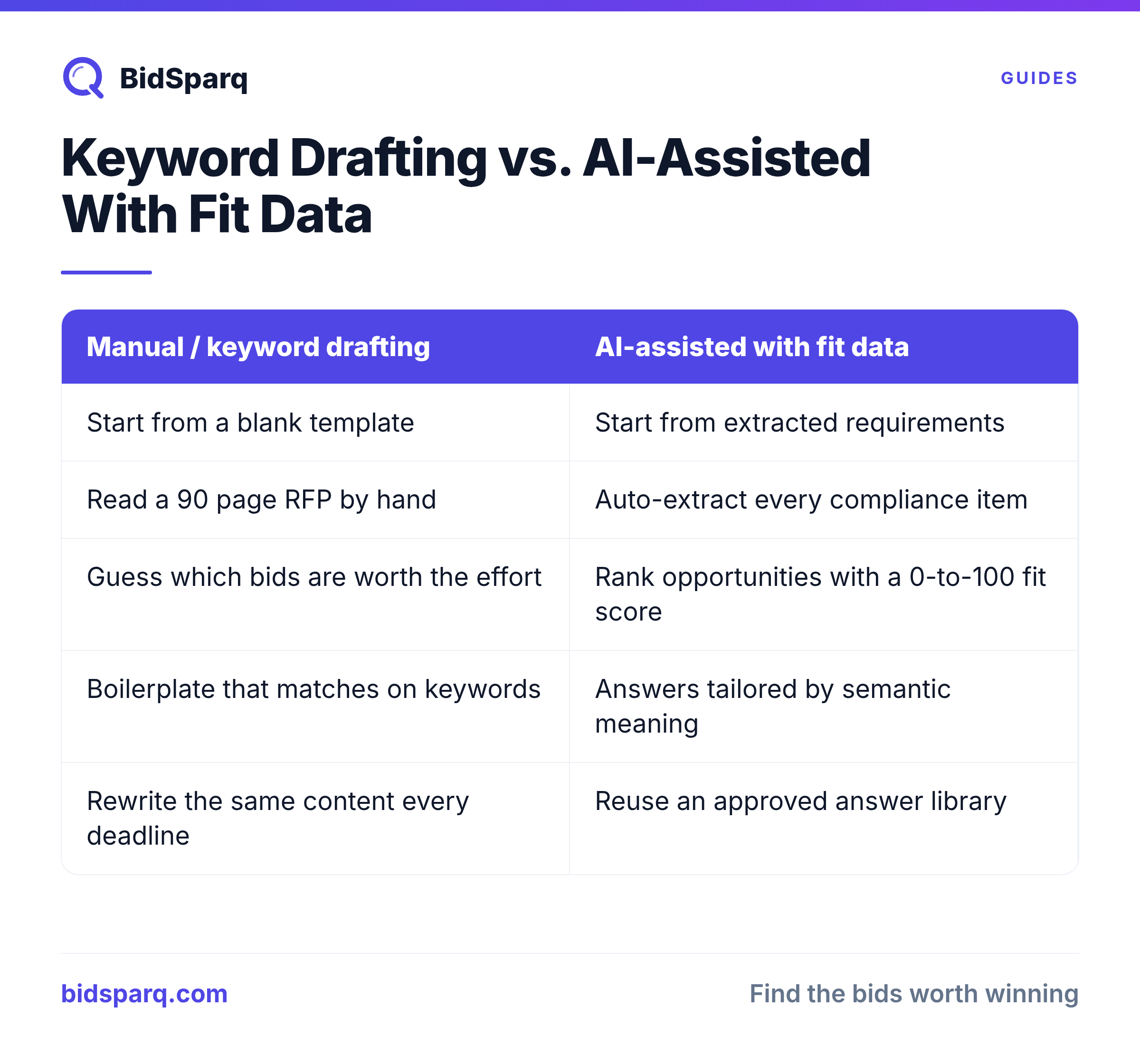
- Start from extracted requirements, never a blank template, so nothing that can disqualify you gets missed.
- Generic drafts lose, so feed the model real fit evidence instead of letting it invent filler.
- Compliance stays a human checkpoint, because one missed mandatory line can void an otherwise strong response.
- A reusable answer library beats rewriting the same capability statements on every deadline.
Where AI Actually Helps in a Bid Proposal
Use AI for the repeatable 70 percent, and reserve your experts for the 30 percent that wins. Consider a specialty subcontractor responding to a large healthcare facility build. Most of that response is not creative work. It is safety plans, staffing tables, past-performance summaries, and answers to questions the firm has answered a dozen times. AI can assemble that first pass in minutes. What it cannot do is decide why this bidder beats the incumbent, or how to phrase the schedule commitment that the evaluation team will actually score. Split the work that way and speed stops costing you quality.
Start From the Requirements, Not a Blank Page
Extract every requirement before you write a single sentence. The fastest way to lose a construction or IT bid is to draft a beautiful narrative that quietly skips a mandatory certification, a submission format, or a page limit. Reading a 90 page solicitation by hand and building a compliance matrix is exactly the slow, error-prone work automation was made for. Tools that automatically extract requirements and compliance items turn that day of manual highlighting into a structured checklist you can hand straight to an AI drafter as its outline. The model then writes to the requirements instead of around them.
Feed the AI Real Fit Signals, Not Guesses
Give the model evidence of why you fit, or it will invent generic filler. This is where keyword-era tools fall down and where modern discovery earns its keep. Semantic matching reads a solicitation by meaning rather than by matching strings, so it surfaces the requirements and themes that actually map to your capabilities. A 0-to-100 fit score tells you, before you commit a proposal team, whether the opportunity is worth a serious draft or a quick decline. Incumbent and contract-vehicle intelligence tells you who you are displacing and how the buyer typically purchases. Hand those signals to your AI drafter and the tailoring writes itself; withhold them and you get boilerplate that any competitor could have submitted. Platforms like BidSparq exist to produce exactly these signals so the draft starts from evidence, not assumptions.
Keep Humans on Compliance and Win Themes
Never let AI own the two things that decide the outcome: what gets you disqualified, and what sets you apart. A confident model will happily assert a certification you do not hold or paraphrase a mandatory clause into something noncompliant. It will also flatten your strongest differentiator into a sentence that sounds like everyone else. Use AI to draft, then have a human verify every compliance answer against the extracted matrix and rewrite the two or three win themes in language a real evaluator responds to. The pattern is simple: machines for coverage and speed, people for judgment and risk.
Build a Reusable Content Engine
Turn every proposal into raw material for the next one. The teams that scale with AI are not regenerating answers from scratch each time. They keep a curated library of approved capability statements, past-performance entries, and standard responses, and they let AI adapt those to each new solicitation's requirements and tone. Over a year that library becomes the difference between chasing three bids and pursuing thirty. The AI is only as good as the source content you give it, so treat the library as a product, not a folder.
FAQ
Can AI write a winning bid proposal on its own?
No. AI can produce a fast, complete first draft and handle the repeatable sections well, but a fully automated proposal tends to be generic and carries real compliance risk. The winning version comes from AI drafting the bulk and experts owning compliance verification and the differentiating win themes.
Is it safe to use AI for RFP and government bid responses?
It is safe when a human verifies every requirement against the actual solicitation and no confidential data goes anywhere it should not. AI is excellent at extracting requirements and drafting structure across government, education, healthcare, and commercial bids, but you should never submit machine-written compliance answers without a human sign-off.
How do I stop AI from writing generic proposal content?
Feed it evidence instead of a blank prompt. Give the model the extracted requirements, a fit score, incumbent context, and your approved past-performance library, then ask it to tailor. Drafts built on real fit signals read like you understood the buyer; drafts built on keywords read like a template.
Stop losing bids to the clock. See your bid matches and fit scores free, no credit card needed.
Find RFPs that match your business
BidSparq monitors 23,000+ procurement sources and uses AI to score every opportunity against your capabilities. Try it free for 14 days.
Start Free Trial →