Where to Find Federal RFPs Besides SAM.gov (Real Sources)
SAM.gov is one source, not the whole map. Here is where to find federal RFPs besides SAM.gov, plus how to stop missing winnable work hidden across other channels.
A construction estimator types "facility renovation" into SAM.gov, scans two pages of mismatched notices, and closes the tab convinced there is nothing to bid this week. Meanwhile the exact project the firm could win is already in motion: it appeared six weeks ago in an agency acquisition forecast, and the formal solicitation will post on a state portal spending federal pass-through dollars. SAM.gov never showed it, because the work was not on SAM.gov yet and the wording would not have matched that search anyway. This is the quiet way pipelines run thin. Knowing where to find federal RFPs besides SAM.gov is the difference between seeing a sliver of the market and seeing the whole field.
Key takeaways
- SAM.gov is a baseline, not the whole map. Plenty of federal opportunity lives on systems it never indexes.
- Agency acquisition forecasts often signal upcoming work months before a solicitation ever posts.
- Subcontracting portals open federal revenue to firms that will never hold a prime contract.
- Award databases reveal who holds the work today and which contract vehicle it runs through.
- Keyword search misses meaning, while semantic matching surfaces opportunities phrased nothing like your query.
- Coverage beats effort. Watching more channels and scoring by fit wins more than refreshing one search box harder.
The blind spot SAM.gov creates
If your federal pipeline feels thin, the cause is usually coverage, not effort. SAM.gov is genuinely comprehensive for posted contract solicitations above the simplified acquisition threshold, which is exactly why teams trust it to be the whole picture. It is not. A large share of real opportunity sits upstream and sideways from it: in forecasts that have not become solicitations, in grant programs that never touch the contract side, in subcontracting under primes, and in state and local portals spending federal pass-through dollars on infrastructure, education, and health programs. A team that searches one box on one site is reading a fraction of the market and calling it the whole thing, then wondering why the funnel is empty.
Where to find federal RFPs besides SAM.gov
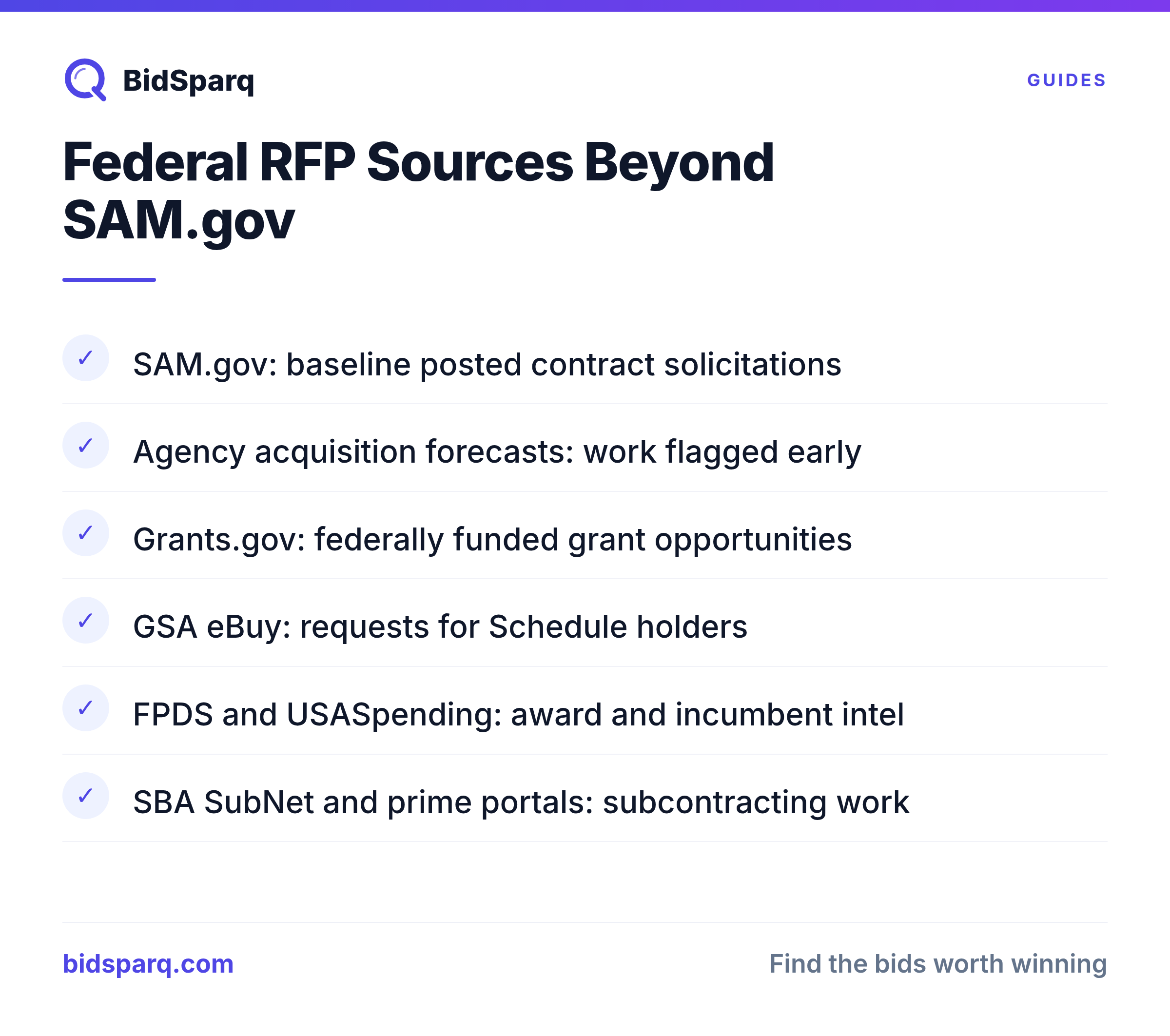
The fix is to map federal opportunity across several channels instead of relying on one. Each system below carries work that a single SAM.gov search will not reliably surface, so the goal is coverage, not loyalty to one portal.
- Agency acquisition forecasts. Many agencies publish forecasts of contracting opportunities that name upcoming work long before it becomes a formal solicitation, giving you time to position rather than scramble.
- Grants.gov. Federally funded grant opportunities that fall outside the contract process entirely, which matters for education, research, and health-focused organizations.
- GSA eBuy. Where holders of GSA Schedules receive requests that are never broadcast on the open contract feed.
- FPDS and USASpending.gov. Award databases that show historical contracts, dollars, and the agencies that buy what you sell.
- SBA SubNet and prime contractor portals. Subcontracting opportunities that let smaller firms earn federal revenue without winning a prime award.
- State and local portals with federal pass-through funding. Federally backed projects are frequently procured at the local level, far from any federal system.
The intel layer most teams skip
Finding an RFP is the easy half; knowing whether you can actually win it is where most teams fly blind. Discovery puts an opportunity in front of you, but it says nothing about whether the contest is real. That answer lives in award data. The incumbent tells you who you are displacing and how entrenched they are. The contract vehicle tells you whether you are even eligible to play. The agency's buying pattern tells you whether this is an open competition or a recompete that was effectively decided two budget cycles ago. Pulling that picture by hand across FPDS, USASpending, and scattered agency pages is slow enough that it usually does not happen, so teams pour days into proposals they were never positioned to win. Automated incumbent and contract-vehicle intelligence delivers that read alongside the opportunity itself, which turns a hopeful guess into a qualified go or no-go decision before anyone drafts a word.
Why more tabs is not the answer
Resist the urge to solve a discovery problem with manual labor. The reflex after reading the list above is to bookmark eight sites and check them every morning, but that is the trap, not the escape. Keyword search on any one portal misses opportunities described in language you did not think to type, and no amount of tab-switching fixes a matching problem. Procurement is far bigger than the federal vertical, and BidSparq was built to read that whole market the way a person would, not the way a search box does. Semantic matching reads each opportunity for meaning and surfaces the ones that fit what you actually do, then assigns a 0 to 100 fit score so you triage by relevance instead of skimming everything. Compliance and requirement extraction pulls the must-meet terms out of long documents automatically, so a buried certification or bonding requirement does not sink you after you have already invested days. Aggregating 23,000+ distinct bid sources daily means the federal channels above sit beside state, education, healthcare, construction, and commercial opportunities in one place, all scored the same way. You can compare the manual approach and the automated one side by side in our RFP discovery software built for the whole market.
How to build a federal discovery routine that holds up
Build the routine around coverage and scoring, not around checking favorite sites. A durable process starts wide across every channel, watches forecasts so you catch work early, reads award data before committing resources, and filters by genuine fit rather than raw volume. Notice what that routine does not depend on: discipline to refresh the most tabs, or luck in guessing the right keywords. The teams that win consistently are the ones who see more of the real market and waste less time on opportunities they were never going to land. Find more, chase less, and let the matching do the searching.
FAQ
Where can I find federal RFPs if not on SAM.gov?
Beyond SAM.gov, check agency acquisition forecasts, Grants.gov for federally funded grants, GSA eBuy if you hold a Schedule, subcontracting portals like SBA SubNet and prime contractor sites, and award databases such as FPDS and USASpending.gov. State and local portals also carry federally funded work. A platform that aggregates these sources removes the need to monitor each one by hand.
Is SAM.gov the only place to find government contracts?
No. SAM.gov is the central system for posted federal contract solicitations, but a large share of opportunity exists as forecasts, grants, subcontracts, and locally procured projects funded by federal dollars. Relying only on SAM.gov means seeing opportunities late, or not at all.
How do I find federal subcontracting opportunities?
Start with SBA SubNet and the subcontracting or supplier portals run by large prime contractors, since primes are often required to subcontract a portion of major awards. Award databases also help you identify which primes hold contracts in your space so you can approach them directly.
See your matches free, no credit card required.
Find RFPs that match your business
BidSparq monitors 23,000+ procurement sources and uses AI to score every opportunity against your capabilities. Try it free for 14 days.
Start Free Trial →