Marine Corps Contracting: How to Find and Win USMC Contracts
Learn how Marine Corps contracting works, where to find USMC RFPs, key procurement offices (MCSC, MCICOM, MCLC), NAICS codes, small business programs, and how to win contracts.

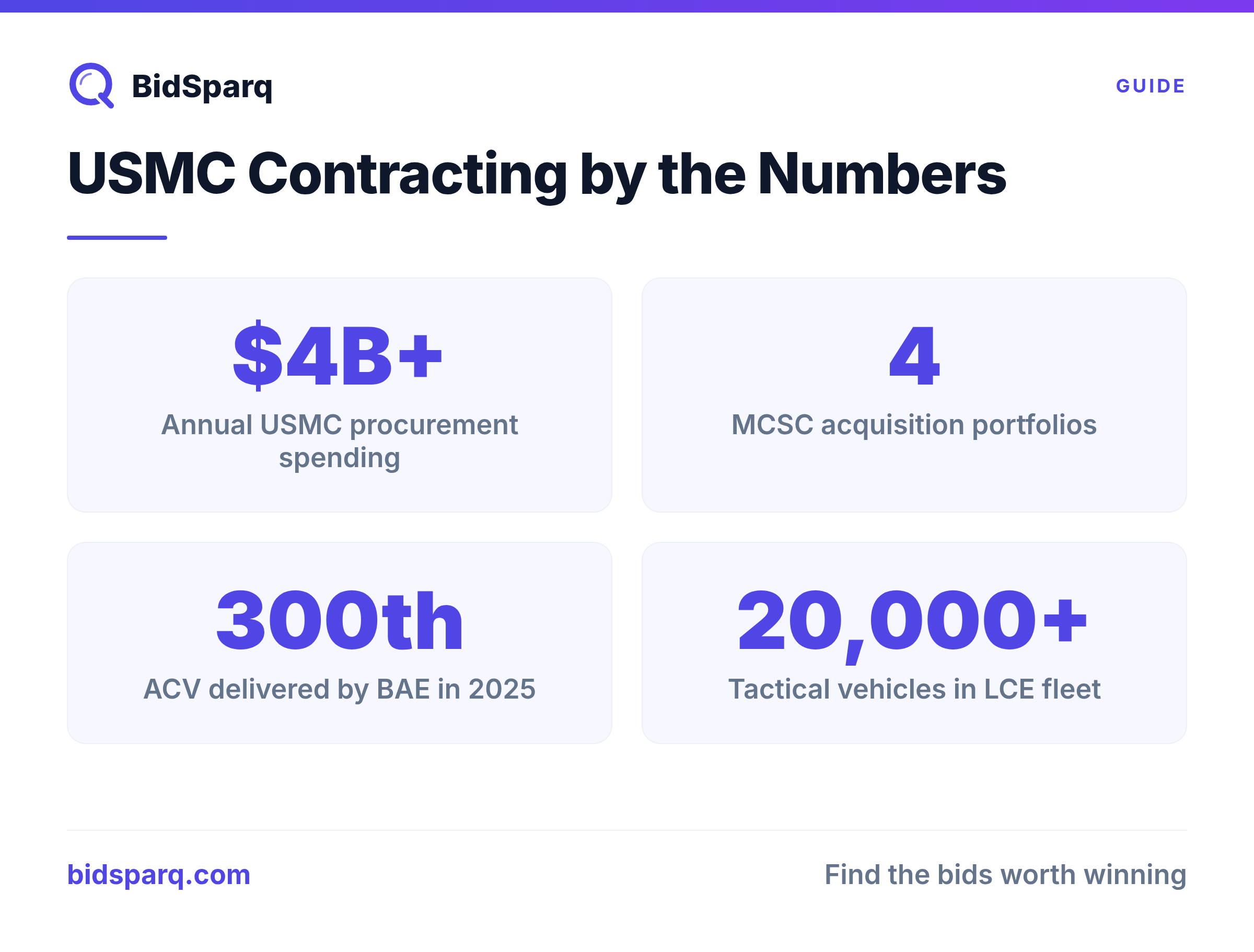
The United States Marine Corps spends over $4 billion annually on procurement: from amphibious combat vehicles and tactical radios to IT systems, base construction, and logistics support. For contractors who understand the USMC's unique expeditionary mission and acquisition structure, Marine Corps contracts offer substantial opportunities with less competition than Army or Navy programs.
This guide covers everything vendors need to know: how Marine Corps procurement is organized, where to find opportunities, what makes USMC contracting different, and how to position your company to win.
How Marine Corps Procurement Is Organized
Unlike the Army (which has 7+ Program Executive Officers) or the Navy (multiple PEOs), the Marine Corps has historically operated the smallest and most streamlined acquisition enterprise in the Department of Defense. Three main organizations handle the bulk of USMC contracting:
Marine Corps Systems Command (MCSC): Quantico, VA
MCSC is the sole acquisition command of the Marine Corps and serves as Head of Contracting Authority. Its unofficial tagline: it equips Marines with "everything they drive, shoot, and wear." MCSC manages four acquisition portfolios:
- Ground Combat Element Systems: Infantry weapons (M27 IAR), tactical vehicles (JLTV), amphibious platforms (ACV). BAE Systems delivered the 300th Amphibious Combat Vehicle in 2025.
- Command Element Systems: C4ISR, tactical networks, intelligence fusion, and cyber defense systems.
- Logistics Combat Element Systems: Tactical vehicles (managing a fleet of 20,000+ units), supply and maintenance systems.
- Supporting Establishment Systems: Infrastructure, PPE, CBRNE response gear, and facilities.
MCSC also houses standalone program offices including PM Light Armored Vehicles (Detroit Arsenal, MI), PM Training Systems (Orlando, FL: ~$368M annual budget), and an International Programs office managing $135M+ in Foreign Military Sales.
Marine Corps Installations Command (MCICOM): Arlington, VA
MCICOM handles installation support services: facilities maintenance, base IT, construction, food service, transportation, professional services, and recreation. In November 2024, MCICOM awarded a $164M IDIQ to 10 contractors for logistics, IT, training, and installation readiness support.
Marine Corps Logistics Command (MCLC): Albany, GA
MCLC manages spare parts, depot maintenance, and supply chain services from two bases: MCLB Albany, GA (eastern forces) and MCLB Barstow, CA (western/Pacific forces). The Marine Depot Maintenance Command at Albany handles multi-commodity repair of ground combat systems. MCLC has its own Small Business Office.
Note on construction: Most construction projects on Marine Corps installations are contracted through NAVFAC (Naval Facilities Engineering Systems Command), not MCSC. In September 2023, NAVFAC awarded a $99M construction MACC for MCLB Albany covering warehouses, maintenance facilities, and training areas.
What Makes Marine Corps Contracting Different
USMC procurement has several characteristics that set it apart from other DoD branches:
Expeditionary-First Doctrine
Everything the Marine Corps buys must be lighter, more mobile, and ship-deployable. Unlike the Army (which plans for prolonged ground campaigns with heavy logistics), Marine Corps equipment must be transportable on amphibious ships (LHDs, LPDs): constraining weight, size, and sustainment requirements. The JLTV is used by both services, but the Marine Corps evaluates it differently because it must be helicopter-liftable.
Force Design 2030 Is Reshaping Procurement
The Marine Corps is undergoing its most dramatic restructuring in decades through Force Design 2030. The Corps eliminated all tanks and cut infantry battalions in favor of anti-ship missiles, long-range precision fires, and drone swarms. This created entirely new procurement categories:
- NMESIS: Shore-based anti-ship missile launchers (Raytheon, ~$50M LRIP contract in 2024)
- Landing Ship Medium (LSM): New class of vessels for island-hopping operations
- Marine Littoral Regiments: New units requiring unique C4ISR and logistics systems
- Long-range fires: Including Tomahawk Block V missiles (46 planned over 5 years)
If you sell systems that support distributed maritime operations, small-unit logistics, or expeditionary C4ISR, the Marine Corps is actively buying.
Single PEO, Streamlined Oversight
In April 2026, the Department of the Navy replaced PEO Land Systems with a new Portfolio Acquisition Executive-Marine Corps (PAE-MC), consolidating oversight further. The stated goal: "maneuver warfare in acquisition, speed, alignment, velocity and accountability." This means faster decision-making and fewer bureaucratic layers than Army or Air Force procurement.
Rapid Acquisition Programs
The Marine Corps has several mechanisms for fast-tracking procurement:
- Marine Corps Rapid Capabilities Office (MCRCO): Located at Marine Corps Warfighting Laboratory, Quantico. Uses a "fusion framework" with acquisition, S&T, and warfighting personnel working in parallel.
- Urgent Universal Needs Statement (UUNS): Formal mechanism for rapid fielding when a combat capability gap is identified. Approval authority at O-9 (Lieutenant General) level: faster than Navy or Air Force equivalents.
Marine Corps Procurement Budget
The FY2024 Procurement, Marine Corps appropriation was $3.98 billion, with a FY2025 request of $4.2 billion. Major line items include:
| Program | FY2025 Request | Details |
|---|---|---|
| Amphibious Combat Vehicle (ACV-30mm) | $810M | 80 vehicles |
| Joint Light Tactical Vehicle (JLTV) | $341M | 674 vehicles + 340 trailers |
| Marine Air Defense Integrated System | $180M | Integrated air defense |
| CH-53K King Stallion | Multi-billion | 19 aircraft (2-year block buy); $10.9B 5-year contract awarded Sept 2025 |
| F-35B/C | Per-aircraft | 13 F-35B + 13 F-35C requested |
| G/ATOR Radar | $51M | Sensor upgrades |
Beyond procurement, the Marine Corps spends $4.7B on ground combat readiness, $5.7B on aviation readiness, and $4.5B on Fleet Marine Force readiness: all of which flow to contractors through maintenance, sustainment, and support contracts.
Where to Find Marine Corps RFPs
SAM.gov
All Marine Corps solicitations over $25,000 are posted on SAM.gov. Filter by agency "Marine Corps" or sub-agency "Marine Corps Systems Command" or "Marine Corps Installations Command." This is the mandatory and most complete source.
MCSC Contracts Page
MCSC publishes active and upcoming solicitations, contract vehicles, and industry day announcements on its engagement opportunities page at marcorsyscom.marines.mil.
Key Contract Vehicles
- SeaPort-NxG: The Navy and Marine Corps' joint $50 billion IDIQ for professional and engineering support services. Covers 23 functional areas including engineering, program management, and financial management. Over 1,800 contract holders with rolling admissions.
- GSA Multiple Award Schedules: USMC uses GSA Schedules for commercial products and services.
- OASIS+: Government-wide IDIQ for complex professional services across 29 NAICS codes.
MCICOM Contracting Portal
Installation-specific solicitations are posted at mcicom.marines.mil/Resources/MCICOM-Contracting/.
Aggregators
Marine Corps opportunities are scattered across SAM.gov, MCSC, MCICOM, NAVFAC, and SeaPort-NxG. BidSparq monitors 23,000+ procurement sources including federal defense solicitations and surfaces opportunities matched to your capabilities.
NAICS Codes for Marine Corps Contracts
Key NAICS codes for Marine Corps procurement:
- 336992: Military Armored Vehicle, Tank, and Tank Component Manufacturing (ACVs, JLTVs, LAVs)
- 336411: Aircraft Manufacturing (CH-53K, F-35B/C)
- 336414: Guided Missile and Space Vehicle Manufacturing (NMESIS, Tomahawk, Javelin)
- 332994: Small Arms, Ordnance, and Ordnance Accessories Manufacturing
- 541512: Computer Systems Design Services (C4ISR, command and control)
- 541330: Engineering Services (systems integration, program support)
- 541519: Other Computer Related Services (IT services)
- 811310: Commercial and Industrial Machinery Repair and Maintenance (depot maintenance)
- 237990: Other Heavy and Civil Engineering Construction (NAVFAC base construction)
- 611699: All Other Miscellaneous Schools and Instruction (training systems)
Small Business Programs
The Marine Corps actively supports small business participation in procurement:
- MCSC Office of Small Business Programs: Targets 23% of contracting dollars to small businesses. FY2022 small business goals exceeded $2 billion in value.
- Navy SBIR/STTR: MCSC contributes topics to the Navy SBIR/STTR solicitation (issued ~3x/year for SBIR, 2x/year for STTR). Eligibility: U.S.-owned companies with 500 or fewer employees.
- DoD Mentor-Protégé Program: Large prime contractors mentor small businesses; mentors receive additional fee/profit as incentive. Permanently authorized by FY2023 NDAA.
- MCLC Small Business Office: Separate small business office at MCLB Albany focusing on spare parts, maintenance services, and logistics support.
Federal small business set-aside goals apply to all USMC contracting: 23% overall small business, 15% Small Disadvantaged Business, 5% SDVOSB, 5% WOSB, and 3% HUBZone.
Recent Notable Marine Corps Contracts
| Contract | Contractor | Value | Date |
|---|---|---|---|
| CH-53K King Stallion (up to 99 helicopters, 5-year) | Sikorsky/Lockheed Martin | $10.9B | Sept 2025 |
| Network Infrastructure IDIQ (10-year, 6 companies) | Multiple | $809M | May 2024 |
| Falcon IV Multi-Channel Radios (10-year IDIQ) | L3Harris | $750M | Aug 2024 |
| Amphibious Combat Vehicle (ongoing) | BAE Systems | $3.86B total | Ongoing |
| Camp Blaz Communications Facility (Guam) | Core Tech-HDCC-Kajima | $290M | Sept 2025 |
| Installation Command Support (10-company IDIQ) | Multiple | $164M | Nov 2024 |
| MCLB Albany Construction MACC (5-year) | Multiple | $99M | Sept 2023 |
| NMESIS Anti-Ship Missile (LRIP) | Raytheon/RTX | ~$50M | Apr 2024 |
How to Win Marine Corps Contracts
Understand the Expeditionary Mission
Generic defense proposals fail with the Marine Corps. Demonstrate that you understand the unique constraints: weight limits for ship transport, austere operating environments, rapid deployment requirements, and the shift toward distributed maritime operations under Force Design 2030.
Leverage SeaPort-NxG
If you provide professional or engineering services, getting on the SeaPort-NxG contract vehicle is one of the most effective paths to Marine Corps work. With 1,800+ holders and rolling admissions, the barrier to entry is manageable.
Attend Industry Days
MCSC regularly hosts industry days and publishes acquisition update briefings. PM Training Systems (TRASYS) publishes detailed acquisition briefs. These events give you direct access to program managers and upcoming requirements.
Start with MCICOM or MCLC
If you're new to Marine Corps contracting, installation support (MCICOM) and logistics/maintenance (MCLC) contracts are more accessible than MCSC weapons system programs. These offices procure IT, facilities services, training, and professional services that don't require weapons-specific experience.
Target Small Business Set-Asides
With 23% small business goals and an active OSBP, small businesses have meaningful opportunities. The SBIR/STTR program is particularly valuable for technology companies, and MCSC has a dedicated Technology Transition Office to move SBIR innovations into production contracts.
Next Steps
- Try BidSparq free for 14 days: AI-matched defense RFPs from 23,000+ sources
- Browse active defense RFPs by state
- Learn about SAM.gov registration: required for all federal contracts
- Understand NAICS codes for defense procurement
- Read our guide to DOD contracts
Find RFPs that match your business
BidSparq monitors 23,000+ procurement sources and uses AI to score every opportunity against your capabilities. Try it free for 14 days.
Start Free Trial →