What Is an RFP in Healthcare? How Vendors Can Find and Win Healthcare Contracts
Learn how healthcare RFPs work, where to find them, what compliance requirements apply, and how to write winning proposals for hospitals, health systems, and government health agencies.
Healthcare is one of the largest and most consistent sources of government and institutional procurement in the United States. Hospitals, health systems, state Medicaid agencies, the VA, and public health departments all use Requests for Proposals (RFPs) to purchase everything from medical equipment and pharmaceuticals to IT systems, consulting services, and facility management.
If you sell products or services to healthcare organizations, understanding how healthcare RFPs work is essential. This guide covers the landscape, compliance requirements, where to find opportunities, and how to write proposals that win.
What Is a Healthcare RFP?
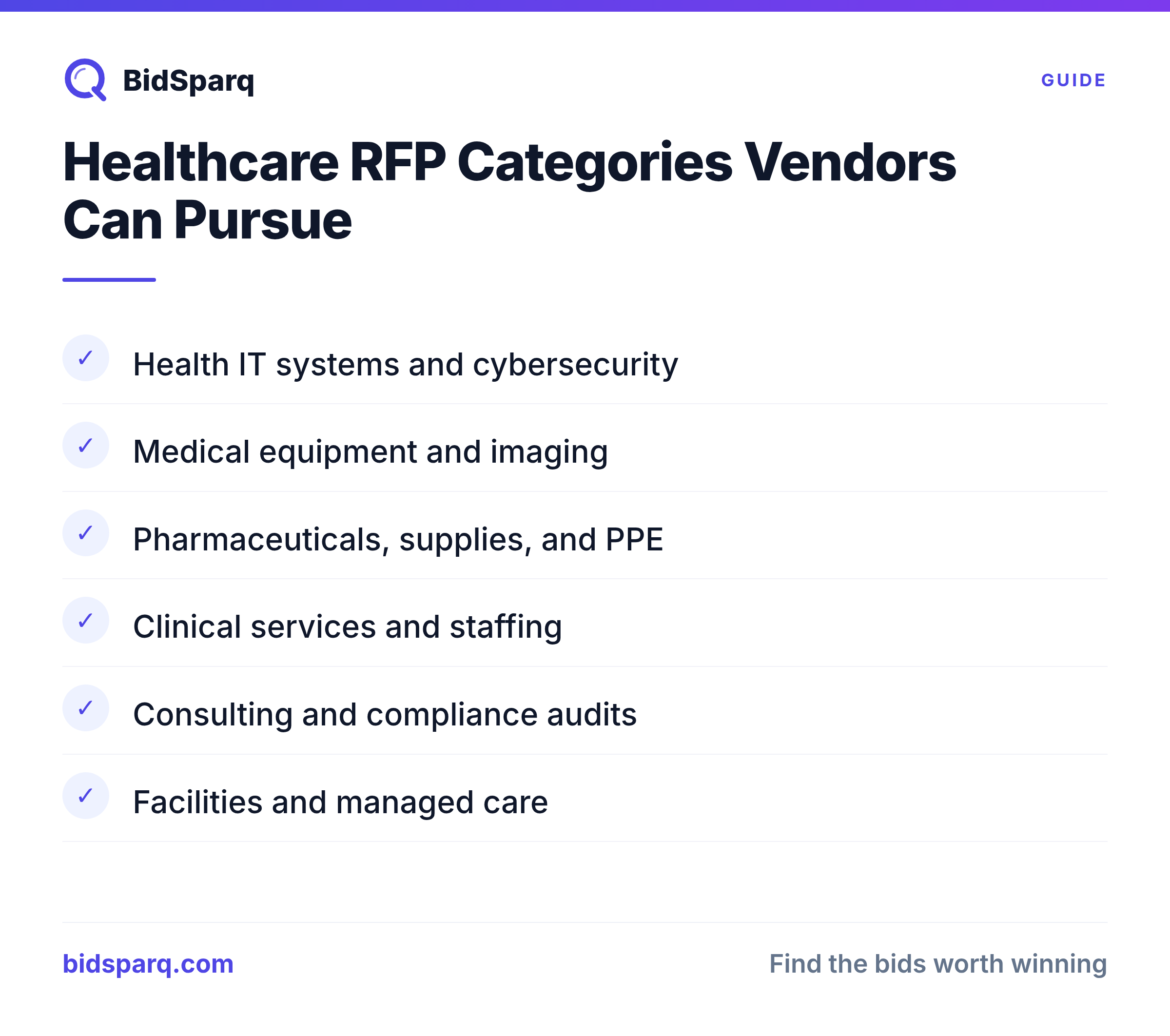
A healthcare RFP is a formal solicitation issued by a healthcare organization: a hospital, health system, government health agency, or managed care plan, inviting vendors to propose solutions for a specific need. Healthcare RFPs cover an enormous range of purchases:
- Health IT: EHR/EMR systems, telehealth platforms, clinical decision support, revenue cycle management, cybersecurity
- Medical equipment: Imaging systems, surgical equipment, laboratory instruments, patient monitoring
- Pharmaceuticals and supplies: Drug procurement, medical/surgical supplies, PPE, reagents
- Clinical services: Staffing agencies, lab services, radiology reading, behavioral health programs
- Consulting: Strategic planning, compliance audits, revenue cycle optimization, population health
- Facilities: Construction, renovation, biomedical engineering, environmental services, food services
- Managed care: Insurance carriers, third-party administrators, pharmacy benefit managers
Who Issues Healthcare RFPs?
Healthcare procurement is split between public-sector agencies (which must follow formal procurement rules) and private health systems (which have more flexibility but still use RFPs for major purchases).
Government Health Agencies
- Department of Veterans Affairs (VA): The largest integrated healthcare system in the U.S., with 171 medical centers and over $100 billion in annual spending. VA RFPs are posted on SAM.gov.
- Department of Health and Human Services (HHS): Includes CMS (Medicare/Medicaid), CDC, NIH, FDA, HRSA, and SAMHSA. Each agency issues its own RFPs.
- State Medicaid agencies: Every state procures managed care plans, IT systems, and services for their Medicaid program. These are often the largest state-level healthcare contracts.
- State and local health departments: Public health programs, community health centers, behavioral health services, and emergency preparedness.
- Military health (DHA/TRICARE): The Defense Health Agency procures healthcare services for military members and families.
- Indian Health Service (IHS): Healthcare services for American Indian and Alaska Native populations.
Public Hospitals and Health Systems
Many hospitals are government-owned: county hospitals, university medical centers, and public health systems. These entities follow public procurement rules and post RFPs through their state or local procurement portals.
Private Health Systems
Large private health systems (HCA, CommonSpirit, Ascension, Kaiser Permanente) issue RFPs for major purchases, though they're not required to post them publicly. Getting on their vendor lists and building relationships with procurement teams is key.
What Makes Healthcare RFPs Different?
Healthcare RFPs have unique requirements that don't exist in other industries. Missing any of these can disqualify your proposal immediately.
HIPAA Compliance
If your product or service will touch Protected Health Information (PHI), and most healthcare IT, clinical services, and consulting engagements do: you must demonstrate HIPAA compliance. This means:
- Business Associate Agreement (BAA): You must sign a BAA with the covered entity. Include a sample BAA or confirm willingness to sign theirs.
- Security controls: Encryption at rest and in transit, access controls, audit logging, breach notification procedures
- Risk assessment: Evidence of regular security risk assessments per the HIPAA Security Rule
- Training: Documentation that your staff receives HIPAA training
For IT vendors, expect detailed security questionnaires: often 200+ questions, as part of the RFP response.
Interoperability and Standards
Healthcare IT RFPs increasingly require compliance with interoperability standards:
- HL7 FHIR: The modern standard for healthcare data exchange. Many RFPs now require FHIR API support.
- HL7 v2: Legacy messaging standard still widely used for ADT, lab, and pharmacy interfaces
- DICOM: Standard for medical imaging data
- X12 EDI: Electronic transactions for claims, eligibility, and remittance
- CDA/C-CDA: Clinical Document Architecture for care summaries
The 21st Century Cures Act and ONC regulations now require certified health IT to support FHIR-based APIs and prohibit information blocking: so if you sell health IT, be prepared to address these requirements explicitly.
Clinical Evidence and Outcomes
Healthcare buyers expect evidence that your solution works. Unlike general IT procurement where feature lists suffice, healthcare RFPs often ask for:
- Clinical studies or peer-reviewed publications demonstrating efficacy
- Case studies with measurable outcomes (reduced readmissions, improved quality scores, cost savings)
- References from comparable healthcare organizations
- Data on patient safety impact
Regulatory and Accreditation Requirements
Depending on the product/service, you may need:
- FDA clearance/approval: For medical devices, diagnostics, and some software (SaMD, Software as a Medical Device)
- Joint Commission / DNV accreditation alignment: Your services must support the organization's accreditation requirements
- CMS Conditions of Participation: Products used in patient care must support compliance with CMS CoPs
- State licensure: Clinical staffing, laboratory, and pharmacy services require state-specific licenses
NAICS Codes for Healthcare Vendors
The right NAICS codes help you find relevant opportunities and register properly in SAM.gov. Key healthcare NAICS codes include:
- 541512: Computer Systems Design (health IT implementations)
- 518210: Data Processing, Hosting (cloud healthcare platforms)
- 621999: Miscellaneous Ambulatory Health Care Services
- 621610: Home Health Care Services
- 621511: Medical Laboratories
- 339112: Surgical and Medical Instrument Manufacturing
- 339113: Surgical Appliance and Supplies Manufacturing
- 423450: Medical Equipment and Supplies Merchant Wholesalers
- 524114: Managed Care / Health Insurance
- 541611: Management Consulting (healthcare strategy)
- 561320: Temporary Staffing (clinical staffing agencies)
Where to Find Healthcare RFPs
Federal Sources
- SAM.gov: All federal healthcare solicitations, including VA, HHS, DHA, and IHS. Filter by healthcare NAICS codes.
- VA eCMS: The VA's Electronic Contract Management System for simplified acquisitions.
- NIH OAMP: National Institutes of Health Office of Acquisition and Management Policy for research-related procurements.
- GSA Advantage / GSA Schedule 65 (Medical Equipment) and 621 I (Health IT): Pre-negotiated contract vehicles that streamline federal healthcare purchasing.
State Sources
- State procurement portals: State Medicaid managed care contracts, health IT modernization projects (often funded by CMS), and public health programs. Browse active RFPs by state.
- State health information exchanges (HIEs): Procurement for health data infrastructure.
- Public hospital systems: County and university hospital procurement pages.
Group Purchasing Organizations (GPOs)
GPOs aggregate purchasing volume for hospitals and negotiate contracts with vendors. Getting on a GPO contract is one of the most effective ways to access the hospital market:
- Vizient: Largest GPO, serving over 50% of U.S. hospitals
- Premier: 4,400+ hospitals and health systems
- HealthTrust (HCA): GPO for HCA and affiliated hospitals
- Intalere: Focused on non-acute and ambulatory care
GPOs issue their own RFPs for contract categories. Winning a GPO contract gives you access to thousands of member hospitals without bidding individually.
Aggregators
Healthcare RFPs are scattered across federal, state, local, and institutional sources. BidSparq monitors 23,000+ procurement sources and uses AI to surface healthcare opportunities matched to your capabilities: so you don't miss contracts buried on obscure state portals or hospital websites.
Evaluation Criteria for Healthcare RFPs
Healthcare RFPs typically evaluate proposals on these factors:
| Criterion | Typical Weight | What They're Looking For |
|---|---|---|
| Technical approach | 30-40% | Solution design, implementation plan, workflow impact, clinical integration |
| Experience and references | 20-25% | Similar implementations at comparable organizations, measurable outcomes |
| Compliance and security | 10-20% | HIPAA, interoperability standards, regulatory requirements |
| Price | 20-30% | Total cost of ownership: license/subscription, implementation, training, ongoing support |
| Innovation | 5-10% | AI/ML capabilities, predictive analytics, patient engagement, population health |
Notice that price is typically not the dominant factor in healthcare RFPs: clinical outcomes, compliance, and implementation quality matter more. This is good news for vendors who invest in strong proposals rather than racing to the bottom on price.
How to Write a Winning Healthcare RFP Response
1. Lead with Outcomes, Not Features
Healthcare buyers care about results: reduced readmission rates, improved HEDIS scores, faster turnaround times, lower cost per member per month. Lead every section with the outcome your solution delivers, then explain how.
Weak: "Our platform includes a real-time ADT notification engine with configurable alert rules."
Strong: "Community Hospital reduced 30-day readmissions by 18% using our real-time ADT notification engine, which alerts care teams within 15 minutes of an ER visit or admission."
2. Address Compliance Upfront
Don't bury HIPAA, interoperability, and regulatory compliance in an appendix. Dedicate a prominent section to:
- Your HIPAA compliance program and BAA willingness
- Security certifications (SOC 2, HITRUST, FedRAMP if applicable)
- Interoperability capabilities (FHIR APIs, HL7 interfaces)
- FDA status (if applicable)
3. Show You Understand Healthcare Workflows
Generic technology proposals fail in healthcare. Demonstrate deep understanding of:
- Clinical workflows and how your solution fits into them
- EHR integration points (Epic, Cerner/Oracle Health, MEDITECH, etc.)
- Credentialing, privileging, and provider enrollment processes
- Regulatory reporting requirements (CMS quality measures, state reporting)
4. Provide Detailed Implementation Plans
Healthcare organizations are risk-averse: they need to know exactly how implementation will work without disrupting patient care. Include:
- Phased implementation timeline with milestones
- Change management and training approach
- Data migration strategy (especially for legacy system replacements)
- Go-live support plan (on-site resources, command center, rollback procedures)
- Post-implementation optimization and support
5. Include Strong References
Healthcare buyers heavily weight references from organizations similar to theirs. Provide:
- 3-5 references from comparable organizations (similar size, type, complexity)
- Measurable outcomes at each reference site
- Contact information for both the executive sponsor and an operational user
- Case studies with before/after metrics
Contract Vehicles and Strategic Positioning
GSA Schedule
A GSA Schedule contract (particularly Schedule 65 for Medical Equipment and MAS categories for IT) streamlines purchasing for federal healthcare agencies. The VA, DHA, and IHS frequently purchase through GSA Schedules because it reduces procurement time from months to weeks.
IDIQ and BPA Contracts
IDIQ contracts (Indefinite Delivery/Indefinite Quantity) are common in healthcare for services that will be needed repeatedly: clinical staffing, IT support, consulting. Winning an IDIQ gives you a "hunting license" to compete for task orders over 5-10 years.
Small Business Set-Asides
The VA is one of the most aggressive federal agencies in meeting small business goals. VA-specific programs include the Veterans First Contracting Program, which gives priority to Service-Disabled Veteran-Owned Small Businesses (SDVOSBs) and Veteran-Owned Small Businesses (VOSBs). If you qualify, this significantly reduces competition.
Healthcare RFP Red Flags
Watch for these signals that an RFP may be wired for an incumbent or not worth pursuing:
- Extremely specific technical requirements that match only one vendor's product
- Very short response windows (less than 3 weeks for a complex healthcare IT RFP)
- No Q&A period or questions due before the RFP is fully released
- Requirements for references at the issuing organization (only the incumbent would have this)
- Budget that seems unrealistic for the scope described
That said, even "wired" RFPs sometimes get overturned by a superior proposal: especially when the evaluation committee includes clinical staff who prioritize outcomes over familiarity.
Next Steps
Healthcare procurement is complex, compliance-heavy, and relationship-driven, but it's also one of the most stable and lucrative markets for vendors. Government healthcare spending grows every year regardless of economic conditions, and the shift to value-based care is creating entirely new categories of procurement.
- Try BidSparq free for 14 days: AI-matched healthcare RFPs from 23,000+ sources
- Browse active healthcare RFPs
- Learn about HIPAA compliance requirements for vendors
- Understand SAM.gov registration for federal healthcare contracts
- Read our guide to government contract search engines
Find RFPs that match your business
BidSparq monitors 23,000+ procurement sources and uses AI to score every opportunity against your capabilities. Try it free for 14 days.
Start Free Trial →