Altus Air Force Base Construction Contracts: How to Find and Win Them
Practical guide to Altus AFB (Oklahoma) construction contracting: base mission, the agencies that buy construction there, NAICS codes that apply, and how to surface opportunities before they close.

Altus Air Force Base in southwest Oklahoma is one of the U.S. Air Force's primary training installations: home of the 97th Air Mobility Wing, which trains every Air Force pilot, boom operator, and loadmaster who flies the C-17 Globemaster III, KC-46 Pegasus, and KC-135 Stratotanker. That training mission drives a steady, predictable construction and facilities pipeline that's worth understanding if your business builds, renovates, or maintains military infrastructure.
This guide covers what you actually need to know to compete for construction work at Altus: who buys, what they buy, which NAICS codes show up most, where to find solicitations, and how to position a small business to win.
What Altus AFB is, briefly
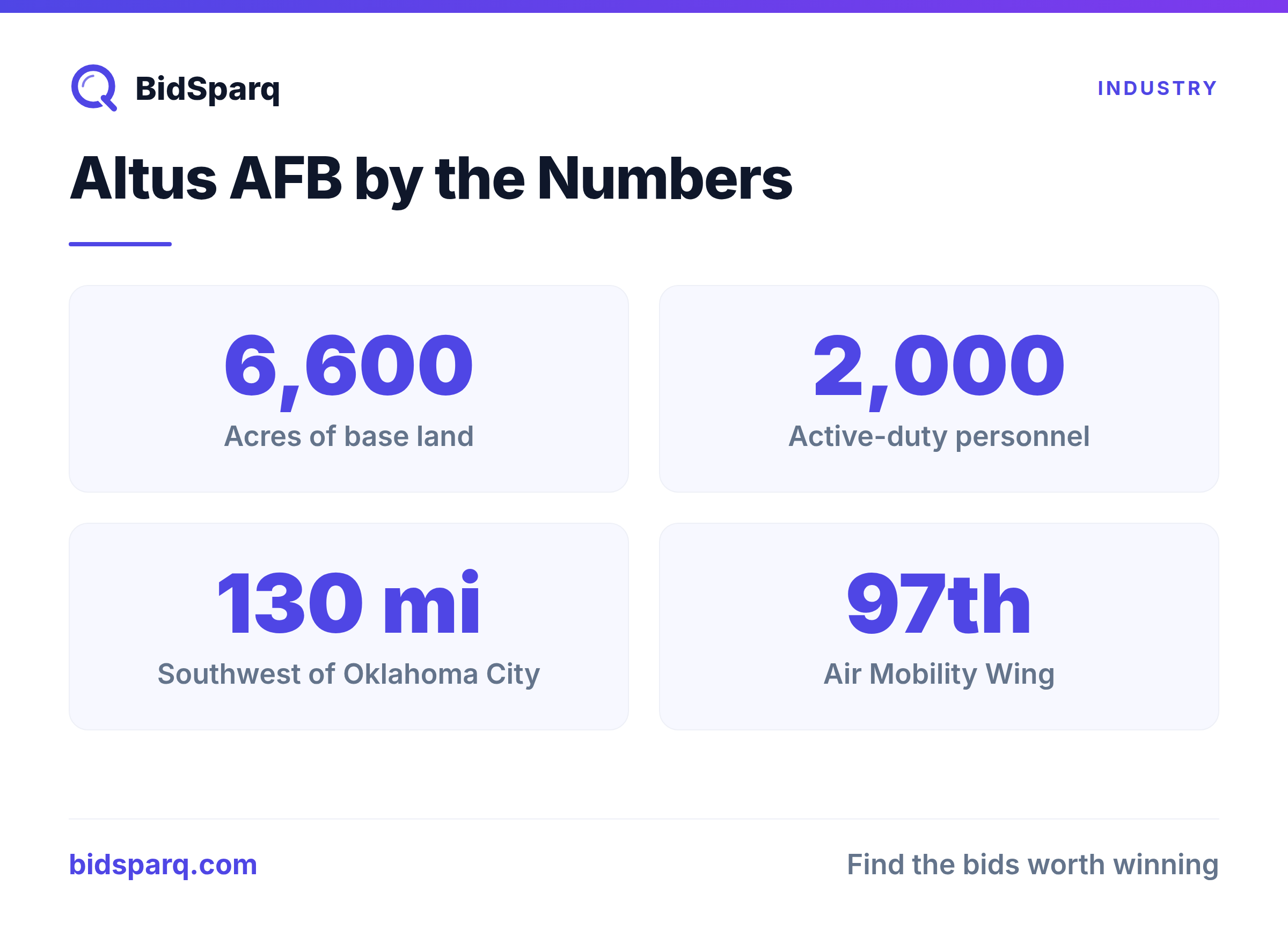
Altus AFB sits on roughly 6,600 acres about 130 miles southwest of Oklahoma City. The base employs about 2,000 active-duty personnel plus a substantial civilian and contractor workforce, and the training mission keeps three large aircraft fleets flying out of Altus year-round. That means continuous demand for runway maintenance, hangar and simulator-building work, airfield lighting, fuel systems, mission-support facilities, lodging for transient students, and the standard installation-wide construction needs (housing, dining facilities, utilities, roads, perimeter security).
For construction contractors, three things make Altus distinctive:
- Steady recapitalization pipeline. The KC-46 Pegasus is still being integrated and requires new and modified facilities. Hangar reconfiguration, fuel-system upgrades, and simulator-building work all flow from this.
- USACE Tulsa District as primary contracting agent for major MILCON. Big construction projects at Altus typically come through the U.S. Army Corps of Engineers, Tulsa District: not directly from the Air Force base contracting office.
- Mix of MILCON, O&M, and JOC. Altus uses Military Construction (MILCON), Operations & Maintenance funding for smaller jobs, and Job Order Contracts (JOC) for repetitive task-order work. Each follows a different acquisition path.
Who buys construction at Altus
You'll see solicitations from three primary buying activities. Each has its own SAM.gov posting cadence and contracting-officer pool:
| Buyer | What they buy | Typical contract type |
|---|---|---|
| USACE Tulsa District | Major MILCON projects ($1M+), runway and airfield work, large facility construction | FFP, sometimes design-build IDIQ task orders |
| 97th Contracting Squadron (at Altus) | Smaller O&M projects, base facility repairs, JOC task orders, supply contracts | FFP, JOC task orders, Simplified Acquisition Procedures (SAP) |
| AETC Acquisition Management (HQ-level) | Air Education and Training Command rolled-up requirements that affect multiple training bases | IDIQ vehicles, single-award contracts |
If you're tracking Altus construction specifically, you need to monitor postings from all three. SAM.gov filtering on the place-of-performance ZIP (73522) and the Altus AFB DUNS/UEI catches most, but USACE Tulsa often lists the project location as Oklahoma without "Altus" in the title.
NAICS codes that apply to Altus construction work
The set-aside size standards and competition pool you face depend on the NAICS code assigned to each solicitation. The most common for Altus construction work:
- 236220: Commercial and Institutional Building Construction. The default for hangar, simulator-building, dormitory, and support-facility construction. Size standard $45M (revenue, 3-year average).
- 237310: Highway, Street, and Bridge Construction. Used for road, parking apron, and airfield-pavement work. Size standard $45M.
- 237990: Other Heavy and Civil Engineering Construction. Catch-all for site work that doesn't fit roads or buildings. Size standard $45M.
- 238210: Electrical Contractors and Other Wiring Installation. Airfield lighting, comm-line installs. Size standard $19M.
- 238220: Plumbing, Heating, and Air-Conditioning Contractors. Mechanical work in hangars, dorms, simulator buildings. Size standard $19M.
- 561210: Facilities Support Services. When the requirement is integrated operations & maintenance rather than pure construction.
Note the size-standard difference: at $45M (revenue) for the construction codes versus $19M for the trades codes, you'll qualify as a small business for prime general-contracting work at a much larger company size than you would for an electrical or mechanical sub. That matters for set-aside eligibility: see below.
Set-aside opportunities at Altus
The Air Force has annual small-business goals across all 6 socioeconomic categories. At Altus specifically, construction has historically been a strong area for:
- 8(a) sole-source and competitive awards for projects up to $4.5M (services) or $7M (construction/manufacturing). USACE Tulsa runs a fair amount of 8(a)-set-aside MILCON work.
- SDVOSB set-asides for mid-sized renovations and repair work, especially since the Veterans First contracting program applies to all DoD agencies including the Air Force.
- HUBZone: useful around Altus because portions of southwest Oklahoma fall within HUBZone-designated areas. If your business is in a HUBZone, you get a 10% price evaluation preference and access to HUBZone-only set-asides.
- WOSB/EDWOSB: used selectively, mostly for projects under the $4.5M sole-source ceiling.
For a deeper breakdown of how each set-aside program actually works and which one fits your business, see our set-aside programs guide.
How to find Altus construction solicitations before they close
Here's the practical search approach:
- SAM.gov as the primary source. Filter by Federal Supply Class (Y1AZ for construction of buildings, Y1DZ for utilities), or by place-of-performance ZIP (73522). Subscribe to alerts so new postings arrive in your inbox, but expect that the SAM.gov alerts are noisy and often slow.
- USACE Tulsa District's solicitation page at
swt.usace.army.milfor the largest projects. They sometimes pre-announce work through industry-day notices before the formal RFP hits SAM.gov. - FedBizOpps successor (SAM.gov contract opportunities) for IDIQ task-order announcements. JOC task orders at Altus often don't hit SAM as standalone solicitations: they're fulfilled under existing JOC contracts where the prime is already on contract.
- Aggregation tools. If you're tracking opportunities across multiple bases and agencies, a discovery layer like BidSparq normalizes solicitations from SAM.gov, USACE district pages, state portals, and the major aggregators into a single feed, scored against your NAICS codes, set-aside eligibility, and capabilities. That's especially useful if you bid on construction in Oklahoma broadly, not just Altus.
What actually wins at Altus
Air Force construction contracting officers value three things that show up over and over in award debriefs:
- Relevant past performance, specifically on Air Force bases. Generic federal construction past performance is fine, but past Air Force work scores higher in evaluations. If you don't have it, partner with someone who does.
- A clear plan for working in a secure training environment. Altus has active flight ops on every weekday. Your construction plan needs to address airfield safety, FOD prevention, and how your crews will work around training schedules. Generic schedules get marked down.
- Local presence or commitment. Not strictly required, but contractors with Oklahoma offices, local subs, and demonstrated ability to staff quickly tend to win on tie-evaluations. For HUBZone firms, this aligns naturally.
For broader proposal-writing strategy that applies to Altus and other MILCON work, see how to write a winning government proposal.
Other Air Force training bases with similar pipelines
If you're building a pursuit list, Altus is one of several active training-base construction markets. Similar contracting patterns exist at:
- Sheppard AFB (Wichita Falls, TX): 82nd Training Wing, technical training. Different agency (AETC) but overlapping contracting officers with Altus.
- Vance AFB (Enid, OK): also in Oklahoma, also a flying-training mission. Construction at Vance is procured under similar NAICS and USACE Tulsa often handles MILCON there too.
- Columbus AFB (Mississippi): 14th Flying Training Wing.
- Laughlin AFB (Texas): 47th Flying Training Wing.
Pursuing all four AETC pilot-training bases as a single market is a reasonable strategy for an Oklahoma- or Texas-based contractor: you cover hundreds of square miles of likely-recurring work with one set of past-performance examples.
Next steps
If Altus is in your target market:
- Make sure your SAM.gov registration is active and your NAICS codes include the construction codes above.
- Get your capability statement tuned for Air Force MILCON specifically: generic federal capabilities get less attention than work that names AETC, the 97th AMW, and USACE Tulsa.
- Set up alerts on SAM.gov for the relevant FSC codes and ZIP, plus check USACE Tulsa's page weekly.
- Track recent awards (USAspending, FPDS) at Altus to identify likely recompetes. If a five-year contract was awarded in 2021, expect the recompete in 2026. Use our guide on spotting wired contracts to triage whether you have a realistic shot.
The construction pipeline at Altus isn't enormous compared to the largest Air Force installations (Eglin, Wright-Patterson, Hill), but it's steady, predictable, and dominated by a small enough set of buyers that you can realistically build relationships with the contracting officers and capture managers over time. That's often a better small-business strategy than chasing megaprojects elsewhere.
Find RFPs that match your business
BidSparq monitors 23,000+ procurement sources and uses AI to score every opportunity against your capabilities. Try it free for 14 days.
Start Free Trial →