What Is an RFP in Construction? A Complete Guide for Contractors
Learn how construction RFPs work, what they include, how to find them, and how to write winning responses. Covers bonding, Davis-Bacon, prequalification, and more.
If you run a construction company and want to win government or institutional projects, you need to understand Requests for Proposals (RFPs). Construction RFPs are the primary way that federal, state, and local agencies: plus schools, hospitals, and utilities, solicit bids for building projects.
This guide covers everything contractors need to know: what construction RFPs contain, where to find them, how they differ from other industries, and how to write responses that win.
What Is a Construction RFP?
A construction RFP is a formal document issued by a project owner: typically a government agency, school district, or institution, inviting qualified contractors to submit proposals for a building, renovation, or infrastructure project.
Unlike simple Invitations for Bid (IFBs) where the lowest price wins, RFPs evaluate proposals on multiple factors: qualifications, approach, schedule, safety record, and price. This is called best-value procurement, and it's increasingly common for complex construction projects.
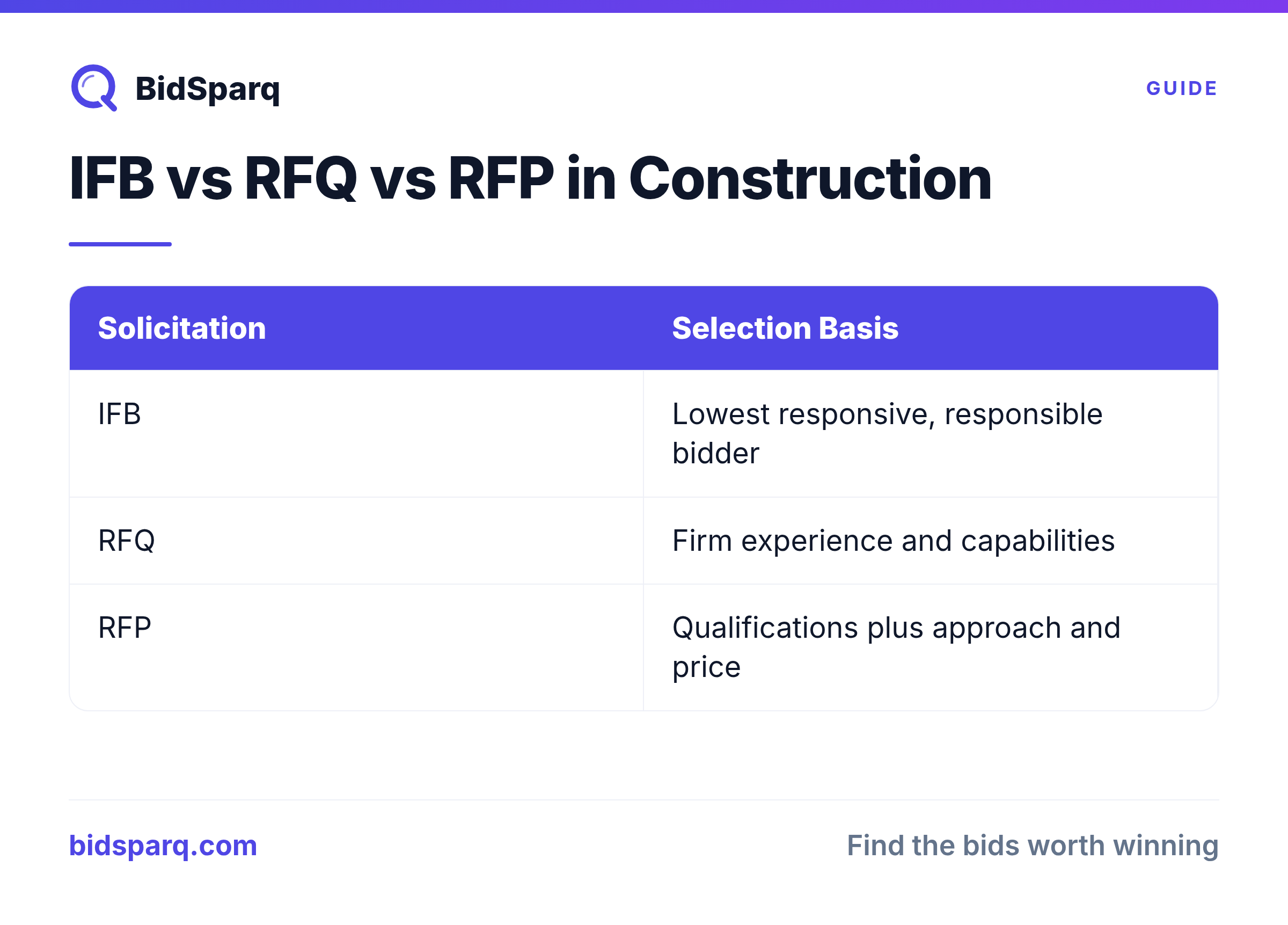
You'll also encounter related solicitation types in construction:
- IFB (Invitation for Bid): Lowest responsive, responsible bidder wins. Used for straightforward projects with clear specs.
- RFQ (Request for Qualifications): Evaluates your firm's experience and capabilities before you're invited to bid. Common for design-build and large projects.
- RFP (Request for Proposal): Evaluates both qualifications and proposed approach/price. Used for complex projects requiring judgment.
What's Inside a Construction RFP?
Construction RFPs are typically longer and more detailed than RFPs in other industries. A typical construction RFP includes:
Project Description and Scope of Work
The scope defines exactly what needs to be built, renovated, or demolished. It includes architectural drawings, engineering specifications, material requirements, and site conditions. For federal projects, this section references CSI MasterFormat division codes to organize the work.
Plans and Specifications
Most construction RFPs include (or reference) a complete set of construction documents: architectural plans, structural drawings, MEP (mechanical/electrical/plumbing) specs, and site plans. These are often available as separate downloads, sometimes hundreds of pages.
Bonding Requirements
This is where construction RFPs diverge sharply from other industries. Federal projects over $150,000 require surety bonds under the Miller Act:
- Bid bond: Typically 20% of the bid amount. Guarantees you'll honor your bid if selected.
- Performance bond: 100% of the contract value. Guarantees you'll complete the work.
- Payment bond: 100% of the contract value. Guarantees you'll pay subcontractors and suppliers.
Most states have "Little Miller Acts" with similar requirements, often with lower thresholds (some as low as $25,000). If you can't get bonded, you can't bid on most public construction work: so establishing a relationship with a surety company is essential.
Prevailing Wage Requirements
Federal construction contracts over $2,000 must comply with the Davis-Bacon Act, which requires paying workers the prevailing wage rate for the project's locality. Most states have similar prevailing wage laws. The RFP will specify which wage determinations apply, and your proposal must reflect these rates in your pricing.
Prequalification Requirements
Many agencies require contractors to be prequalified before they can even receive the RFP. Prequalification typically involves submitting:
- Audited financial statements
- Bonding capacity letter from your surety
- List of completed projects (similar size and type)
- Safety record (EMR: Experience Modification Rate)
- Key personnel resumes
- References from past clients
Some agencies maintain standing prequalification lists; others require project-specific prequalification for each solicitation.
Evaluation Criteria
Construction RFP evaluation criteria typically weight these factors:
- Price (30-50%): Still the largest factor in most construction procurements
- Experience and qualifications (20-30%): Past projects of similar scope, size, and complexity
- Technical approach (15-25%): Project schedule, methodology, phasing plan, logistics
- Safety record (5-15%): EMR, OSHA citations, safety program quality
- Small business participation (5-10%): Subcontracting plan for DBE/MBE/WBE goals
Insurance Requirements
Construction RFPs specify minimum insurance coverage: typically general liability ($1-2M per occurrence), auto liability, workers' compensation, and often umbrella/excess liability ($5-10M). Some projects require builder's risk, pollution liability, or professional liability for design-build work.
NAICS Codes for Construction
Government agencies classify construction work using NAICS codes. Knowing your codes is critical for finding relevant RFPs and registering in SAM.gov. The main construction sectors are:
- 236: Construction of Buildings: Residential (236110) and nonresidential (236220) building construction
- 237: Heavy and Civil Engineering: Highways/bridges (237310), water/sewer (237110), power/communication (237130), land subdivision (237210)
- 238: Specialty Trade Contractors: Electrical (238210), plumbing/HVAC (238220), concrete (238110), roofing (238160), painting (238320), and dozens more
Most construction companies register under multiple NAICS codes. A general contractor doing commercial buildings might register under 236220, 238110, 238210, and 238220.
Where to Find Construction RFPs
Construction RFPs are published across hundreds of sources. Here's where to look:
Federal Sources
- SAM.gov: All federal construction solicitations over $25,000 are posted here. Filter by NAICS codes 236-238.
- Army Corps of Engineers (USACE): One of the largest federal construction buyers, with projects posted on SAM.gov and their own portal.
- GSA: General Services Administration manages federal building construction and renovation.
- VA: The Department of Veterans Affairs is a major source of hospital and clinic construction projects.
State and Local Sources
- State procurement portals: Every state has a central procurement website. Many have dedicated construction categories. Browse active RFPs by state to see what's available.
- City and county websites: Local governments post construction bids on their own procurement pages, often using platforms like BidNet or PlanetBids.
- School districts: K-12 construction is a massive market. Districts post through state portals, cooperative purchasing programs like BuyBoard and PEPPM, or their own websites.
Plan Rooms and Bid Services
- Dodge Construction Network: The largest construction project database, covering public and private projects.
- ConstructConnect: Formerly iSqFt and CMD, covers commercial and government construction projects.
- BidClerk: Focuses on public construction bidding.
- Local plan rooms: Many cities have physical plan rooms (like AGC chapters) where drawings are available for review.
Aggregators
Instead of checking dozens of individual sources, RFP aggregation platforms like BidSparq monitor 23,000+ procurement sources and use AI to match opportunities to your capabilities. This is especially valuable in construction, where relevant RFPs are scattered across hundreds of city, county, and state portals.
How Construction RFPs Differ from Other Industries
Construction RFPs have several unique characteristics that set them apart:
| Feature | Construction RFPs | IT/Services RFPs |
|---|---|---|
| Bonding | Almost always required (bid, performance, payment) | Rarely required |
| Prevailing wages | Required on most public projects | Not applicable |
| Prequalification | Often required before bidding | Uncommon |
| Plans/drawings | Extensive construction documents | Requirements documents |
| Site visits | Often mandatory pre-bid | Sometimes optional |
| Subcontracting | Complex sub plans with DBE/MBE/WBE goals | Simpler teaming arrangements |
| Safety requirements | EMR, OSHA records, safety plans | Minimal |
| Bid opening | Often public, prices read aloud | Usually private evaluation |
How to Respond to a Construction RFP
Winning construction proposals follow a consistent structure:
1. Go/No-Go Decision
Before investing time in a response, evaluate the opportunity:
- Is the project within your bonding capacity?
- Do you have experience with similar project types and sizes?
- Can you meet the schedule requirements?
- Is the location practical for your team?
- Do you meet prequalification requirements?
- What's your realistic win probability?
2. Attend the Pre-Bid Conference
Most construction RFPs include a pre-bid conference (often mandatory). Attend to:
- Walk the site and assess conditions
- Ask questions about scope ambiguities
- Meet the project team and understand their priorities
- Network with potential subcontractors
3. Build Your Estimate
The cost estimate is the foundation of your proposal. Break it down by CSI division, account for prevailing wages, include bonds and insurance, and add realistic contingency. For best-value RFPs, don't just go lowest price: price fairly and win on qualifications.
4. Write the Technical Proposal
Address every evaluation criterion directly. Include:
- Project approach: Your methodology, phasing plan, and how you'll handle site logistics
- Schedule: A detailed CPM schedule showing milestones and critical path
- Key personnel: Project manager, superintendent, safety officer resumes with relevant experience
- Past performance: 3-5 similar completed projects with references, on-time/on-budget track record
- Safety plan: Your EMR, safety program overview, and site-specific safety plan
- Subcontracting plan: How you'll meet DBE/MBE/WBE participation goals
5. Submit on Time
Construction bids often have strict deadlines: late submissions are rejected with no exceptions. Many agencies now accept electronic submissions, but some still require physical delivery of sealed bids. Confirm the method and deadline, and submit early.
Special Considerations
Design-Build vs. Design-Bid-Build
Traditional design-bid-build means the owner hires an architect, creates complete plans, and then solicits bids from contractors. Design-build means the contractor provides both design and construction services. Design-build RFPs evaluate your design team's qualifications alongside construction capabilities, and the proposals are significantly more complex.
The Brooks Act (Federal A-E Services)
For federal architecture and engineering services, the Brooks Act requires Qualifications-Based Selection (QBS): firms are selected based on qualifications alone, then negotiate price. This means your past work and team expertise matter more than your fee proposal.
Green Building and Sustainability
Federal construction projects increasingly require LEED Gold certification or equivalent (GSA mandates this for new federal buildings). State and local projects may have their own sustainability requirements. Highlighting green building experience and certifications in your proposal can be a significant differentiator.
Small Business Set-Asides
A significant portion of federal construction work is set aside for small businesses. If your firm qualifies as a small business under SBA size standards (varies by NAICS code: typically $39.5M in average annual revenue for general construction), you have access to less competition. Additional preference programs include 8(a), HUBZone, SDVOSB, and WOSB.
Common Mistakes to Avoid
- Missing the pre-bid conference: If it's mandatory, you're disqualified. Even if optional, attending shows commitment and gives you critical information.
- Ignoring bonding requirements: Don't bid on a $10M project if your bonding capacity is $5M. Talk to your surety before committing.
- Underestimating prevailing wages: Using your normal labor rates instead of prevailing wage rates is a fast way to lose money on the project.
- Generic proposals: Don't reuse the same boilerplate for every bid. Address the specific project, site conditions, and evaluation criteria.
- Neglecting the subcontracting plan: DBE/MBE/WBE goals are evaluated, and agencies take them seriously. Show real commitments, not vague promises.
- Submitting late: There are no extensions in public construction bidding. Build in a buffer.
Next Steps
Construction RFPs are more complex than most industries, but they represent an enormous market: the federal government alone spends over $100 billion annually on construction. With proper bonding, prequalification, and a systematic approach to finding and responding to RFPs, contractors of any size can compete.
- Try BidSparq free for 14 days: AI-matched construction RFPs from 23,000+ sources
- Browse active construction RFPs
- Learn about NAICS codes to find your construction categories
- Understand SAM.gov registration: required for all federal contracts
- Read our guide to finding RFPs for free
Find RFPs that match your business
BidSparq monitors 23,000+ procurement sources and uses AI to score every opportunity against your capabilities. Try it free for 14 days.
Start Free Trial →